For growing technology companies, speed of data processing has become a competitive advantage.
Applications powered by AI, IoT devices, and real-time analytics generate enormous volumes of data. When all this data must travel to distant cloud servers for processing, latency increases, performance drops, and operational costs rise.
This is where edge computing services become valuable.
Edge computing processes data closer to the source - devices, sensors, or operational environments - rather than relying entirely on centralized cloud infrastructure.
By combining edge computing with Google Cloud, businesses can build distributed systems that process data faster, reduce bandwidth costs, and enable real-time decision making.
For SMEs, scale-ups, and mid-size companies, this approach enables powerful capabilities without building large infrastructure internally.
According to Gartner, by 2025 more than 75% of enterprise-generated data will be created and processed outside traditional centralized data centers.
This shift is driving rapid adoption of Google Cloud edge computing solutions.
What’s Inside
I. What Is Edge Computing and How Does It Work?
II. Market Growth and Business Impact
III. What is Google Cloud Edge Computing?
IV. Cloud vs Edge vs Hybrid Infrastructure
VI. Practical Edge Computing Use Cases for Growing Companies
VII. Challenges of Edge Computing (and How Google Cloud Helps)
VIII. Edge Computing Trends in 2026
Key Takeaways
Businesses evaluating Google Cloud edge computing should understand:
- Edge computing enables low-latency real-time data processing
- Google Distributed Cloud Edge extends cloud capabilities to edge locations
- Hybrid cloud-edge architectures improve scalability and cost efficiency
- Edge AI solutions enable real-time analytics for IoT and automation
- SMEs and scale-ups can deploy edge infrastructure without building large data centers
I. What Is Edge Computing and How Does It Work?
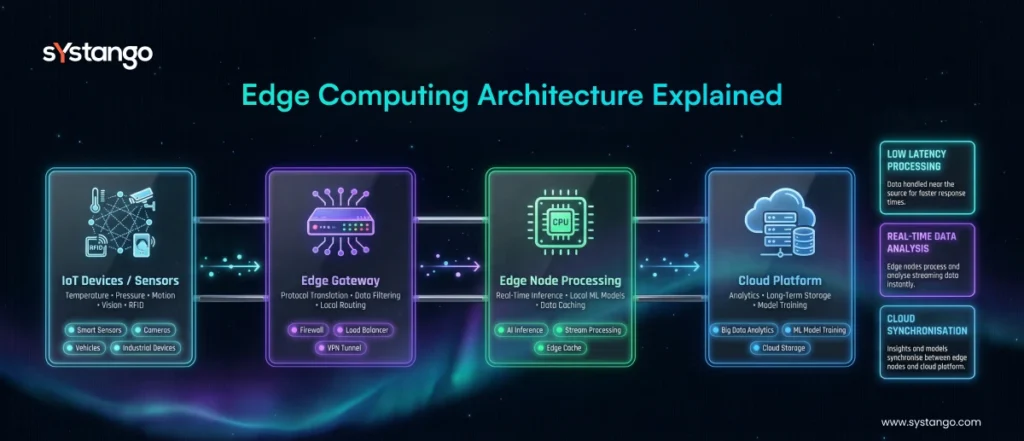
Edge computing is a distributed computing model where data is processed closer to the device or user instead of being sent to centralized cloud infrastructure.
Traditional cloud architecture:
Device → Internet → Cloud data center → Processing → Response
Edge architecture:
Device → Edge node → Local processing → Cloud synchronization
Key components of edge computing architecture include:
- IoT edge gateways
- Edge nodes
- Edge orchestration systems
- Cloud-to-edge deployment platforms
This distributed model enables real-time data processing and faster response times.
II. Market Growth and Business Impact
Edge computing adoption is growing rapidly as businesses deploy connected devices and AI systems.
Research from Grand View Research projects the global edge computing market will reach $155.9 billion by 2030, growing at a 36.9% CAGR.
For scale-ups and mid-size companies, edge computing can deliver:
- Faster application performance
- Reduced bandwidth costs
- Real-time analytics capabilities
- Improved operational visibility
III. What is Google Cloud Edge Computing?
Google Cloud edge computing enables companies to run cloud services closer to devices, users, or operational environments.
This is achieved through distributed infrastructure that supports:
- low-latency computing
- edge AI inference
- hybrid cloud-edge architectures
- containerized workloads
One of the key platforms enabling this is Google Distributed Cloud Edge, which allows organizations to deploy Google Cloud services directly at edge locations.
This architecture allows companies to combine:
- centralized cloud management
- localized processing power
- scalable application deployment
IV. Cloud vs Edge vs Hybrid Infrastructure
Many growing companies are adopting hybrid cloud-edge deployment models.
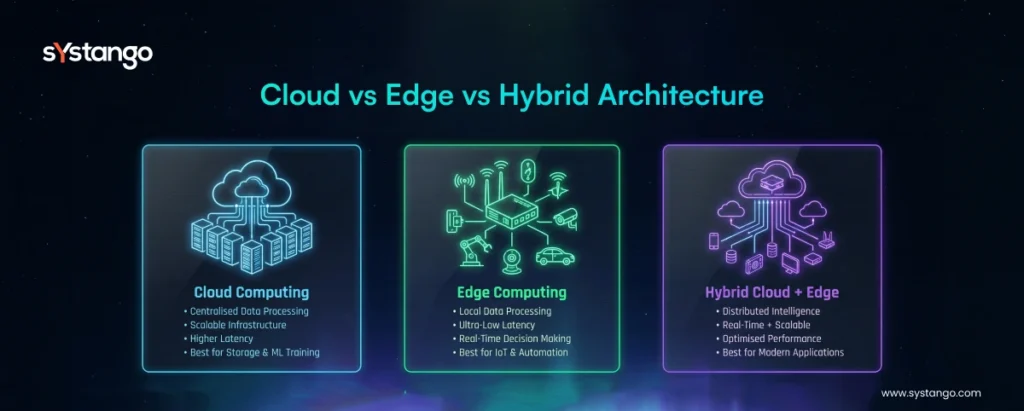
Hybrid architectures allow companies to run real-time operations at the edge while keeping core services in the cloud.
V. Edge AI: The Real Game Changer
A major innovation in modern distributed infrastructure is AI running directly at the edge.
Instead of sending data to the cloud for processing, AI models run locally on edge nodes, enabling instant decision making.
This is known as Edge AI inference.
Examples include:
- computer vision systems analysing video feeds
- predictive maintenance detecting equipment failures
- fraud detection systems analysing financial transactions
- autonomous devices making real-time decisions
VI. Practical Edge Computing Use Cases for Growing Companies
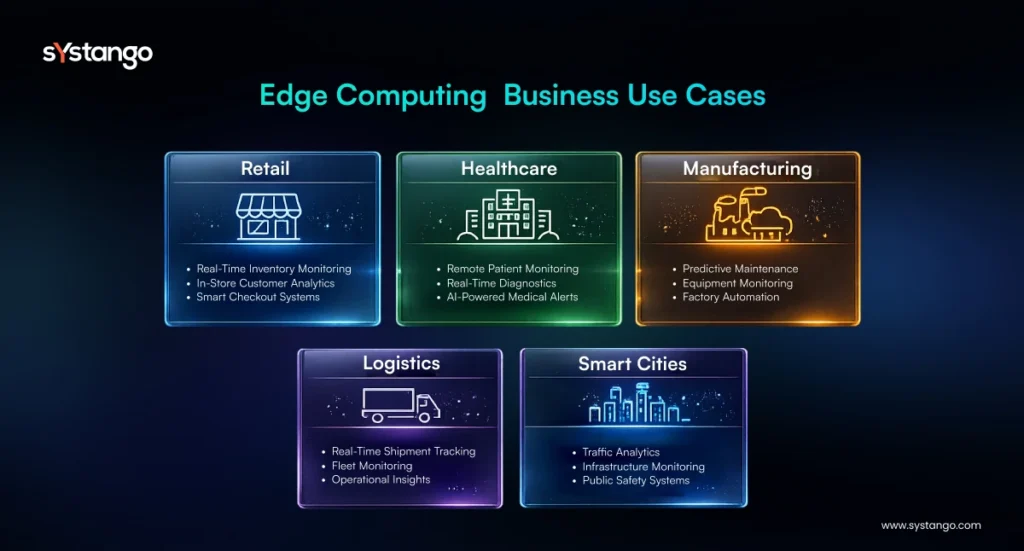
Edge computing is becoming practical for many industries.
- Retail
Stores use edge AI solutions for real-time inventory monitoring and customer analytics.
- Healthcare
Hospitals use edge computing in healthcare for remote patient monitoring and real-time diagnostics.
- Manufacturing
Factories deploy smart manufacturing edge computing for predictive maintenance and operational monitoring.
- Logistics and Supply Chains
Edge infrastructure enables real-time shipment tracking and operational analytics.
- Smart Cities
Municipal systems use edge infrastructure to analyse traffic flows and optimize transportation.
VII. Challenges of Edge Computing (and How Google Cloud Helps)
While edge computing offers advantages, businesses often face implementation challenges.
- Infrastructure Complexity
- Managing distributed infrastructure across multiple locations can be difficult.
- Google Cloud simplifies deployment through containerized workloads and centralized orchestration tools.
- Security Risks
- Edge nodes may operate outside secure data centers.
- Google Cloud addresses this with:
- encrypted communications
- identity-based access control
- zero-trust security models
- Data Synchronisation
- Edge systems must synchronize data with cloud platforms.
- Google Cloud enables automated synchronization between edge nodes and cloud services.
VIII. Edge Computing Trends in 2026
Several trends are accelerating edge adoption.
- AI-Native Edge Platforms
Edge systems increasingly run AI inference directly at the edge.
- 5G Edge Computing
The expansion of 5G networks enables multi-access edge computing (MEC) and ultra-low latency applications.
- Hybrid Multi-Cloud Architecture
Companies increasingly combine multiple cloud platforms with edge infrastructure.
- Data Localization and Sovereign Cloud
Regulations require certain data to remain within geographic regions, making edge computing important for compliance.
According to Deloitte, combining 5G networks with edge computing will unlock new real-time applications across industries.
Strategic Takeaway for Growing Businesses
Edge computing is becoming essential for companies building:
- real-time applications
- IoT systems
- AI-powered analytics platforms
Platforms like Google Cloud allow businesses to deploy scalable edge infrastructure without building large data centers, enabling faster innovation and operational efficiency.
Strategic Summary
This guide explains Google Cloud edge computing in 2026, including how Google Distributed Cloud Edge, edge AI inference, and hybrid cloud-edge infrastructure enable low-latency real-time data processing. It explores edge computing architecture, real-world use cases, and cost-efficient deployment models for scale-ups and mid-size companies adopting AI, IoT, and real-time analytics.
You’ll learn how edge computing works, the difference between cloud and edge computing, and why businesses increasingly deploy hybrid cloud-edge systems. The guide also explains how Google Cloud consulting services and migration services help growing companies deploy scalable edge infrastructure without complex in-house operations.
Conclusion
As connected devices and AI workloads expand, data processing needs to move closer to the source.
Google Cloud edge computing enables businesses to combine:
- cloud scalability
- real-time processing
- distributed infrastructure
Executive Summary
For SMEs, scale-ups, and mid-size companies, this creates an opportunity to build high-performance digital systems without heavy infrastructure investment.
With the right cloud architecture and deployment strategy, edge computing can unlock faster insights, better user experiences, and more resilient digital platforms.
Google Cloud edge computing enables businesses to process data closer to its source, reducing latency and improving real-time performance. In 2026, solutions like Google Distributed Cloud support hybrid cloud-edge architectures that combine scalability with faster decision-making.
For SMEs and growing companies, edge computing services provide a cost-efficient way to deploy AI-driven, real-time applications without heavy infrastructure. As adoption grows, businesses leveraging edge AI and distributed cloud systems will gain a competitive advantage through speed, efficiency, and better user experiences.