Inside VoidAI: Building Cross-Chain Economic Infrastructure for Bittensor
Published on 06 Jan 2026

Inside VoidAI: Building Cross-Chain Economic Infrastructure for Bittensor
Artificial intelligence is evolving from centralised silos to a world where collaboration defines progress. In our previous discussion on Bittensor, we explored how interoperability connects AI ecosystems across blockchains. Unlike traditional AI subnets, VoidAI transforms liquidity into intelligence, redefining how miners contribute to decentralised AI ecosystems. Now, let’s take a closer look inside one of the most promising implementations built on Bittensor: VoidAI, and understand how it’s transforming the ecosystem by bridging intelligence and liquidity across chains.
I. The Building Blocks of Decentralised Intelligence: Bittensor Subnets
At the core of Bittensor lie subnets, independent, specialised networks that act as “mini AI marketplaces.” Here, miners contribute models or data, while validators evaluate them for quality and reward performance using TAO tokens. Each subnet focuses on a unique domain, from NLP to fraud detection, operating autonomously yet interconnected through Bittensor’s blockchain. This modular structure promotes scalability, fairness, and true decentralisation in AI development.
II. The Role of VoidAI in the Bittensor Network
Among the growing number of subnets, VoidAI (Subnet 106) stands out as a pioneering example of multi-chain liquidity provisioning within the Bittensor ecosystem.
It’s not about AI model inference; it’s about creating economic bridges that connect TAO and subnet tokens across major blockchains such as Ethereum, Solana, and Base. Think of VoidAI as a financial engine powering AI growth across chains.
In other words, VoidAI redefines what “mining” means in Bittensor.
Instead of training models, miners act as liquidity providers (LPs), depositing tokens into concentrated liquidity pools (CLMMs) on Solana (via Raydium) or Ethereum (via Uniswap). These LPs receive NFT-based LP tokens representing their positions, which they stake to earn rewards based on performance.
Key Design Components
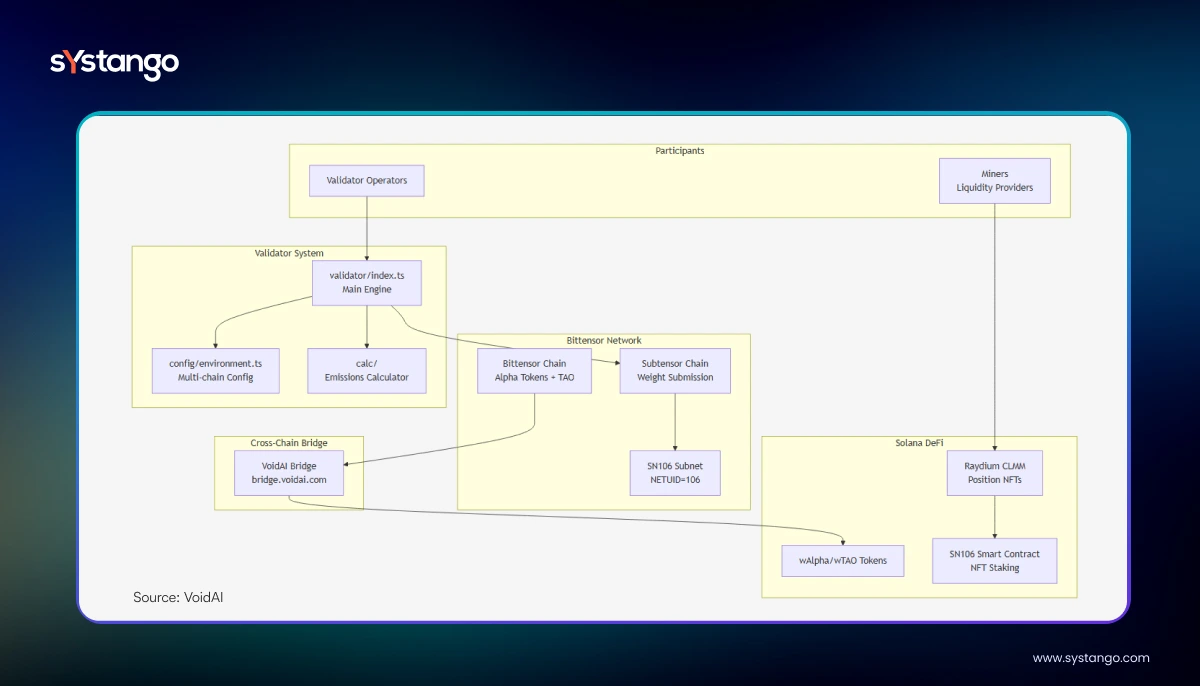
1. Bridge & Wrapped Assets: The VoidAI Bridge locks native TAO on the Bittensor side and issues wTAO (wrapped TAO) on Solana. Similar mechanisms exist for subnet-specific Alpha tokens. Liquidity pools on Solana and Ethereum manage wAlpha/wTAO trading, with LPs facilitating the markets.
2. Miners as Liquidity Providers: “Miners” deposit liquidity into CLMM pools, earn LP NFTs, and stake them. Their rewards depend on liquidity amount, range width, and proximity to the current price tick, encouraging stable, active market participation.
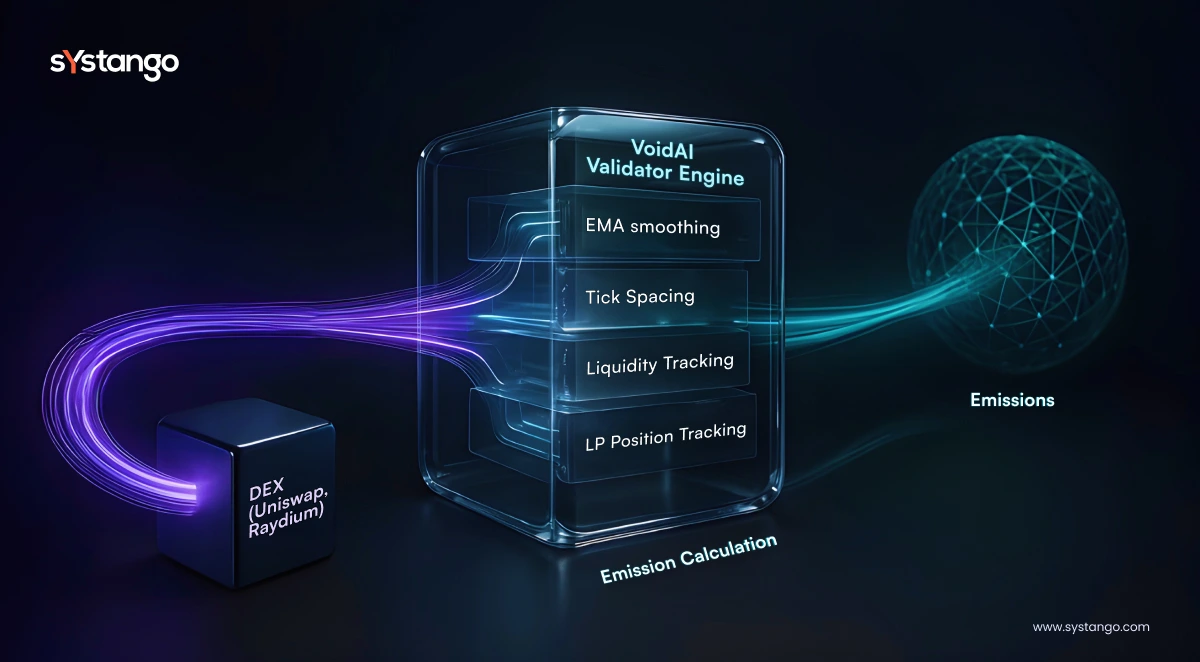
3. Validators & Emission Engine: Validators operate in random time cycles, fetching on-chain data from Solana and Ethereum, computing miner scores, and submitting results to Bittensor. This ensures fair, real-time reward distribution based on liquidity performance.
4. Cross-Chain Integration: VoidAI is inherently multi-chain, already supporting Solana and Ethereum, with future support planned for chains like Base and Ink. Cross-chain state observation, tracking liquidity, ticks, and positions, is key to maintaining consensus and emission logic.
III. The Distinctiveness of VoidAI
Most Bittensor subnets focus on AI inference and training, rewarding miners for producing high-quality model outputs.
VoidAI changes the paradigm.
Here, intelligence is financial, not algorithmic. The subnet measures the quality of liquidity and market contribution, using smart contract-driven validation to assess miners based on real on-chain liquidity state.
In short:
-
Traditional Subnets: Evaluate AI intelligence or model utility.
-
VoidAI (Subnet 106): Evaluates liquidity performance and market contribution.
This approach transforms Bittensor from a purely AI network into a multi-dimensional ecosystem where data, models, and capital all contribute to collective intelligence.
IV. Engineering Challenges and Innovations
Developing and scaling VoidAI introduced unique challenges that reshaped subnet design practices:
-
Stability Optimisation (EMA):
Early miners exploited timing windows to maximise rewards by entering near epoch ends. To counter this, EMA-based smoothing was introduced to stabilise validator rankings and ensure fair, consistent scoring. -
Validator Implementation:
Unlike most Bittensor validators (Python-based), VoidAI’s validator logic was built in TypeScript, enhancing integration with Systango’s infrastructure stack and improving cross-chain data handling. This enhanced cross-chain integration and allowed faster, more reliable reward distribution for LPs. -
Pool Weighting Evolution:
The subnet started with 80+ active pools and gradually optimised to focus on the USDC and SN106 pools, aligning liquidity with TAO emissions for maximum stability and performance.
V. Why Subnets Like VoidAI Matter
For developers, subnets like VoidAI unlock the ability to:
-
Experiment with new forms of decentralised economic coordination.
-
Participate in liquidity mining tied directly to AI ecosystem growth.
-
Build tools that merge DeFi and decentralised intelligence.
For enterprises, they offer:
-
A scalable, interoperable foundation for decentralised AI participation.
-
The ability to connect internal AI infrastructure with public blockchain ecosystems.
-
Transparent reward systems powered by TAO incentives.
VI. Systango’s Role in Accelerating Subnet Adoption
At Systango, we help organisations harness the full potential of Bittensor by combining AI engineering and Web3 infrastructure expertise.
From smart contract design and TAO staking frameworks to cross-chain bridges like VoidAI, our solutions enable businesses to create, validate, and scale decentralised intelligence seamlessly.
Our work on VoidAI (Subnet 106) and Nodexo (Subnet 27) showcases how subnets can be reimagined, not just for AI inference but also for liquidity, compute, and cross-network scalability.
VII. What’s Next
Subnets like VoidAI prove that decentralised AI infrastructure extends beyond model training, enabling liquidity, interoperability, and economic coordination across chains.
But what if we move one step deeper into the backbone of this transformation, the computing power that fuels it all?
That’s where Nodexo comes in. A decentralised GPU marketplace built on Bittensor, Nodexo redefines how AI workloads are powered, turning idle GPUs into a global, on-demand compute network.
Developers and enterprises can explore how subnets like VoidAI and Nodexo open new frontiers for decentralised AI, and connect with Systango to get started.
In our next piece, we’ll explore how Nodexo brings scalability, reliability, and transparency to the heart of decentralised AI. Stay tuned, because the future of AI infrastructure is about to get truly distributed.

Related posts

Artificial Intelligence
Generative AI
Reimagining First-Level Candidate Screening: How Systango Partnered with WhoHire to Accelerate AI-Led Innovation
03 Feb 2026

Web3
Blockchain
Artificial Intelligence
Inside Bittensor: How Decentralised Machine Learning Is Redefining AI Collaboration
10 Nov 2025
Let’s talk, no strings attached.