Enterprise AI ambitions are outpacing infrastructure readiness.
Boards are funding AI pilots. Product teams demand real-time analytics. Data teams require elastic processing. Yet many enterprises still operate on fragmented legacy systems not designed for AI-scale workloads.
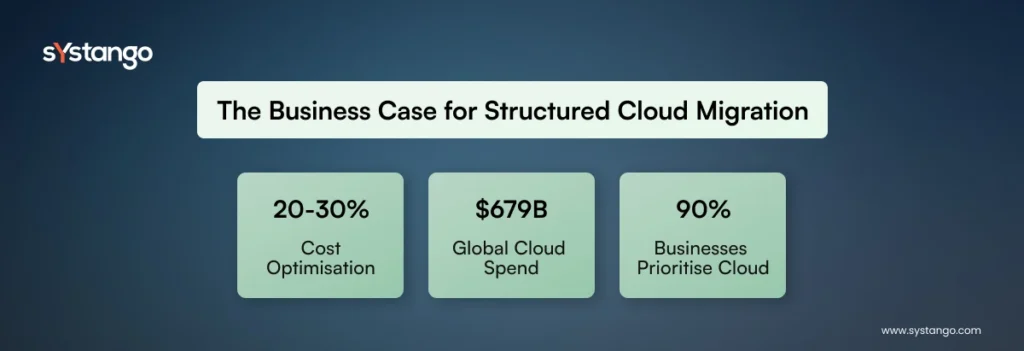
Deloitte’s Future of Cloud Survey indicates that nearly nine in ten organisations view cloud as essential to digital transformation and business competitiveness.
The strategic shift is clear:
Cloud migration is no longer infrastructure modernisation.
It is AI-readiness architecture.
This is why Google Cloud migration services UK have become a strategic boardroom decision.
What’s Inside
I. The AI-Native Infrastructure Imperative
II. The Enterprise Migration Challenge
III. Insight: Migration Must Be Strategy-Led, Not IT-Led
IV. Strategic Framework: The 6R Enterprise Migration Model
V. Real-World Enterprise Proof
VI. Detailed Implementation Roadmap (Board-Ready Execution Plan)
IX. Future Outlook: 2026 and Beyond
X. Strategic Takeaways for Enterprise Leaders
Key Takeaways
This guide explains how to:
- Migrate to Google Cloud platform securely
- Execute structured enterprise cloud migration to GCP
- Control the cost of migrating to Google Cloud
- Compare Google Cloud vs AWS for enterprise migration
- Implement a governance-led GCP migration roadmap
With the right GCP migration partner UK, enterprises can modernise legacy systems within 3–6 months while building scalable, AI-ready infrastructure.
I. The AI-Native Infrastructure Imperative
McKinsey reports that organisations adopting structured cloud transformation programmes can achieve ~20% cost optimisation, while broader cloud adoption unlocks significant enterprise value across innovation and resilience.
Cloud is now:
- A data strategy decision
- An AI enablement platform
- A scalability lever
II. The Enterprise Migration Challenge
Cloud migration complexity spans more than infrastructure.
Key enterprise risks:
- Downtime during lift and shift to GCP
- Compliance exposure
- Cost overruns
- Security misconfiguration
- Legacy application interdependencies
ISG Provider Lens™ research highlights growing enterprise reliance on certified cloud ecosystem partners to support secure, scalable migration and transformation initiatives.
Selecting the right Google Cloud consulting company directly impacts ROI realisation.
III. Insight: Migration Must Be Strategy-Led, Not IT-Led
Enterprises that treat migration as a technical project underperform.
Those that align migration with:
- AI strategy
- Data architecture
- Cost governance
- Compliance frameworks
Unlock exponential value.
Cloud modernisation is an operating model shift — not a hosting decision.
IV. Strategic Framework: The 6R Enterprise Migration Model
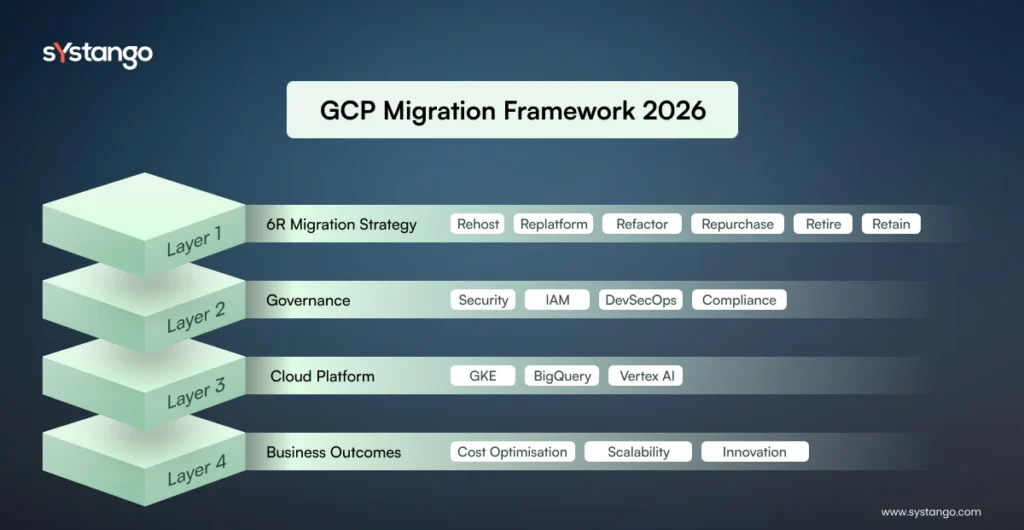
- Rehost – Rapid lift-and-shift
- Replatform – Optimised transition
- Refactor – Cloud-native rebuild
- Repurchase – SaaS replacement
- Retire – Decommission legacy assets
- Retain – Hybrid strategy
A structured Google Cloud migration strategy aligns workloads to ROI, compliance risk, and scalability priorities.
V. Real-World Enterprise Proof
A classic sports simulation platform partnered with Systango to modernise its legacy system into a responsive, cloud-native gaming experience. This transformation delivered measurable performance and engagement uplifts:
- 30% growth in user engagement via cloud accessibility
- 38% faster load and data query times
- 100% cross-platform access
- 40% increase in returning players
The platform now scales globally with enhanced performance and experience.
VI. Detailed Implementation Roadmap (Board-Ready Execution Plan)
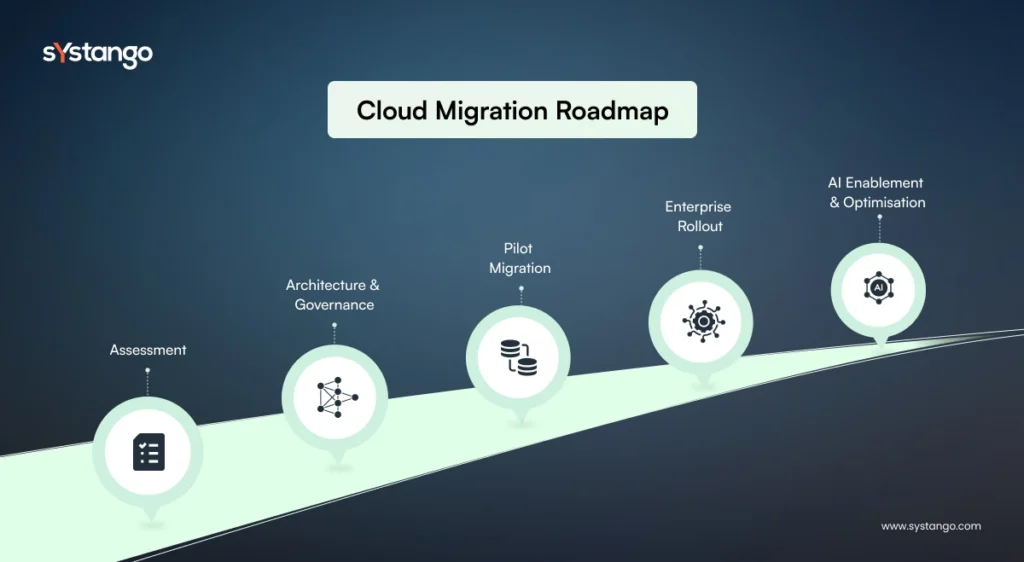
Phase 1: Strategic Assessment (Weeks 1–3)
- Cloud readiness audit
- Infrastructure inventory
- Application dependency mapping
- Regulatory and compliance gap analysis
- Cost modelling (TCO vs projected GCP spend)
Outcome: Business case validation and migration prioritisation.
Phase 2: Architecture & Governance Design (Weeks 3–6)
- Secure landing zone setup
- Identity & access management design
- Network architecture blueprint
- FinOps governance model
- DevSecOps framework definition
Outcome: AI-ready cloud architecture foundation.
Phase 3: Pilot Migration (Weeks 6–10)
- Migrate non-critical workloads
- Performance benchmarking
- Security validation
- Cost monitoring validation
Outcome: Risk mitigation before enterprise-scale rollout.
Phase 4: Enterprise Rollout (Months 3–6)
- Phased workload migration
- Legacy decommissioning
- Replatforming or refactoring where required
- Compliance audit validation
Outcome: Scalable, secure enterprise cloud environment.
Phase 5: Optimisation & AI Enablement (Ongoing)
- BigQuery data lake implementation
- Vertex AI integration
- Kubernetes scaling optimisation
- Cost governance refinement
Outcome: AI-native infrastructure driving measurable ROI.
Partnering with a proven cloud migration company 2026 significantly reduces execution and financial risk.
VII. Business Impact & ROI
Strategic ROI drivers:
- Reduced CapEx refresh cycles
- Faster DevOps releases
- AI-ready cloud-native transformation Google Cloud
- Elastic scaling
VIII. Risk of Inaction
Enterprises delaying migration risk:
- AI capability lag
- Rising infrastructure maintenance cost
- Slower product innovation
- Increased cybersecurity exposure
Cloud hesitation compounds competitive disadvantage.
IX. Future Outlook: 2026 and Beyond
Cloud in 2026 will be defined by:
- AI-native infrastructure
- Carbon-aware workload scheduling
- Multi-cloud governance via Anthos
- Data mesh architecture
- Automated compliance frameworks
Google’s AI investment positions it among the best cloud provider for AI workloads 2026 for analytics-driven enterprises.
X. Strategic Takeaways for Enterprise Leaders
- Cloud migration is a strategic transformation lever.
- AI readiness must drive architectural decisions.
- Governance-first execution prevents cost overruns.
- Sustainability is becoming a procurement criterion.
- Partner expertise reduces operational risk dramatically.
Strategic Summary
Enterprises adopting Google Cloud migration services in 2026 are prioritising:
- AI-native platforms (BigQuery, Vertex AI)
- Kubernetes-led scalability (GKE)
- Sustainable infrastructure
- Predictable cost governance
- Secure enterprise cloud migration
However, migration outcomes depend on structured execution.
As a certified Google Cloud Partner, Systango delivers governance-first, ROI-aligned cloud modernisation programmes, enabling enterprises to move beyond lift-and-shift towards AI-driven scalability and long-term resilience.
Conclusion
Enterprise migration to Google Cloud is not about servers.
It is about enabling AI, unlocking scalable data intelligence, and building resilient digital ecosystems.
Organisations that approach migration strategically unlock compounding value.
As a certified Google Cloud Partner, Systango delivers secure, scalable, ROI-aligned enterprise cloud migration programmes designed for long-term digital growth.
The future belongs to AI-native enterprises.
Executive Summary
Enterprise cloud migration in 2026 is a strategic transformation initiative driven by AI enablement, cost governance, and digital scalability. Gartner and McKinsey confirm accelerating cloud investment and measurable cost optimisation when executed through structured frameworks.
Google Cloud offers analytics maturity, Kubernetes leadership, sustainability commitments, and AI-native tooling. However, migration risks remain significant without governance-led execution.
The 6R migration model, combined with phased implementation and FinOps discipline, ensures scalable, secure enterprise cloud transformation.
Partnering with a certified GCP migration partner UK such as Systango enables secure enterprise cloud migration aligned to ROI, compliance, and AI readiness.Cloud migration is not the objective.
AI-driven scale is.