Technological disruption no longer unfolds over decades—it happens in quarters.
Between 2000 and 2009, companies had only a 63% chance of survival across the decade. Today, disruption cycles are even shorter. AI-native companies are rewriting industry rules, compressing margins, redefining customer expectations, and automating core decision systems.
For C-level leaders, the real question in 2026 is no longer:
“Should we adopt AI?”
It is:
“Are we building AI capability fast enough to remain competitive?”
This is where the right Generative AI Company becomes a strategic growth partner—not a technology vendor.
What’s Inside
I. Why Generative AI Is Now Business-Critical
II. From Efficiency to Revenue: Unlocking New Market Opportunities
III. Generative AI Companies 2026: Category-Based Landscape
IV. How to Choose the Best Generative AI Development Company for Fintech
V. Building a Scalable Business AI Ecosystem
VI. Business AI Implementation Roadmap
VIII. Strategic Takeaways for 2026
Key Takeaways
- Generative AI has shifted from experimental technology to core business infrastructure.
- Companies using AI for predictive analytics and decision automation outperform slower competitors.
- AI-driven personalisation is now central to customer experience strategy.
- Businesses adopting AI consulting services and full-cycle AI development accelerate deployment while reducing operational risk.
- Successful AI adoption requires data governance, domain expertise, and responsible AI frameworks.
I. Why Generative AI Is Now Business-Critical
According to McKinsey & Company, generative AI could create $2.6–$4.4 trillion in annual value, significantly improving efficiency and revenue across multiple business functions.
Generative AI is not a feature. It is infrastructure.
Businesses in 2026 face five systemic pressures:
- Margin compression from digital-native competitors
- Regulatory expansion across financial and compliance-heavy sectors
- Hyper-personalised customer expectations
- Escalating operational costs
- Decision latency in complex environments
AI addresses these at structural level.
1. Predict Market Shifts Before Competitors
Generative AI models analyse:
- Sales patterns
- Behavioural data
- Sentiment signals
- Macroeconomic indicators
This enables proactive pricing, inventory optimisation, and revenue forecasting.
Example: Walmart uses AI-driven predictive analytics to personalise campaigns and optimise supply chains at scale.
2. Accelerate Innovation Cycles
Traditional product cycles take months.
Generative AI enables:
- Rapid prototyping
- Design iteration
- Simulation testing
- Automated documentation
Example: Nike integrates generative AI with computational design and 3D prototyping to significantly accelerate product development and prototyping cycles.
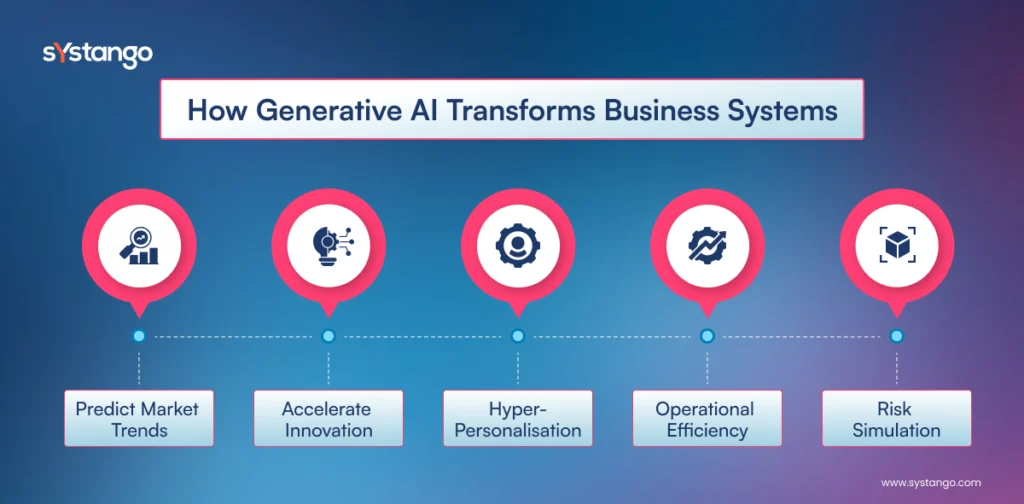
3. Hyper-Personalise Customer Experiences
AI systems dynamically adapt:
- Recommendations
- Pricing models
- Communication flows
- Engagement triggers
Example: Amazon uses AI-driven recommendation engines that influence up to ~35% of its total sales, highlighting the impact of personalised AI on revenue.”
4. Optimise Operations & Reduce Costs
Business AI reduces friction across:
- Legal processing
- HR workflows
- Compliance reviews
- Customer support
Business Proof: AI Legal Operations Platform
A large legal operations firm partnered with Systango to deploy an AI-powered document intelligence platform.
Results:
- 30% increase in workflow efficiency
- 80% faster document turnaround
- 20% reduction in workforce load
- Firm-wide visibility via real-time dashboards
This demonstrates how a specialised generative ai development company can transform compliance-heavy environments.
5. Mitigate Risk Through Simulation
Businesses use AI to run “what-if” simulations across:
- Supply chain scenarios
- Financial stress tests
- Regulatory exposure
- Cybersecurity risk
II. From Efficiency to Revenue: Unlocking New Market Opportunities
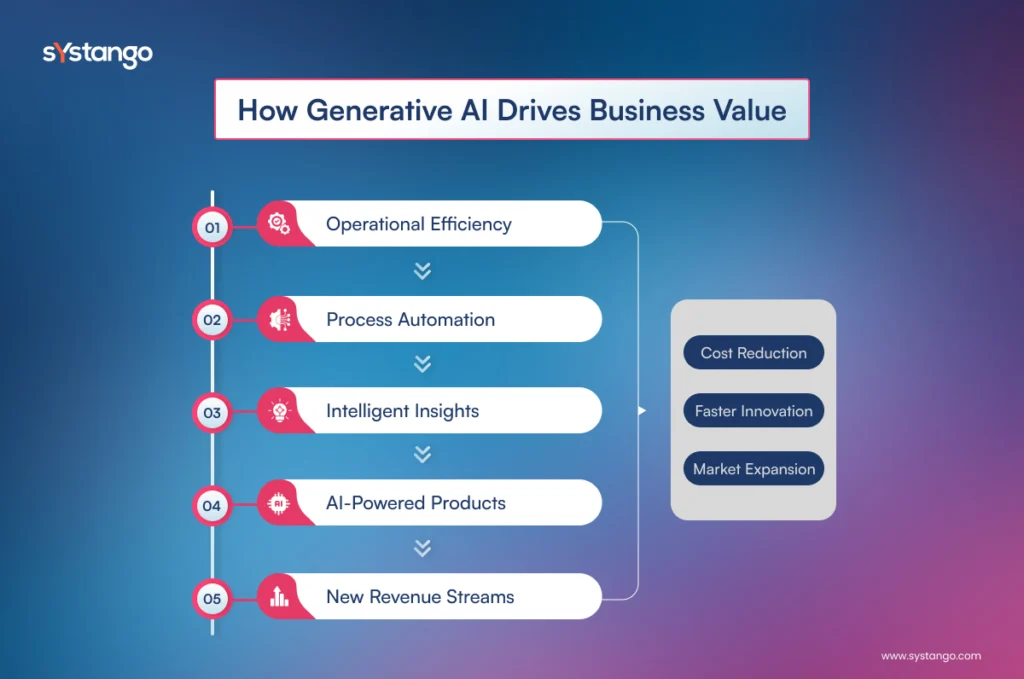
Generative AI does more than optimise—it monetises intelligence.
Businesses are now building:
- AI-powered SaaS products
- Intelligent compliance tools
- Autonomous decision engines
- AI-enhanced customer platforms
Business Proof: AI Carbon Intelligence Platform
A climate-tech business partnered with Systango to develop an AI-powered carbon tracking ecosystem.
Impact:
- 30% reduction in carbon emissions
- 45% increase in eco-friendly behaviour adoption
- 60% improvement in user engagement
- 50% faster B2B onboarding
This positions Systango among business generative ai companies delivering measurable ESG transformation.
III. Generative AI Companies 2026: Category-Based Landscape
When executives ask:
- Who are the top generative AI companies in 2026?
- Which generative AI company is best for business?
- Which company leads in business generative ai?
The answer depends on category.
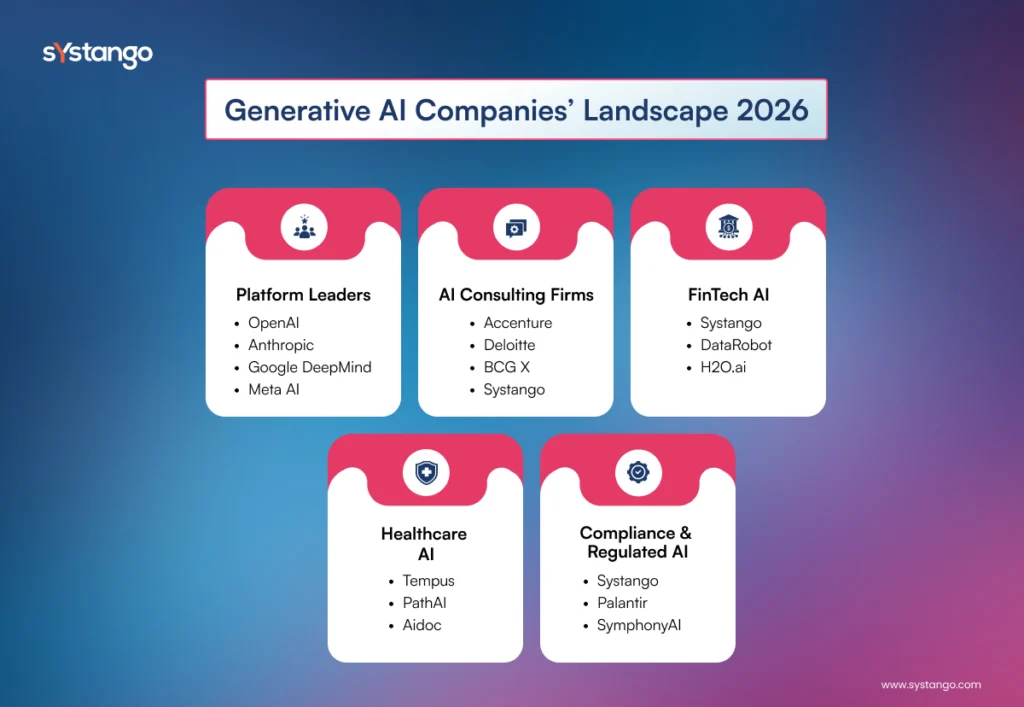
1. Generative AI Platform Leaders
- OpenAI
- Anthropic
- Google DeepMind
- Meta AI
These firms build foundational LLM infrastructure.
2. Business AI Consulting Firms
- Accenture
- Deloitte
- BCG X
- Systango
These organisations deliver ai consulting services and business integration.
3. Generative AI for FinTech
Businesses searching for the best generative ai company for fintech should prioritise regulatory maturity.
Notable players include:
- Systango
- DataRobot
- H2O.ai
4. Generative AI for Healthcare
- Tempus
- PathAI
- Aidoc
5. Generative AI for Compliance-Heavy Industries
When evaluating generative ai companies for regulated industries, governance capability is critical.
- Systango
- Palantir Technologies
- SymphonyAI
IV. How to Choose the Best Generative AI Development Company for Fintech
If you are evaluating:
- generative ai companies usa
- top generative ai companies uk
- A specialised generative ai consulting company
Use this framework:
1. Regulatory Architecture
SOC 2, GDPR, HIPAA alignment
2. AI Governance Model
Bias detection, model explainability, auditability
3. Data Infrastructure Capability
Scalable, secure, multi-cloud deployment
4. Domain Expertise
Fintech, legal, ESG, compliance sectors
5. End-to-End AI Software Delivery
From advisory to deployment — full-stack ai software development capability
V. Building a Scalable Business AI Ecosystem
Business success requires more than model selection.
1. Robust Data Governance
Structured datasets + compliance frameworks
2. AI Talent Strategy
Internal capability + external expertise
3. Responsible AI Framework
Bias monitoring + regulatory compliance
4. Strategic AI Partner
An experienced generative ai development company that aligns technology with business outcomes
VI. Business AI Implementation Roadmap
Phase 1: AI Readiness & Strategy
Phase 2: Data Infrastructure Modernisation
Phase 3: Model Integration & LLM Customisation
Phase 4: Business Deployment
Phase 5: Continuous Monitoring & Optimisation
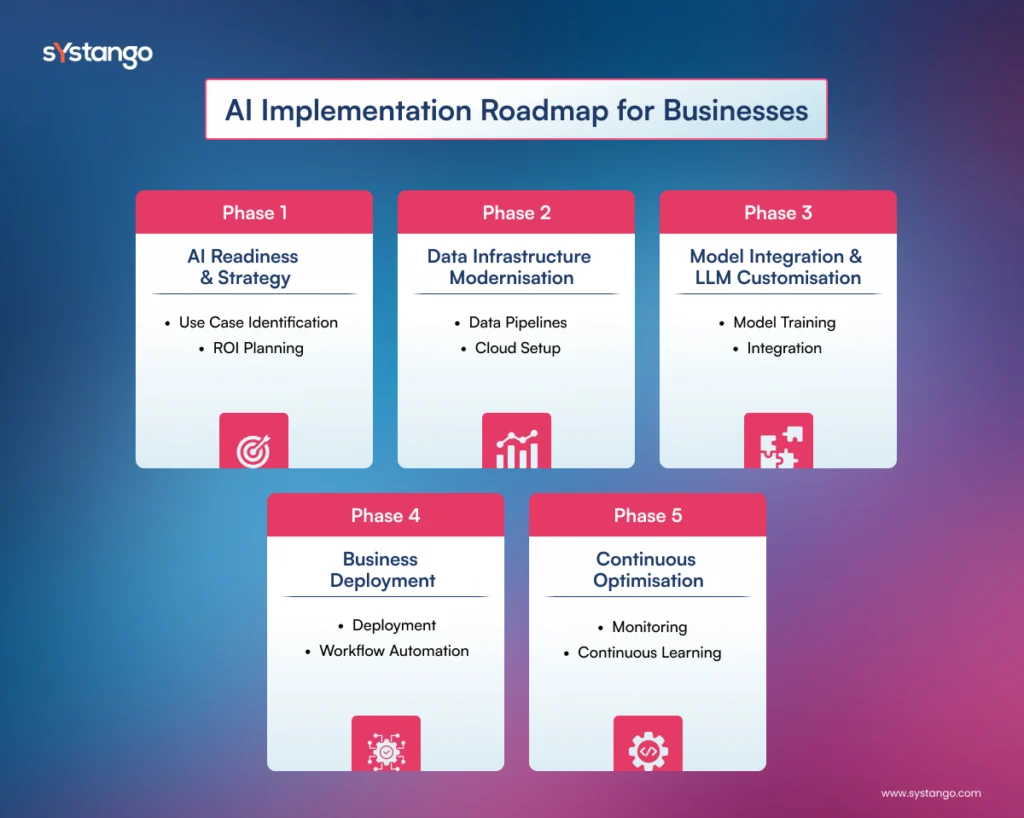
This phased implementation roadmap provides a representative framework for delivering scalable AI development services.
Organisations that move sequentially avoid costly AI pilot failures.
VII. The Risk of Inaction
Businesses that delay AI adoption risk:
- Competitive pricing disadvantage
- Slower product innovation
- Reduced customer retention
- Higher operational cost base
- Regulatory lag in AI governance
AI capability compounds. Delay compounds risk.
VIII. Strategic Takeaways for 2026
- Generative AI is now business infrastructure
- Industry specialisation determines ROI
- Governance-first deployment is mandatory
- AI maturity directly correlates with market resilience
Why Systango?
Systango is a specialised Generative AI Company delivering business-grade:
- ai consulting services
- ai development services
- Full-cycle ai software development
- Regulated-industry AI architecture
Operating across the UK and US, Systango supports businesses seeking:
- Scalable AI deployment
- Compliance-ready infrastructure
- Fintech-focused solutions
- ESG and legal automation platforms
If you are evaluating business generative ai companies and seeking measurable business outcomes—not experimentation—Systango provides strategy-to-deployment execution.
Build AI capability that drives revenue, resilience, and regulatory confidence.
Because in 2026, AI adoption is no longer optional.
It is strategic survival.
Strategic Summary
In 2026, Generative AI has evolved from experimentation to core business infrastructure. Enterprises are leveraging AI to predict market shifts, automate complex workflows, and deliver hyper-personalised customer experiences at scale.
This guide outlines how businesses use generative AI to move beyond efficiency gains and unlock new revenue streams through AI-powered products and intelligent platforms. It highlights category-based leaders, from foundational model providers like OpenAI and Google DeepMind to consulting-led implementation partners.
The blog also provides a structured framework for selecting the right generative AI development company, emphasising governance, regulatory alignment, and domain expertise—especially for fintech and compliance-heavy industries.
With a clear implementation roadmap and real-world case studies, it demonstrates how organisations can build scalable, secure, and ROI-driven AI ecosystems.
Systango supports enterprises in executing this transformation—combining AI consulting services, full-cycle development, and compliance-first architecture to deliver measurable business outcomes.
Conclusion
In 2026, Generative AI is no longer an experimental capability—it is the foundation of modern business strategy.
Enterprises that lead are not simply adopting AI; they are embedding it across decision systems, customer experiences, and operational workflows. From predictive intelligence to AI-powered products, the shift is clear: competitive advantage now comes from how effectively businesses operationalise AI at scale.
However, success is not driven by tools alone. It depends on architecture, governance, domain expertise, and the ability to move from pilots to production without friction. This is where the role of a specialised generative AI development company becomes critical—bridging strategy, execution, and measurable outcomes.
Systango enables organisations to build scalable, compliant, and revenue-focused AI ecosystems—combining AI consulting services with full-cycle development to accelerate real-world impact.
The real question for business leaders is no longer whether to invest in AI.
It is whether your organisation can build, scale, and govern AI fast enough to stay competitive in an AI-driven economy.
Executive Summary
In 2026, generative ai companies 2026 are no longer experimenting with prototypes. Business leaders are deploying production-grade AI ecosystems to:
- Predict market shifts
- Automate regulated workflows
- Launch AI-powered products
- Improve compliance visibility
- Reduce operational costs
This guide explores:
- Why generative AI is business-critical
- How AI creates measurable ROI
- Category-based leaders across industries
- How to choose the best generative ai development company for fintech
- Real business case studies
- A practical AI implementation roadmap