Automation used to mean scripts.
Now it means autonomy.
Enterprises today are not just optimising workflows — they are redesigning operations around intelligent systems. Routine processes are too complex for static RPA tools. Decision cycles are too fast for manual intervention.
AI Agents represent the shift from automation to orchestration — autonomous systems capable of analysing context, collaborating across workflows, and continuously improving performance.
What’s Inside
III. Strategic Insight: AI Agents vs Traditional Automation
IV. What Are AI Agents and How Do They Work?
V. Real-World Enterprise Proof
VI. Business Impact: ROI Drivers
VII. Implementation Roadmap for AI Agents
X. Strategic Takeaways for Leaders
Key Takeaways
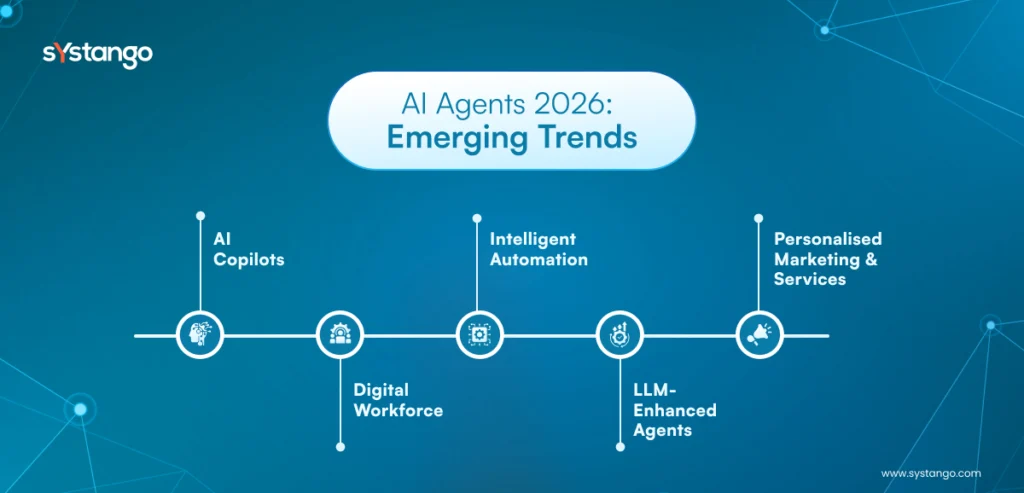
This guide explains how AI Agents 2026 are transforming enterprise operations through intelligent automation, LLM-powered reasoning, and multi-agent orchestration.
It covers:
- What AI Agents are and how they work
- The role of AI agents in automation
- Real-world enterprise outcomes
- Strategic deployment roadmap
- ROI drivers and risk mitigation
Designed for C-level leaders, this guide outlines how to implement Autonomous AI Agents for scalable operational transformation.
I. Why AI Agents Matter Now
McKinsey estimates generative AI could contribute up to $4.4 trillion annually to the global economy, driven largely by automation and decision augmentation across enterprise workflows.
Gartner further predicts that by 2026, 75% of global enterprises will apply decision intelligence, positioning AI-augmented decision-making as a major competitive differentiator.
The structural shift is clear:
- From rule-based automation
- To intelligent, adaptive agents
- From siloed AI pilots
- To multi-agent digital workforces
II. The Enterprise Challenge
Despite growing AI investment, many organisations face:
- Disconnected automation tools
- Pilot fatigue without scale
- Limited integration into core systems
- Poor ROI visibility
- Governance and compliance gaps
Traditional RPA cannot handle multi-step reasoning, dynamic data interpretation, or cross-system orchestration.
This is where Autonomous AI Agents outperform legacy automation models.
III. Strategic Insight: AI Agents vs Traditional Automation
Traditional automation:
- Executes predefined rules
- Breaks under dynamic inputs
- Operates within siloed tasks
AI Agents:
- Interpret context dynamically
- Collaborate across systems
- Learn from outcomes
- Orchestrate end-to-end workflows
In 2026, competitive advantage lies in multi-agent orchestration, not isolated task bots.
IV. What Are AI Agents and How Do They Work?
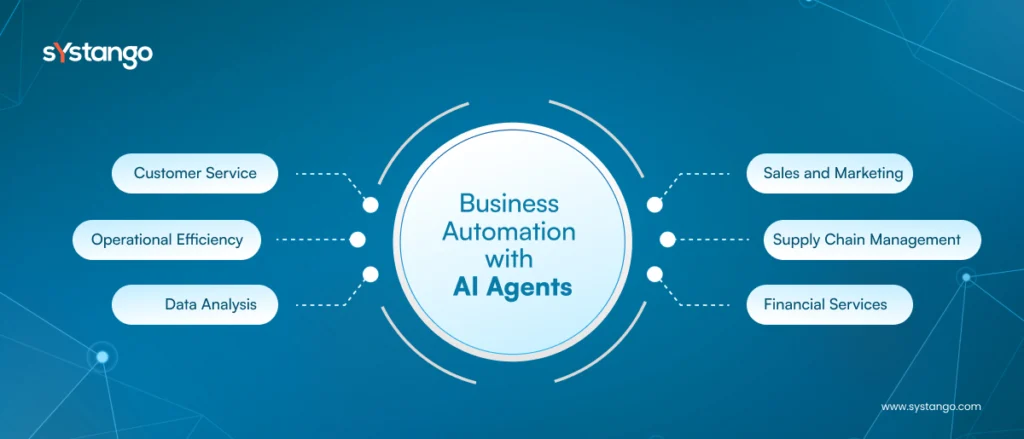
AI Agents are intelligent software entities that:
- Perceive structured and unstructured data
- Reason using machine learning and LLMs
- Make decisions
- Execute multi-step actions
- Adapt based on feedback
They are powered by:
- OpenAI GPT agents
- LangChain agents
- CrewAI orchestration frameworks
- Predictive analytics engines
Unlike chatbots, Business AI Agents execute workflows autonomously — across CRM, ERP, legal systems, and supply chains.
V. Real-World Enterprise Proof
1. AI Legal Operations Transformation
A legal enterprise partnered with Systango to deploy AI-powered workflow agents across intake, document preparation, and compliance.
Measured outcomes:
- 30% efficiency uplift across legal workflows
- 80% faster document processing from intake to filing
- 20% workforce load reduction via AI support
- Higher client satisfaction through secure self-service
2. AI-Driven Carbon Intelligence Platform
A sustainability platform integrated AI agents to analyse behavioural data and environmental impact at scale.
Outcomes included:
- 30% reduction in carbon emissions
- 45% increase in eco-friendly behaviour adoption
- 60% improvement in user engagement
- 50% growth in B2B onboarding efficiency
These examples demonstrate that structured AI development services convert AI ambition into measurable operational gains.
VI. Business Impact: ROI Drivers
Organisations deploying AI Agents 2026 unlock value through:
1. Cost Optimisation
Manual workload reduction and fewer processing errors.
2. Productivity Scaling
Digital workforce expansion without proportional hiring.
3. Decision Acceleration
Real-time predictive insights embedded into operations.
4. Customer Experience Uplift
Always-on AI interactions and personalised journeys.
PwC research suggests that AI adoption could boost global economic output by up to 15 percentage points by 2035, driven by productivity gains, automation, and the emergence of intelligent enterprise systems.
VII. Implementation Roadmap for AI Agents
Phase 1: Strategic Assessment (Weeks 1–3)
Identify high-impact workflows and define governance controls.
Phase 2: Architecture & Agent Design (Weeks 3–6)
Select AI agent platforms and define orchestration layers.
Phase 3: Pilot Deployment (Weeks 6–10)
Deploy in controlled environments and validate ROI metrics.
Phase 4: Enterprise Rollout (Months 3–6)
Scale multi-agent collaboration and embed performance dashboards.
This governance-first, phased approach provides a representative roadmap for reducing implementation risk while accelerating ROI realisation.
VIII. Risk of Inaction
Enterprises delaying AI agent adoption risk:
- Rising labour and operational costs
- Slower innovation cycles
- Competitive disadvantage against AI-native firms
- Fragmented automation ecosystems
- Missed productivity gains
In 2026, AI orchestration is no longer optional infrastructure.
IX. Future Outlook
The next evolution of AI Agents will include:
- Autonomous digital departments
- Industry-specific agent ecosystems
- Compliance-by-design AI frameworks
- Cross-enterprise multi-agent collaboration
The future enterprise will not just adopt AI.
It will orchestrate AI agents as a workforce layer.
X. Strategic Takeaways for Leaders
- AI Agents are infrastructure, not add-ons.
- Multi-agent orchestration drives scalable ROI.
- Governance and integration determine long-term success.
- Structured AI consulting services reduce execution risk.
- Early adopters gain operational compounding advantage.
Strategic Summary
In 2026, AI Agents are evolving beyond chatbots into enterprise-grade digital workforce infrastructure. Organisations deploying Business AI Agents are achieving measurable efficiency uplift, faster processing cycles, workforce load reduction, and improved decision intelligence. Powered by LLMs and orchestration frameworks, AI Agents 2026 integrate into legal operations, sustainability platforms, supply chains, and financial systems.
Through structured AI consulting services and AI development expertise, Systango enables enterprises to design and scale AI agent ecosystems aligned to measurable ROI.
Conclusion
AI Agents 2026 are redefining global business operations.
From legal automation to sustainability intelligence, enterprises deploying Business AI Agents are achieving measurable efficiency uplift, workforce load reduction, and scalable decision intelligence.
Through Systango’s AI consulting services and AI development expertise, organizations can architect, deploy, and scale Autonomous AI Agents confidently — transforming automation into sustainable competitive advantage.
Executive Summary
AI Agents 2026 represent a structural shift from rule-based automation to intelligent enterprise orchestration. Organisations deploying Business AI Agents report measurable efficiency uplift, faster document processing, workforce load reduction, and behavioural transformation at scale. Powered by LLM reasoning and multi-agent collaboration, AI Agents integrate into legal, sustainability, finance, and operational systems to drive scalable ROI. With a phased implementation roadmap and governance-first design, enterprises can unlock measurable impact within months. Partnering with experienced AI consulting services providers such as Systango ensures secure deployment, scalable architecture, and sustainable growth.