Data is no longer the challenge for modern organisations—interpreting it fast enough is.
Enterprises today generate massive volumes of operational, customer, and behavioural data across digital platforms. Yet traditional analytics tools often struggle to convert that data into actionable insights quickly enough for real-time decision-making.
According to McKinsey & Company, artificial intelligence and advanced analytics could generate $3.5 trillion to $5.8 trillion in annual business value across industries by improving decision-making, operations, and customer insights.
This shift has accelerated the adoption of AI for data analytics, where machine learning, automation, and natural language processing transform raw data into predictions, recommendations, and intelligent decision support.
What’s Inside
I. What Is AI for Data Analytics?
II. How AI Is Transforming Data Analysis in 2026
III. Types of AI Data Analytics Tools & Technologies
IV. Real-World AI Data Analytics Use Cases
V. Augmented Analytics: The Future of Intelligent Insights
VI. Predictive vs Prescriptive Analytics with AI
VII. Data Security, Governance & Trust in AI Analytics
VIII. Benefits of AI Data Analytics Solutions for Organisations
Key Takeaways
AI for data analytics is reshaping how enterprises convert complex, high-volume data into real-time insights, predictive intelligence, and faster strategic decisions. This guide explores how modern AI data analytics solutions differ from traditional BI systems and how organisations can leverage machine learning analytics tools, predictive analytics with AI, and augmented analytics platforms to automate insight generation at scale.
You’ll learn the core technologies powering enterprise AI analytics, real-world use cases across industries, implementation best practices, ROI benchmarks, and emerging trends shaping the future of enterprise data analytics in 2026 across the USA and UK.
I. What Is AI for Data Analytics?
AI for data analytics refers to the use of artificial intelligence—machine learning, deep learning, NLP, and automation—to analyse large, complex datasets and generate insights that go beyond traditional BI and reporting.
Unlike rule-based analytics, AI data analytics tools 2026 can:
- Learn continuously from new data
- Detect hidden patterns humans miss
- Predict outcomes and recommend actions
- Automate analysis at scale
This shift marks the evolution from descriptive dashboards to AI evolved analytics strategies that are proactive, predictive, and prescriptive.
II. How AI Is Transforming Data Analysis in 2026
In 2026, analytics is no longer reactive. Organisations expect real-time, explainable, and action-ready insights.
As per Gartner, by 2026 nearly 75% of analytics workflows are expected to incorporate AI or automation, signalling a major shift toward augmented analytics and automated insight discovery.
Key transformations include:
- Data analytics automation with AI tools replacing manual reporting
- Predictive analytics with AI embedded into everyday workflows
- Conversational analytics using NLP (“Ask your data”)
- AI-driven anomaly detection and forecasting
- AIOps and AI analytics integration for IT and operational intelligence
This shift allows leaders to move from “What happened?” to “What should we do next?”
III. Types of AI Data Analytics Tools & Technologies
1. Machine Learning Analytics Tools
ML models learn from historical data to identify trends, predict outcomes, and automate insights. Used heavily in churn prediction, fraud detection, demand forecasting, and pricing optimisation.
2. Deep Learning
Ideal for high-dimensional data like images, audio, logs, and sensor data—powering advanced forecasting, vision analytics, and behavioural modelling.
3. Natural Language Processing (NLP)
NLP enables analysis of unstructured data such as emails, reviews, tickets, and documents—unlocking sentiment analysis, topic discovery, and intent detection.
4. Augmented Analytics Solutions (ML and NLP in Data Pipelines)
Augmented analytics combines ML + NLP to:
- Auto-prepare data
- Auto-generate insights
- Enable natural-language querying
This is a major driver for augmented analytics for mid-market companies in 2026.
IV. Real-World AI Data Analytics Use Cases
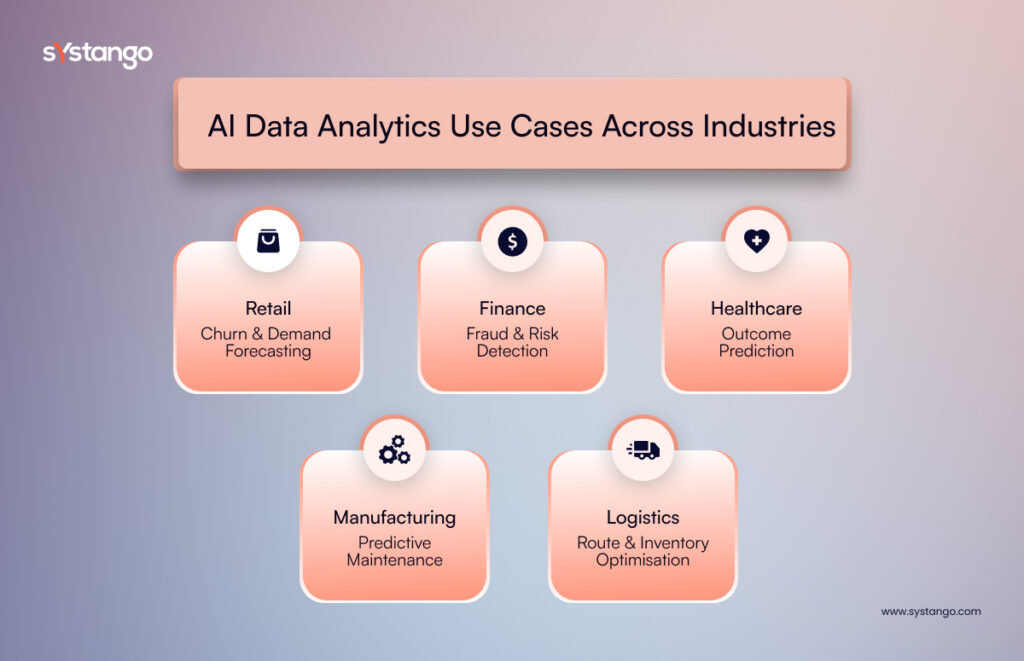
Across industries, AI data analytics use cases are delivering measurable value:
- Retail: Predict customer churn, personalise campaigns, optimise inventory
- Finance: Real-time fraud detection, risk modelling, forecasting
- Healthcare: Outcome prediction, diagnostic insights, capacity planning
- Manufacturing: Predictive maintenance, downtime reduction
- Logistics: Route optimisation, demand planning
V. Augmented Analytics: The Future of Intelligent Insights
Augmented analytics solutions represent the next phase of analytics maturity. Instead of analysts manually exploring data, AI systems:
- Surface insights automatically
- Explain why something happened
- Recommend what to do next
This is critical for organisations asking:
how to use AI for business analytics without scaling headcount.
In 2026, augmented analytics is no longer optional—it’s table stakes.
VI. Predictive vs Prescriptive Analytics with AI
1. Predictive Analytics with AI
- Forecasts future outcomes using historical and real-time data.
- Examples: demand forecasting, churn prediction, risk scoring.
2. Prescriptive Analytics
- Goes one step further—recommends optimal actions based on predicted outcomes.
- Examples: pricing optimisation, supply chain decisions, treatment planning.
Together, they power AI analytics implementation guides used by modern enterprises.
VII. Data Security, Governance & Trust in AI Analytics
As analytics become automated, trust becomes non-negotiable.
Modern enterprise AI analytics services rely on:
- AI-driven anomaly detection
- Automated compliance (GDPR, CCPA)
- Data lineage and auditability
- Explainable AI for transparency
These capabilities address growing concerns around bias, privacy, and regulatory exposure—especially in the USA and UK.
VIII. Benefits of AI Data Analytics Solutions for Organisations
- Faster, Better Decisions
- Massive Efficiency Gains through automation
- Lower Analytics Costs
- Discovery of Hidden Opportunities
- Sustainable Competitive Advantage
This answers the growing question:
AI vs traditional analytics — which is better?
For scale, speed, and accuracy—AI wins decisively.
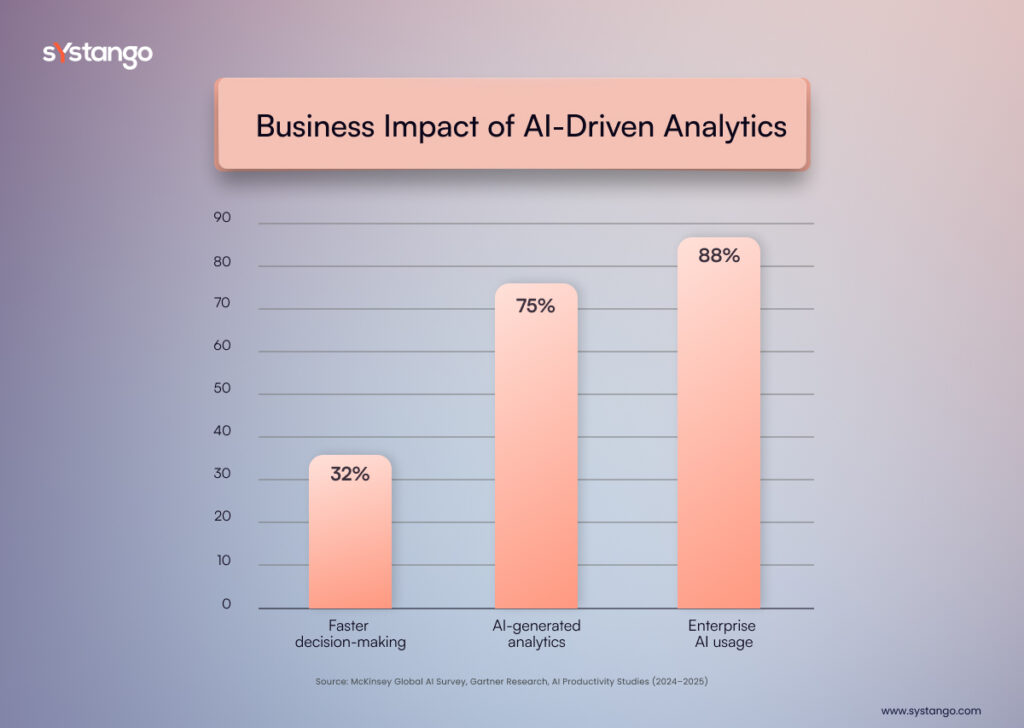
These outcomes are increasingly tied to AI data analytics ROI example metrics such as:
- Impact → 32% faster decisions
- Future trend → 75% AI-generated analytics
- Adoption scale → 88% enterprise AI usage
Real World Use Case: AI-Driven Data Intelligence for Legal Operations
A leading U.S. law firm partnered with Systango to modernise its legal operations using AI-powered analytics and intelligent workflow automation.
The firm implemented AI-driven document processing, automated client support systems, and real-time analytics dashboards to improve operational visibility and streamline internal processes.
Key outcomes included:
- 30% increase in workflow efficiency through AI-enabled operational optimisation
- 80% faster document turnaround using intelligent document processing
- 20% reduction in workforce load through AI-powered client support automation
- Firm-wide visibility via real-time analytics dashboards and reporting tools
This transformation demonstrates how AI-powered analytics combined with workflow automation can significantly improve efficiency, reduce manual workload, and provide leadership teams with real-time operational insights.
You can read the detailed case here.
How to Get Started: AI Analytics Implementation Checklist
A proven AI analytics implementation guide includes:
- Align analytics goals with business outcomes
- Choose scalable AI data analytics tools 2026
- Start with high-impact pilot use cases
- Build cross-functional AI + data teams
- Embed governance, security, and explainability
- Measure ROI continuously
This roadmap is essential for organisations evaluating AI analytics platform comparison USA / UK.
Common Challenges & How to Overcome Them
- Data quality issues → Invest in data engineering
- Skills gap → Use managed analytics partners
- Model explainability → Adopt XAI frameworks
- Ethical concerns → Build Responsible AI governance
Addressing these early ensures long-term success.
The Impact of AI on Predictive Modelling (2026 Outlook)
AI is redefining predictive modelling by:
- Adapting models in real time
- Handling unstructured + streaming data
- Enabling edge analytics
- Integrating with AIOps platforms
This is why AI evolved analytics strategies are central to enterprise roadmaps.
Strategic Summary
As organisations generate increasing volumes of data, the ability to convert raw information into actionable insights has become a critical competitive advantage. Artificial Intelligence is transforming data analytics by enabling faster data processing, predictive modelling, and real-time decision intelligence across business functions.
AI-powered analytics platforms help enterprises uncover patterns, automate complex analysis, and improve forecasting accuracy—allowing leadership teams to make more informed, data-driven decisions.
However, implementing AI-driven analytics requires more than just technology adoption. Organisations must align data architecture, governance, and AI models with business objectives to unlock meaningful value.
This is where Systango plays a strategic role. With deep expertise in AI engineering, data analytics solutions, and enterprise digital transformation, Systango helps organisations design and deploy scalable AI-powered analytics systems that improve decision-making, operational efficiency, and long-term business growth.
Conclusion
Artificial Intelligence is rapidly redefining how organisations approach data analytics. Instead of relying solely on historical reporting, businesses can now leverage AI to generate predictive insights, automate data processing, and uncover opportunities that were previously difficult to detect.
From real-time decision intelligence and advanced forecasting to automated data pipelines and anomaly detection, AI-powered analytics enables organisations to operate with greater speed, precision, and strategic clarity.
However, the success of AI in analytics depends on the right combination of data infrastructure, model development, governance frameworks, and system integration.
This is where Systango supports enterprises in building scalable AI-driven analytics ecosystems. By combining expertise in AI engineering, cloud architecture, and advanced data analytics, Systango helps organisations transform complex datasets into meaningful business intelligence.
For companies looking to move beyond traditional analytics and unlock the full potential of AI, the right technology strategy and implementation partner can make the difference between simply collecting data and truly leveraging it as a strategic asset.
Executive Summary
AI for data analytics is redefining enterprise decision-making. By combining machine learning, automation, natural language processing, and augmented analytics, organisations can transform raw data into predictive insights and actionable recommendations.
In 2026, enterprises that implement AI analytics platforms benefit from faster decisions, improved forecasting accuracy, and significant operational efficiencies. From predictive modelling to automated anomaly detection, AI-driven analytics enables businesses to move from reactive reporting to proactive strategy.
With the right implementation framework and governance, AI-powered analytics becomes a scalable competitive advantage—helping organisations unlock deeper insights and respond faster to market changes.