Enterprise blockchain in 2026 is not about choosing a chain.
It is about choosing infrastructure strategy.
As tokenisation accelerates and fintech platforms move on-chain, organisations are no longer evaluating block times alone. They are assessing scalability guarantees, regulatory adaptability, governance clarity, and ecosystem longevity.
In this context, Polygon has evolved from a Layer-2 scaling solution into modular blockchain infrastructure.
The real question is no longer:
What is Polygon?
It is:
Is Polygon architecturally positioned for enterprise Web3 in 2026?
What’s Inside
I. The Enterprise Blockchain Challenge in 2026
II. Polygon vs Ethereum 2026 Comparison
IV. Enterprise Blockchain on Polygon
V. Enterprise Blockchain KPIs in 2026
VII. Business Impact: Why Enterprises Choose Polygon
VIII. Implementation Framework
X. Future Outlook: Polygon Beyond 2026
Key Takeaways
Polygon in 2026 enables:
- zkEVM-based scaling
- Polygon CDK modular chain deployment
- Enterprise PoS infrastructure
- Real-world asset tokenisation
- Fintech-ready blockchain applications
Key advantages:
- EVM compatibility
- Lower gas costs vs Ethereum L1
- zk-validity proofs
- Modular governance
- Mature developer ecosystem
Polygon remains strategically relevant in 2026 due to modular scalability and enterprise adaptability.
I. The Enterprise Blockchain Challenge in 2026
Despite growing adoption, enterprises still face:
- Gas volatility on Ethereum L1
- Layer-2 fragmentation
- Validator governance ambiguity
- Compliance uncertainty
- Cross-chain complexity
- Interoperability risk
Industry research indicates that nearly 45% of blockchain projects face scalability limitations when deployed at enterprise scale. Without architectural discipline, blockchain becomes technical debt.
Polygon must therefore be evaluated not as hype infrastructure — but as enterprise architecture.
II. Polygon vs Ethereum 2026 Comparison
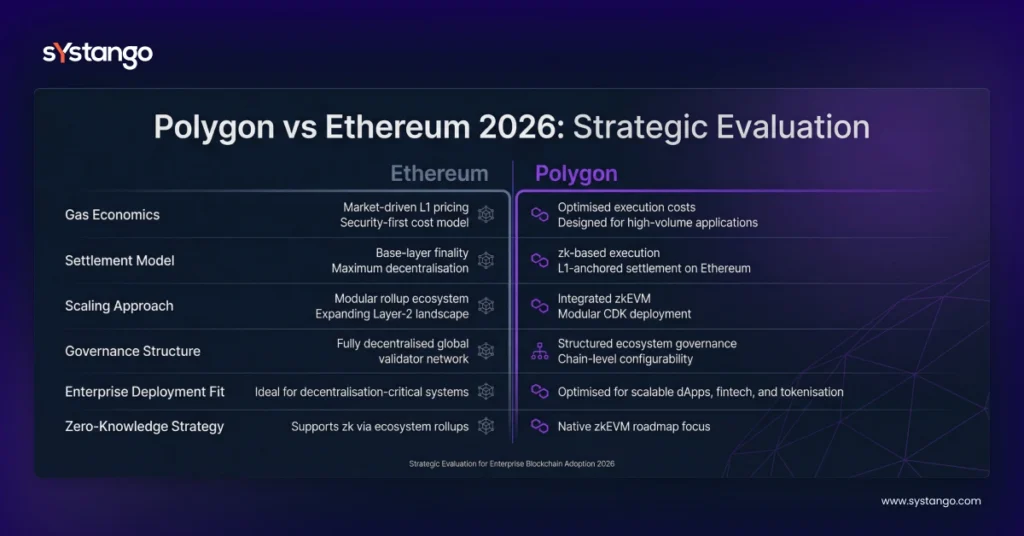
In a polygon vs ethereum 2026 comparison, the distinction is strategic:
Ethereum:
- Maximum decentralisation
- Higher L1 gas fees
- Scaling dependent on external rollups
Polygon:
- zkEVM scaling
- Modular chain deployment
- Predictable cost structure
- Enterprise governance flexibility
Polygon enhances Ethereum security while improving scalability.
Ethereum and Polygon serve complementary roles in enterprise blockchain architecture — base-layer security and scalable execution
III. What Is Polygon zkEVM?
One of the most searched queries is:
What is Polygon zkEVM?
Polygon zkEVM is a zero-knowledge rollup that:
- Executes transactions off-chain
- Submits validity proofs to Ethereum
- Maintains EVM equivalence
It delivers:
- Faster confirmations
- Lower gas fees
- Ethereum-grade security
- Seamless developer migration
Through polygon zkEVM development services, enterprises deploy scalable applications without abandoning Ethereum compatibility.
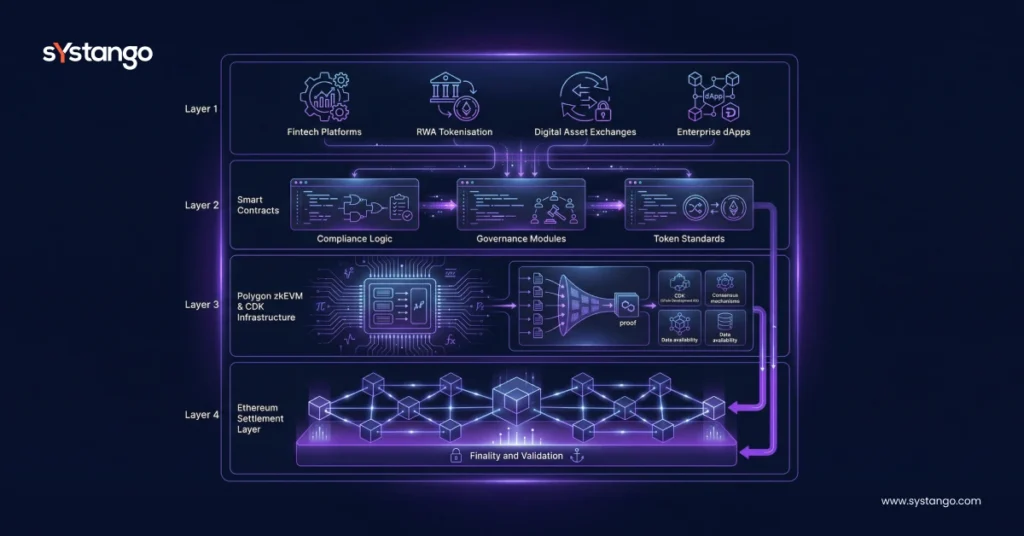
IV. Enterprise Blockchain on Polygon
Is Polygon good for enterprise blockchain?
Yes — when architectured properly.
Use cases include:
- Stablecoin infrastructure
- Polygon for fintech applications
- Cross-border settlement rails
- NFT ecosystems
- Polygon for RWA tokenization
- Gaming and digital asset platforms
For UK organisations exploring enterprise blockchain solutions UK, Polygon provides EVM maturity with cost stability.
For US enterprises evaluating a polygon development company USA, zk scalability reduces infrastructure risk while preserving Ethereum compatibility.
V. Enterprise Blockchain KPIs in 2026
When evaluating enterprise blockchain on Polygon, leaders assess:
- Transaction cost predictability
- Settlement finality latency
- zk proof validation efficiency
- Smart contract audit maturity
- Validator governance transparency
- Cross-chain interoperability readiness
Polygon’s zkEVM improves:
- Gas cost stability
- Settlement reliability
- Throughput scalability
These KPIs determine production viability.
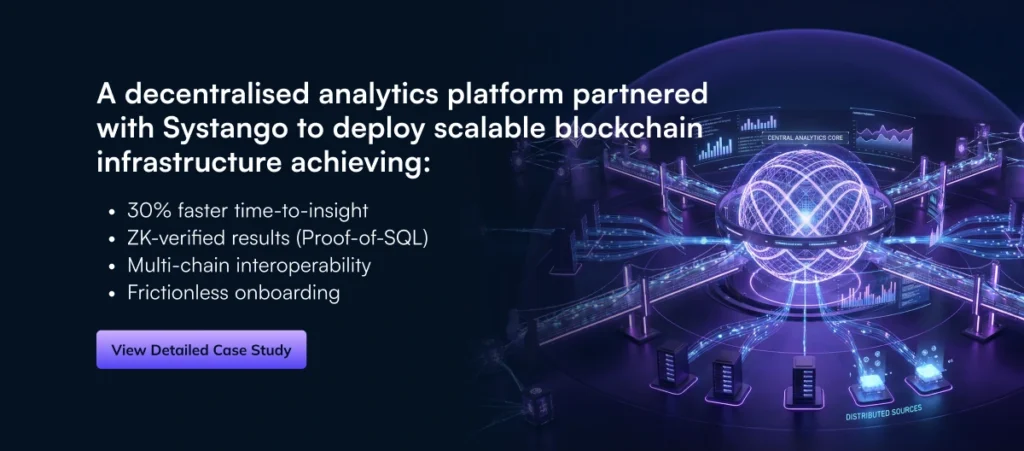
VI. Real World Use Case
VII. Business Impact: Why Enterprises Choose Polygon
A well-architected Polygon deployment delivers:
- Lower transaction cost volatility vs Ethereum L1
- Faster launch cycles
- zk-backed settlement guarantees
- Modular governance control
- Scalable tokenisation infrastructure
For regulated fintech blockchain platforms, this translates into:
- Reduced infrastructure overhead
- Improved liquidity efficiency
- Faster settlement economics
- Predictable operating costs
Infrastructure maturity drives ROI.
VIII. Implementation Framework
Phase 1 – Feasibility & Architecture
Phase 2 – Polygon smart contract development
Phase 3 – zkEVM or polygon CDK development
Phase 4 – Security audit & compliance mapping
Phase 5 – Mainnet deployment & optimisation
This phased approach outlines a representative enterprise deployment sequence, with timelines adjusted based on project requirements.
Partnering with a specialist polygon blockchain development company reduces execution risk and accelerates time-to-market.
IX. Risk of Inaction
Enterprises delaying blockchain strategy risk:
- Lock-in to volatile L1 economics
- Missed RWA tokenisation market share
- Slower fintech innovation
- Reduced DeFi ecosystem participation
- Competitive Web3 displacement
Blockchain ecosystems compound network effects.
Late adoption carries an exponential opportunity cost.
X. Future Outlook: Polygon Beyond 2026
Polygon’s roadmap prioritises:
- Expanded zk rollup adoption
- CDK-powered sovereign chains
- Cross-rollup interoperability
- Enterprise compliance tooling
According to Electric Capital’s Developer Report, EVM ecosystems continue to dominate developer participation.
Modular, zk-native ecosystems will likely define enterprise Web3 infrastructure beyond 2026.
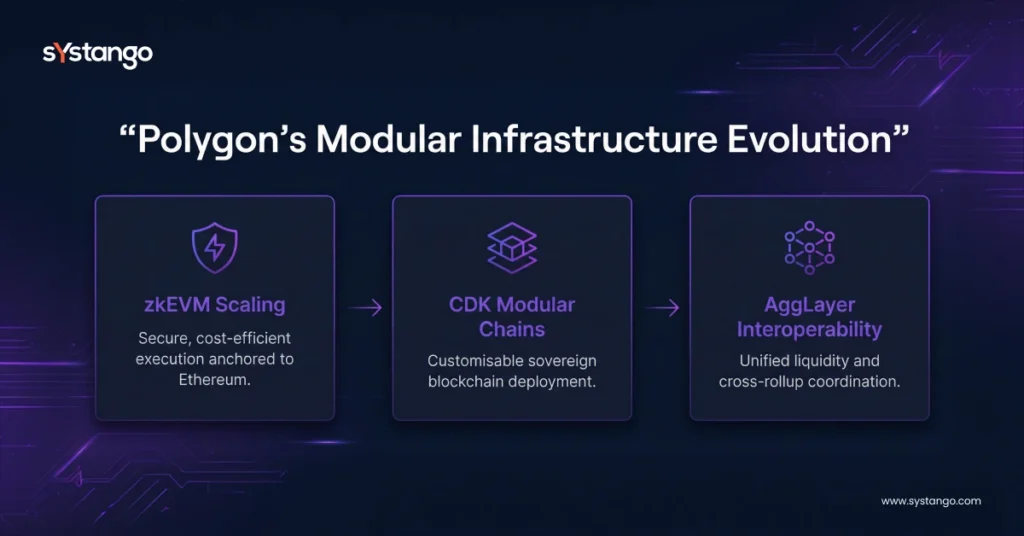
Strategic Takeaways
- Polygon remains relevant in 2026 due to zkEVM and modular design
- It balances Ethereum security with scalable performance
- CDK enables sovereign chain deployment
- zk proofs enhance settlement trust
- Enterprise adoption requires architecture-first deployment
Strategic Summary
In 2026, Polygon is a modular, zk-powered blockchain ecosystem enabling scalable, Ethereum-compatible deployments. Through polygon zkEVM development services, polygon smart contract development, and polygon CDK development, enterprises can build secure, cost-efficient applications aligned with fintech and tokenisation strategies.
With predictable gas economics and zk-backed settlement security, enterprise blockchain on Polygon offers scalable Web3 infrastructure. Systango partners globally as a trusted polygon blockchain development company, delivering compliant, production-grade blockchain architecture across regulated and enterprise environments.
Conclusion
Polygon in 2026 is not just a scaling layer.
It is modular blockchain infrastructure.
For enterprises evaluating scalable Web3 systems, the question is not:
“Can Polygon scale?”
It is:
Can your organisation leverage zk-native modular infrastructure without compromising security, governance, or cost predictability?
Systango, as a trusted polygon blockchain development company, supports enterprises in deploying scalable, secure, and production-ready blockchain systems across regulated and global markets.
Executive Summary
Polygon has matured into a modular, zk-powered Ethereum scaling ecosystem supporting enterprise-grade blockchain deployment. With zkEVM, Polygon CDK, and PoS infrastructure, it enables scalable, cost-efficient, and interoperable applications across fintech, tokenisation, gaming, and Web3 ecosystems.
Through enterprise blockchain on Polygon, organisations achieve predictable transaction economics while maintaining Ethereum-level security. For regulated fintech and RWA tokenisation, Polygon’s zk architecture offers a balanced trade-off between decentralisation and operational efficiency.
As a specialised polygon blockchain development company, Systango supports enterprises across the UK and US in delivering production-ready blockchain systems — from polygon zkEVM development services to secure polygon smart contract development and modular chain architecture.