Feature Image
Blockchain is no longer protected by innovation budgets.
It now competes for infrastructure investment.
According to Deloitte’s Global Blockchain Survey, 86% of senior executives believe blockchain will achieve mainstream adoption. However, fewer than half of organizations have moved beyond pilot stages. Meanwhile,
Gartner predicts that by 2027, 50% of critical enterprise applications will operate outside centralized cloud environments, highlighting a growing shift toward decentralised infrastructure models.
The message is clear:
Blockchain must move from experimentation to enterprise-grade execution.
What’s Inside
I. Why Enterprises Are Reassessing Blockchain in 2026
II. Enterprise Blockchain Architecture Design: What Actually Matters
III. Blockchain + AI Enterprise Solutions
IV. High-Impact Enterprise Blockchain Use Cases
V. Proof: Production-Grade Web3 Infrastructure
VI. Enterprise Blockchain Implementation Roadmap
VII. Blockchain Compliance and Governance
VIII. Business Impact: Blockchain ROI for Enterprises
Key Takeaways
- Enterprise blockchain is shifting from pilots to infrastructure.
- ROI depends on governance, architecture, and integration.
- Hyperledger vs Ethereum decisions hinge on compliance and ecosystem strategy.
- AI + blockchain enterprise solutions unlock automation and tokenisation.
- Production-grade Web3 requires compliance-first deployment.
I. Why Enterprises Are Reassessing Blockchain in 2026
Three forces are driving renewed evaluation:
- Tokenisation economics
- Compliance pressure
- AI convergence
Enterprises without a tokenisation roadmap risk structural disadvantage.
II. Enterprise Blockchain Architecture Design: What Actually Matters
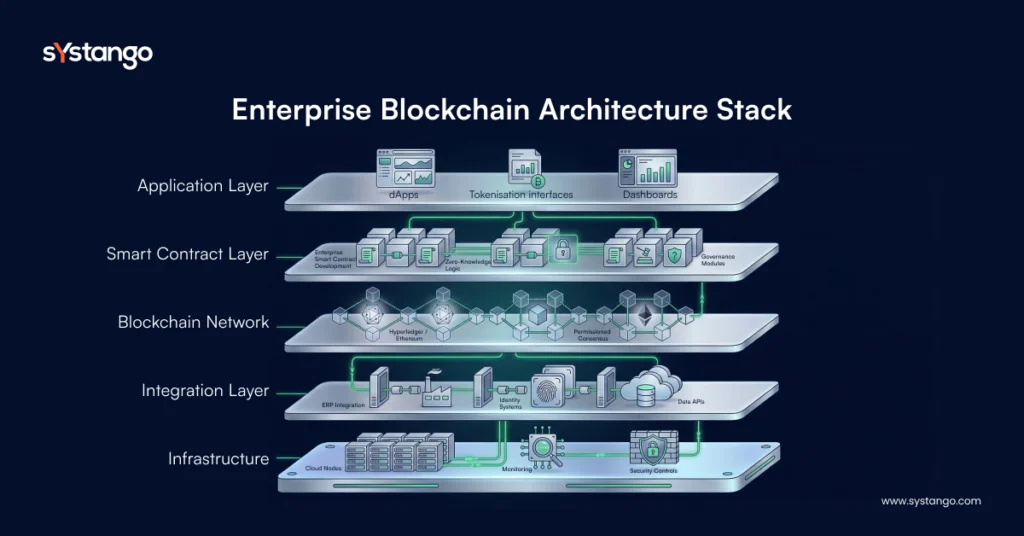
Successful deployment requires four architectural pillars:
- Network model selection (private, consortium, hybrid)
- Enterprise smart contract development
- Blockchain integration with ERP systems
- Governance-first compliance design
Platform selection — Hyperledger vs Ethereum — depends on:
- Privacy requirements
- Ecosystem access
- Throughput demands
- Regulatory constraints
Rather than embedding a comparison table in-text, this decision framework should be visualised
III. Blockchain + AI Enterprise Solutions
The most significant shift in 2026 is AI integration.
AI enhances:
- Liquidity optimisation
- Treasury automation
- Predictive infrastructure scaling
Blockchain ensures:
- Verifiable execution
- Immutable audit trails
- Multi-party trust
Together, they enable infrastructure-grade automation.
IV. High-Impact Enterprise Blockchain Use Cases
Blockchain for Supply Chain Management
- Provenance tracking
- Counterfeit prevention
- Automated compliance documentation
- Real-time settlement triggers
Blockchain for Financial Services
- Cross-border settlement
- Smart contract-based lending
- Tokenised asset issuance
- Automated treasury management
Real-World Asset Tokenisation
Tokenisation unlocks:
- Fractional ownership
- Liquidity access
- Automated governance
- Programmable compliance
The ROI case is becoming measurable — not theoretical.
V. Proof: Production-Grade Web3 Infrastructure
Void AI – Liquidity Infrastructure Optimisation
Systango engineered enterprise Web3 infrastructure delivering:
- 45% increase in effective liquidity depth
- 100% on-chain verification
- 30% uplift in LP rewards
- Fully automated treasury flows
This demonstrates blockchain ROI for enterprises operating decentralised ecosystems.
VI. Enterprise Blockchain Implementation Roadmap
A production-ready roadmap includes:
- ROI-driven use case identification
- Architecture selection
- Secure smart contract engineering
- ERP and identity integration
- Governance and compliance validation
- Incremental production scaling
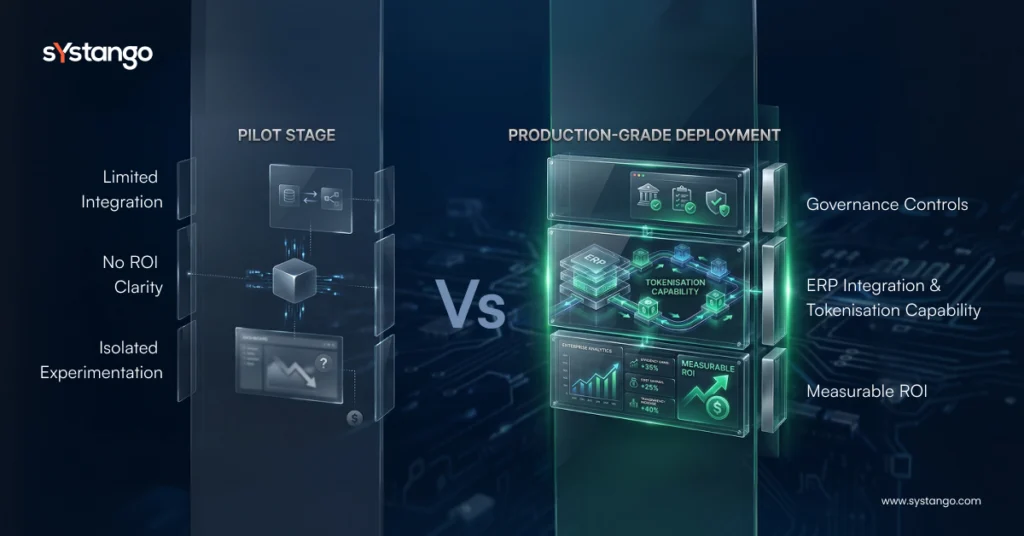
Governance must precede scale.
VII. Blockchain Compliance and Governance
Enterprise deployments must prioritise:
- Smart contract audits
- Interoperability standards
- Identity-based access controls
- Blockchain data privacy solutions
- Regulatory alignment
Compliance is now board-visible.
VIII. Business Impact: Blockchain ROI for Enterprises
When executed strategically, enterprise blockchain development delivers:
- Reduced reconciliation costs
- Automated treasury flows
- Faster settlements
- Enhanced liquidity transparency
- Improved ecosystem trust
Risk of inaction:
- Delayed tokenisation strategy
- Infrastructure disadvantage
- Missed decentralised revenue streams
- Competitive disintermediation
Blockchain is becoming digital infrastructure — not optional experimentation.
IX. Why Systango Is Different
Most blockchain vendors specialise in either advisory or engineering.
Systango combines:
- Enterprise blockchain architecture design
- Hyperledger and Ethereum engineering
- AI + blockchain convergence
- ERP interoperability
- Governance-first deployment
This integrated approach reduces vendor fragmentation and accelerates production-grade Web3 implementation.
Strategic Summary
Enterprise blockchain in 2026 is no longer exploratory. Organisations are deploying production-grade Web3 infrastructure integrated with ERP systems, AI optimisation layers, and real-world asset tokenisation models.
This guide outlines enterprise blockchain architecture design, governance frameworks, scalability considerations, and implementation roadmaps. It explores the convergence of AI + blockchain enterprise solutions and platform decisions such as Hyperledger vs Ethereum for enterprise.
Systango partners with CTOs and CIOs to design, build, and scale secure enterprise blockchain ecosystems — combining smart contract engineering, integration services, AI optimisation, and compliance-first architecture.
Conclusion
The question is no longer whether blockchain works.
It is whether your organisation can scale it securely, compliantly, and profitably.
Systango operates as an enterprise blockchain development company — delivering architecture, integration, smart contract engineering, AI convergence, and scalable Web3 infrastructure.
Move beyond experimentation. Build infrastructure.
Executive Summary
Enterprise blockchain in 2026 is evolving into infrastructure-grade Web3 architecture. Organisations must prioritise measurable ROI, governance alignment, and interoperability with existing systems.
Permissioned networks such as Hyperledger provide control and compliance, while Ethereum ecosystems enable tokenisation and liquidity access. AI integration further enhances automation and optimisation.
Case studies demonstrate measurable impact across liquidity infrastructure and decentralised compute markets.
Systango partners with enterprises to design, implement, and scale secure blockchain ecosystems — combining architecture, AI integration, compliance-first deployment, and production-grade engineering.