AI experimentation is easy. Enterprise AI scale is hard.
While generative models are widely accessible, competitive differentiation in 2026 depends on architectural maturity — not model access.
According to the Stanford AI Index Report 2024, enterprise AI adoption and investment continue to rise across sectors, yet many organisations struggle to convert experimentation into sustained operational impact.
The gap is architectural.
Well-designed Generative AI Architecture determines whether AI becomes enterprise infrastructure — or remains a disconnected pilot.
What’s Inside
I. From AI Capability to AI Infrastructure
IV.-Enterprise-Generative-AI-Architecture-Framework
V. Custom GenAI vs Off-the-Shelf LLMs
VI.-Enterprise-Applications-of-GenAI
VII. Real-World Enterprise Proof
IX. Detailed Implementation Roadmap
XI. Future Outlook (2026–2027)
Key Takeaways
This enterprise guide explains how Generative AI Architecture enables scalable, secure AI systems across:
- Data processing
- Generative models
- Feedback loops
- Deployment infrastructure
It outlines ROI impact, implementation roadmap, governance considerations, and how Systango’s AI consulting services and AI development services help enterprises move from pilots to production-ready AI software development.
I. From AI Capability to AI Infrastructure
Enterprises now expect AI to:
- Accelerate product development
- Automate content and code creation
- Improve decision intelligence
- Personalise customer engagement
However, scaling AI requires disciplined AI software development aligned with governance, cost control, and compliance.
Architecture defines scalability.
II. Challenge
Without structured AI architecture, enterprises face:
- Fragmented data pipelines
- Escalating inference costs
- Model hallucination risks
- Compliance and data privacy exposure
- Inconsistent output reliability
The World Economic Forum has emphasised governance-first AI deployment as critical for enterprise trust and regulatory alignment.
AI without governance creates risk.
III. Insight
Winning enterprises in 2026 follow this principle:
Design architecture first. Embed governance. Enable feedback. Scale deliberately.
Structured AI consulting services in architecture ensure AI systems are resilient, compliant, and business-aligned from day one.
IV. Enterprise Generative AI Architecture Framework
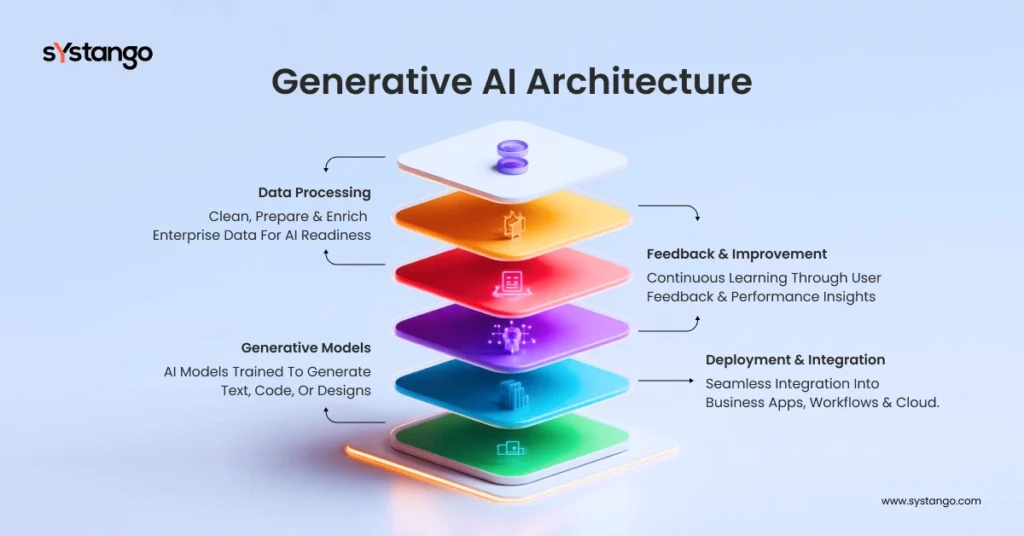
1. Data Processing Layer
- Clean, prepare and enrich enterprise data for AI readiness.
- Embed compliance and privacy controls.
2. Generative Model Layer
- Deploy transformer-based models, GANs, or domain-specific systems.
- Optimise through contextual fine-tuning.
3. Feedback & Improvement Layer
- Continuous evaluation through analytics and human validation.
- Enable drift detection and performance monitoring.
4. Deployment & Integration Layer
- Integrate models into enterprise systems and cloud-native environments.
- Ensure scalability and resilience.
This layered Generative AI Architecture ensures production readiness.
V. Custom GenAI vs Off-the-Shelf LLMs
Custom Generative AI (via AI development services):
- Domain-specific tuning
- Full enterprise data control
- Strong compliance alignment
- Strategic differentiation
- Long-term cost optimisation
Off-the-Shelf LLM APIs:
- Faster prototyping
- Limited transparency
- Vendor dependency
- Reduced competitive advantage
Enterprises in regulated sectors favour custom AI software development to protect IP and manage risk.
VI. Enterprise Applications of GenAI
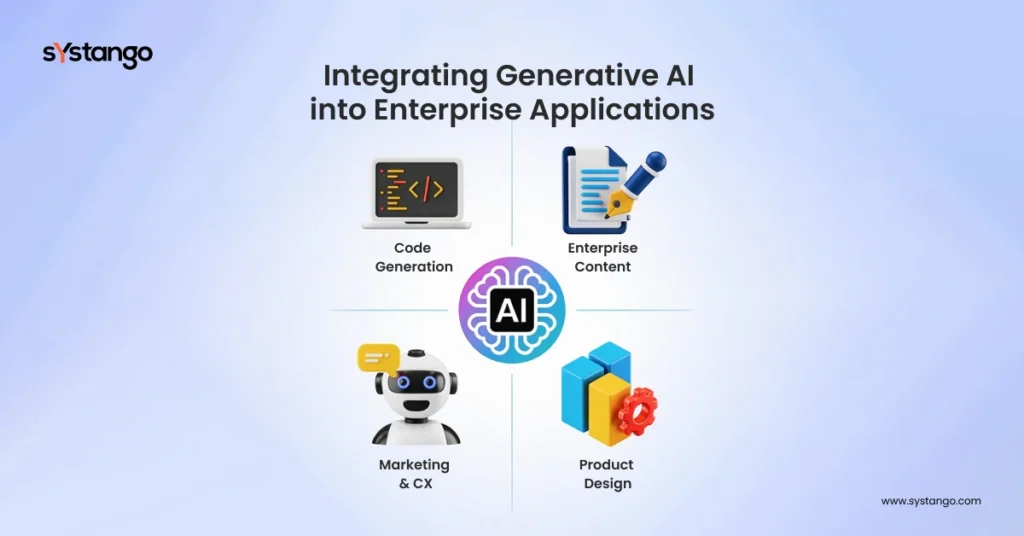
1. Code Generation
Improves engineering throughput and reduces repetitive tasks.
2. Enterprise Content
Automates reporting, documentation, and campaign creation.
3. Marketing & Customer Experience
Enables predictive engagement and personalisation.
4. Product Design
Supports simulation, modelling, and optimisation.
However, application without architecture increases exposure. This is why enterprises engage a specialised Generative AI Company to operationalise responsibly.
VII. Real-World Enterprise Proof
Case Study 1: AI Carbon Intelligence Platform
A sustainability intelligence platform partnered with Systango to build scalable AI-driven carbon tracking systems.
Measured outcomes:
- 30% reduction in carbon emissions across participating organisations
- 45% increase in adoption of eco-friendly behaviours
- 60% improvement in user engagement and platform stickiness
- 50% growth in B2B onboarding efficiency
This demonstrates production-grade AI software development delivering measurable ESG impact.
Case Study 2: AI-Driven Logistics Optimisation
A logistics platform leveraged Systango’s AI development services to deploy AI-powered routing and workflow automation.
Measured outcomes:
- 25% faster delivery completion times
- 40% improvement in operational efficiency
- 2.5× scalability in order volume handling
- 20% reduction in operational costs
This reflects enterprise-scale AI implementation driving cost and performance gains.
VIII. Business Impact (ROI)
A structured Generative AI Architecture drives measurable impact across four levers:
1. Productivity Gains
AI-assisted workflows increase operational throughput.
2. Cost Optimisation
Cloud-native optimisation reduces inference waste.
3. Revenue Enablement
Improved engagement increases lifetime value.
4. Risk Mitigation
Governance-first design reduces regulatory exposure.
According to McKinsey’s State of AI research, organisations scaling AI strategically report measurable performance and efficiency gains across operations.
Architecture converts experimentation into enterprise value.
IX. Detailed Implementation Roadmap
Phase 1: Strategic Assessment (Weeks 1–4)
- AI readiness audit
- Data maturity evaluation
- Compliance mapping
- Use case prioritisation
Phase 2: Architecture Design (Weeks 4–8)
- Model strategy selection
- Infrastructure blueprint
- Governance and monitoring framework
Phase 3: Development & Integration (Weeks 8–16)
- Custom model tuning
- API integration
- Feedback loop implementation
Phase 4: Optimisation & Scaling (Ongoing)
- Continuous performance monitoring
- Drift detection
- Cost governance refinement
This phased implementation roadmap provides a representative framework for delivering scalable AI development services.
X. Risk of Inaction
Enterprises delaying structured AI adoption risk:
- Competitive lag
- Escalating technical debt
- Regulatory vulnerability
- Uncontrolled infrastructure costs
In 2026, AI maturity defines market leadership.
XI. Future Outlook (2026–2027)
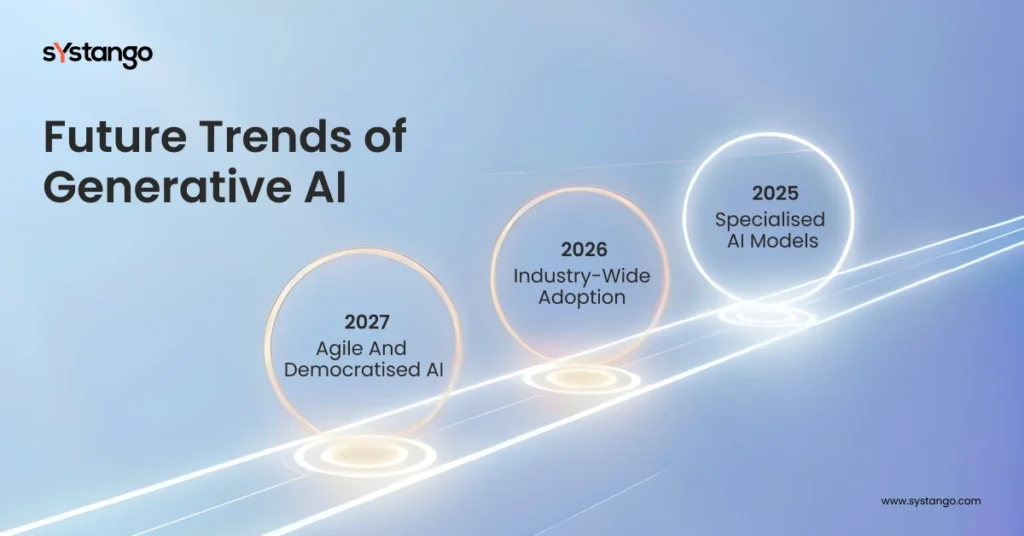
1. Specialised AI Models
Domain-tuned systems outperform general-purpose AI.
2. Industry-Wide Adoption
AI becomes embedded infrastructure across sectors.
3. Agile & Democratised AI
Sustainable AI software development frameworks expand accessibility.
Enterprises investing in robust Generative AI Architecture today will define tomorrow’s ecosystem.
XII. Strategic Takeaways
- Architecture determines scalability.
- Governance must be embedded from inception.
- Custom AI builds defensible competitive advantage.
- Feedback loops sustain performance quality.
- Partnering with expert AI consulting services accelerates secure adoption.
Strategic Summary
Generative AI adoption is accelerating globally, yet enterprise value depends on structured Generative AI Architecture. Organisations embedding governance, feedback loops, and scalable infrastructure outperform pilot-driven competitors. Through specialised AI consulting services and AI development services, Systango and GenAI Studio enable enterprises to operationalise AI securely, compliantly, and at scale — delivering measurable productivity, efficiency, and revenue impact.
Conclusion
Generative AI is no longer optional innovation — it is enterprise infrastructure.
Organisations that design structured Generative AI Architecture unlock sustained productivity, measurable ROI, and operational resilience.
Through Systango’s AI consulting services, AI development services, and GenAI Studio, enterprises gain end-to-end support for secure, scalable AI transformation.
The future belongs to enterprises that architect AI correctly.

Executive Summary
Generative AI adoption is accelerating globally, but enterprise success depends on structured Generative AI Architecture. Organisations must integrate data pipelines, generative models, feedback systems, and deployment frameworks into secure, scalable ecosystems. Without architectural maturity, AI pilots fail to deliver measurable ROI.
Real-world implementations show tangible impact: 30% emission reduction, 60% engagement growth, 2.5× scalability, and 40% operational efficiency improvement. External research from Stanford AI Index, McKinsey, and the World Economic Forum reinforces the importance of governance-first AI deployment.
Through Systango’s AI consulting services and AI development services, enterprises can transition from experimentation to production-grade AI software development — unlocking productivity gains, cost optimisation, revenue growth, and reduced compliance risk.