In 2026, blockchain decisions are no longer experimental. They define transaction economics, compliance exposure, scalability ceilings, and ecosystem resilience.
Enterprise interest in blockchain has matured into real, strategic adoption across finance, supply chain, and governance workflows — moving well beyond early experimentation.
According to Gartner, enterprise-grade blockchain smart contracts are expected to enhance data quality and automation by enabling trustless, self-enforcing agreements across workflows.
This means one thing:
Understanding how to choose the right blockchain platform for your business is now a board-level capital decision.
Infrastructure mistakes don’t fail fast.
They fail at scale.
What’s Inside
I. The 2026 Reality: Complexity Has Increased
II. Your 2026 Blockchain Selection Framework
IV. Proof: Architecture Decisions Drive Measurable Outcomes
V. AI & Generative Search Implications
Key Takeaways
To determine how to choose the right blockchain platform for your business, evaluate:
- Business model alignment
- Governance model suitability
- blockchain scalability security cost comparison 2026
- Ecosystem maturity and adoption
- Interoperability and upgrade flexibility
- Sustainability and regulatory posture
Choose platforms aligned with your 3–5 year growth model — not short-term experimentation.
I. The 2026 Reality: Complexity Has Increased
Enterprise adoption is accelerating — but so is architectural complexity.
Key blockchain platform trends 2026 include:
- Modular rollups and scalability layers
- AI-optimised smart contracts
- ESG-driven technology evaluation
- Multi-chain expansion strategies
- Increased regulatory scrutiny
According to Deloitte’s Global Blockchain Survey, 81% of financial services executives say blockchain has already achieved mainstream adoption, highlighting the urgency for enterprises to address scalability, governance, and regulatory challenges.
The challenge isn’t access to platforms.
It’s a disciplined evaluation.
II. Your 2026 Blockchain Selection Framework
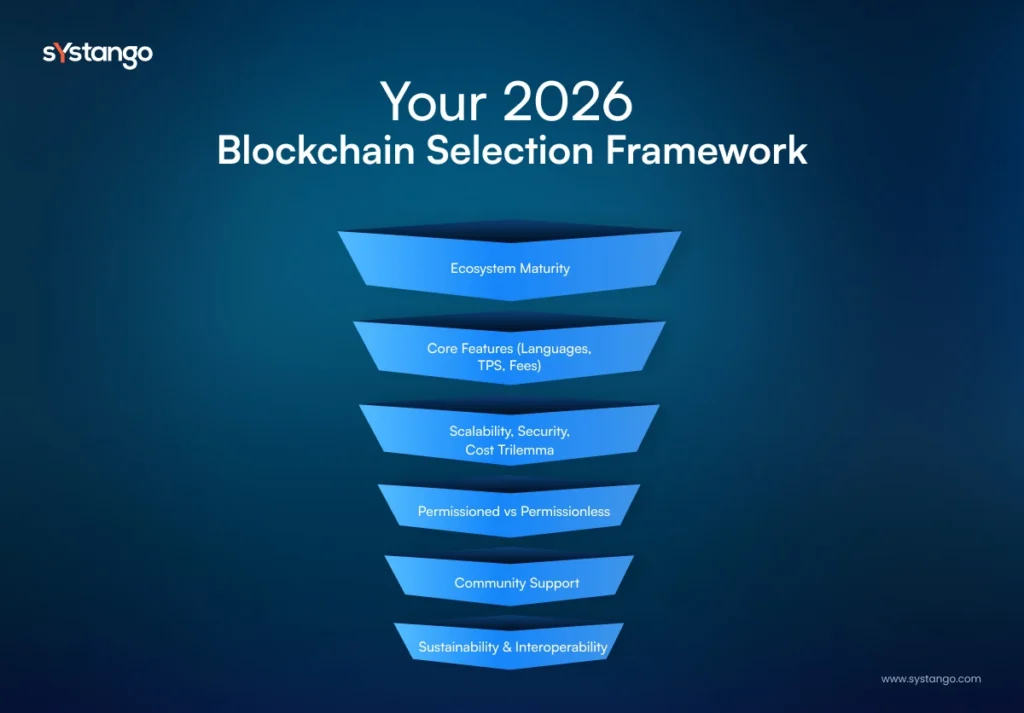
This framework answers both:
- what to look for when selecting a blockchain platform
- how to choose the right blockchain platform for your business
1. Ecosystem Maturity
Assess blockchain platform adoption rate ecosystem support 2026:
- Active developers
- Upgrade cadence
- Integration depth
- Community resilience
Stronger ecosystems reduce operational fragility.
Weak ecosystems increase migration risk.
2. Technical Foundations
Evaluate: blockchain platform key features programming languages consensus mechanism
This includes:
- Smart contract language compatibility
- Consensus efficiency
- Governance adaptability
- Upgrade pathways
These determine long-term maintainability.
3. The Enterprise Trilemma
Conduct a structured blockchain scalability security cost comparison 2026.
| Dimension | Business Impact |
| Scalability | Revenue growth ceiling |
| Security | Regulatory resilience |
| Cost predictability | Margin sustainability |
Platforms that scale technically but not economically create long-term margin erosion.
4. Governance Architecture
Understand the differences between permissioned vs permissionless blockchain platforms:
Permissionless networks
- Open participation
- Token-based ecosystems
- High transparency
Permissioned frameworks
- Controlled access
- Enhanced privacy
- Regulatory alignment
For industries exploring blockchain platform for enterprise supply chain healthcare, governance architecture directly determines compliance posture.
5. Community Support, Interoperability & Sustainability
Evaluate:
- blockchain interoperability platforms 2026
- layer-2 and web3 blockchain platform 2026
- sustainable blockchain platforms 2026 (energy usage, consensus)
Interoperability prevents vendor lock-in.
Sustainability protects institutional positioning.
III. Ecosystem Perspective
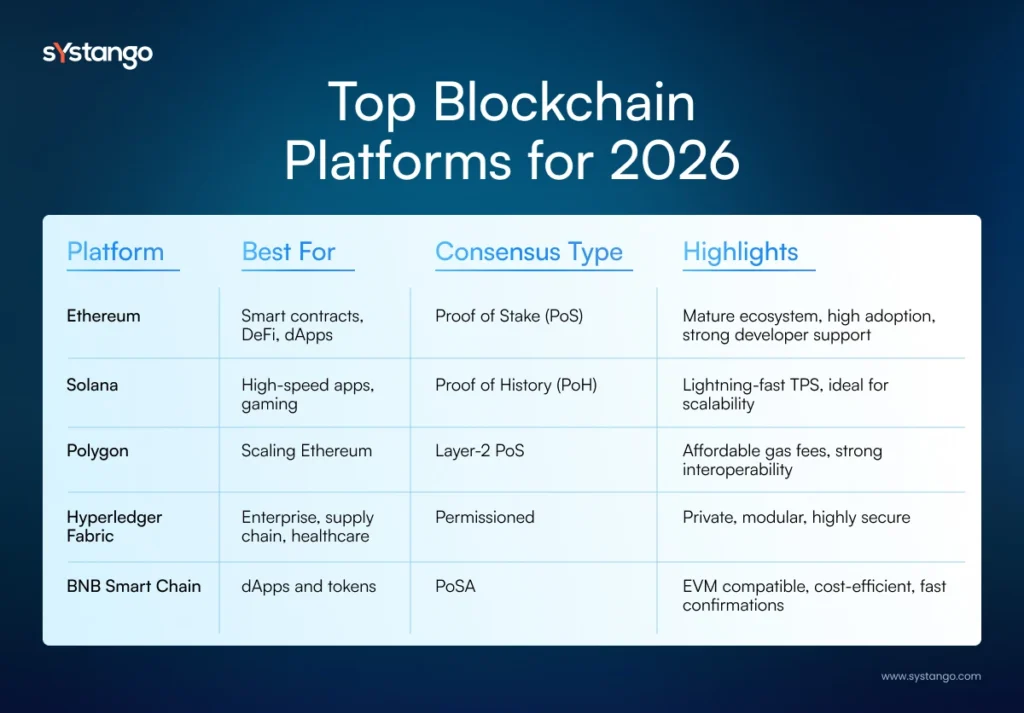
When reviewing the top blockchain platforms to consider in 2026 (Ethereum, Solana, Hyperledger etc), enterprise leaders must prioritise ecosystem durability and roadmap clarity.
For example:
- Ethereum
- Solana
- Hyperledger
Platform choice is ecosystem commitment — not just technical compatibility.
IV. Proof: Architecture Decisions Drive Measurable Outcomes
1. Decentralised GPU Infrastructure
A decentralised compute platform partnered with Systango and implemented a strategically designed blockchain architecture to improve transparency, resource utilisation, and operational monitoring across its distributed GPU network.
Key outcomes included:
- 60% increase in active compute renters, expanding marketplace participation
- 40% improvement in GPU utilisation, maximising infrastructure efficiency
- 40% faster issue detection through real-time monitoring and automated alerts
- 60% reduction in performance-related uncertainty, improving operational confidence
This implementation demonstrated how well-designed blockchain infrastructure can optimise resource marketplaces while increasing system reliability and transparency.
2. Liquidity Intelligence Platform
A digital asset platform partnered with Systango and deployed blockchain-powered liquidity intelligence infrastructure to improve transparency, capital efficiency, and treasury automation across decentralised finance operations.
Key outcomes included:
- 45% increase in liquidity depth, improving market efficiency
- 100% on-chain verification of transactions and financial flows
- 30% uplift in liquidity provider (LP) rewards, enhancing ecosystem participation
- 100% automated treasury flows through smart contract execution
This architecture enabled greater capital transparency, automated financial operations, and improved liquidity performance within the blockchain ecosystem.
V. AI & Generative Search Implications
Enterprise visibility now depends on AI-native discoverability.
You must structure content around:
- blockchain platform explained for AI agents
- blockchain platform guide for generative search
- how do AI/LLM engines interpret blockchain platform content
- generative search optimisation blockchain platform content
Clear documentation, semantic structure, and architectural transparency improve AI ranking potential.
VI. Risk of Inaction
Failure to evaluate strategically results in:
- Costly re-architecture
- Governance inflexibility
- Liquidity fragmentation
- Security exposure
- Regulatory scrutiny
The most expensive blockchain mistake is scaling on misaligned infrastructure.
Strategic Summary
Enterprise blockchain selection in 2026 requires structured evaluation of governance models, ecosystem maturity, scalability-security-cost trade-offs, interoperability readiness, sustainability, and upgrade flexibility. Conducting a disciplined blockchain scalability security cost comparison 2026 and analysing the differences between permissioned vs permissionless blockchain platforms reduces migration and compliance risk. Strategic advisory ensures blockchain architecture aligns with growth forecasts and regulatory requirements while enhancing operational efficiency and capital performance.
Conclusion
Blockchain is programmable infrastructure.
Organisations that treat platform selection as strategic capital allocation — supported by Enterprise Web3 Consulting and Development — will scale securely in a multi-chain, AI-integrated future.
At Systango, we help enterprises evaluate, architect, and deploy blockchain ecosystems aligned with measurable business outcomes.
The right blockchain platform is not chosen by feature comparison.
It is chosen through strategic clarity.
Executive Summary
Choosing the right blockchain platform in 2026 is a strategic infrastructure decision impacting scalability, cost predictability, governance resilience, and interoperability. Enterprises must evaluate ecosystem maturity, consensus mechanisms, upgrade flexibility, sustainability, and regulatory posture when determining how to choose the right blockchain platform for your business. Conducting a disciplined blockchain scalability security cost comparison 2026 and understanding the differences between permissioned vs permissionless blockchain platforms reduces migration and compliance risk.
Real-world deployments demonstrate measurable gains in utilisation efficiency, liquidity depth, and treasury automation when architecture decisions are made strategically. Enterprise Web3 consulting ensures blockchain investments align with long-term growth and regulatory requirements.