Technology leaders aren’t choosing programming languages anymore — they’re choosing infrastructure strategy. Choosing between Rust and Go is no longer just a technical decision, it’s a strategic one that directly affects scalability, security, development speed, and long-term costs. As organisations prioritise high-performance systems and cloud-native architecture, the Rust vs Go 2026 debate has become a key consideration for technology leaders. Understanding where each language excels helps businesses select a backend foundation aligned with their growth, risk, and innovation goals.
What’s Inside
III.-Rust-vs-Go-Performance-Comparison-(2026-Benchmarks)
IV. Architecture Fit: Microservices, APIs & Backend Systems
VII. Developer Productivity & Talent Market
VIII. Cost & Scalability Considerations
IX. Decision Framework: How to Choose Between Rust and Go
X. Microservices & Modern Architecture Trends
XI. 2026 Outlook: Future of Rust vs Go
XII. Strategic Takeaway for Leaders
Key Takeaways
- Choose Rust for security-critical, high-performance systems.
- Choose Go for scalable APIs, cloud platforms, and fast releases.
- Rust vs Go performance comparison shows Rust leading in raw speed.
- Go wins developer productivity and faster time-to-market.
- Enterprises increasingly adopt both together in hybrid architectures.
Who should choose Rust
- Fintech, blockchain, security-focused platforms
- Performance-intensive systems
- Teams prioritising reliability over speed of development
Who should choose Go
- Startups launching fast
- Cloud-native platforms
- Distributed systems and microservices
I. What Is Rust?
Rust is a systems programming language designed for performance, reliability, and safety. It eliminates memory errors at compile time using its ownership model, making it ideal for secure and high-performance software.
Key strengths
- Industry-leading memory protection
- Zero-cost abstractions
- High concurrency safety
- Excellent for Rust vs Go for system programming comparisons
Rust consistently ranks among the most loved languages in developer surveys because of its reliability and performance guarantees.
II. What Is Go?
Go (Golang), developed by Google, is designed for simplicity, concurrency, and scalability. It compiles fast, runs efficiently, and is widely used for distributed systems.
Google’s official Go documentation confirms the language was designed to support scalable distributed systems.
Key strengths
- Lightweight concurrency model
- Fast compilation
- Clean syntax
- Strong ecosystem for Rust vs Go for cloud native apps
Go powers infrastructure tools like Docker and Kubernetes, making it dominant in cloud engineering environments.
III. Rust vs Go Performance Comparison (2026 Benchmarks)
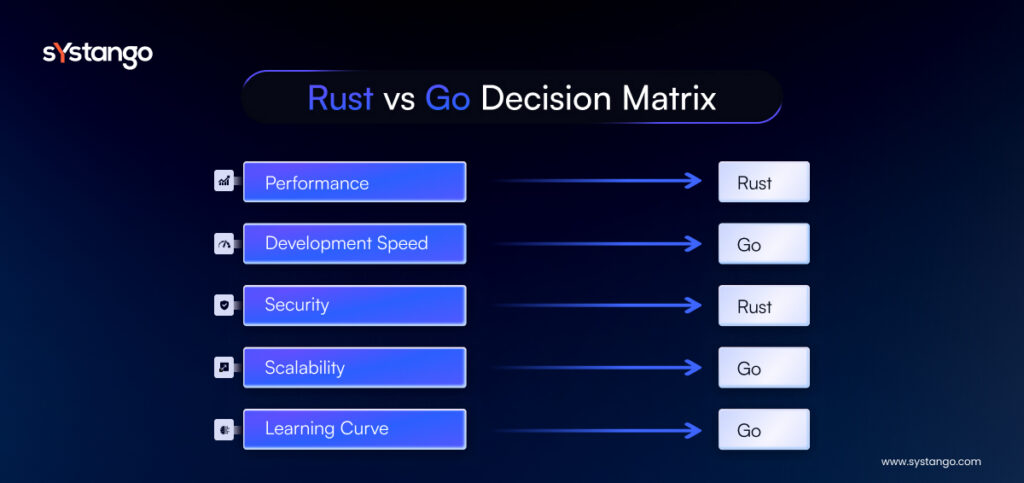
Independent benchmark tests from the Computer Language Benchmarks Game show Rust outperforming Go in several CPU-intensive tasks.
Executive insight:
If milliseconds matter, Rust wins. If delivery speed matters, Go wins.
IV. Architecture Fit: Microservices, APIs & Backend Systems
A. Rust vs Go for microservices
- Rust → high-performance microservices, lower runtime overhead
- Go → faster deployment, easier scaling
B. Rust vs Go for backend development
- Rust → heavy data processing backends
- Go → scalable REST and event-driven services
C. Rust vs Go for high performance APIs
Rust is preferred when:
- latency must be ultra-low
- memory footprint must stay minimal
V. Real-World Use Cases
A. Where Rust Excels
- Blockchain infrastructure
- Security platforms
- Embedded systems
- Financial engines
Especially relevant for Rust vs Go for blockchain development, Rust’s performance and memory safety make it ideal for distributed ledger environments.
B. Where Go Excels
- Cloud platforms
- SaaS systems
- Networking tools
- API infrastructure
For which language is better for microservices Rust or Go, Go often wins due to built-in concurrency and simplicity.
VI. Security Comparison
Security is where the Rust vs Go security comparison becomes decisive.
A. Rust
- Eliminates null pointer errors
- Prevents data races
- Compile-time enforcement
B. Go
- Garbage collection
- Strong standard libraries
- Secure networking support
Executive insight:
Rust prevents bugs.
Go handles them gracefully.
VII. Developer Productivity & Talent Market
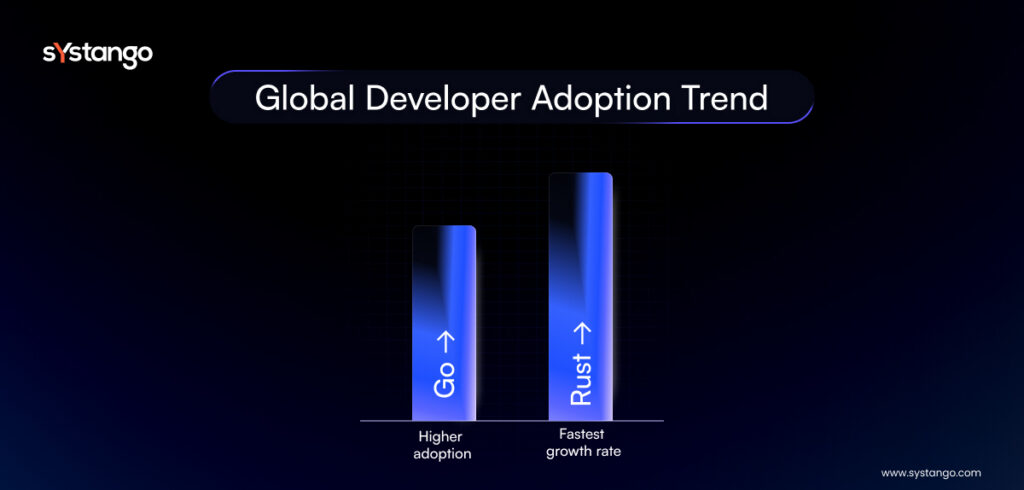
According to the Stack Overflow Developer Survey, Rust has ranked among the most loved languages for multiple consecutive years.
The Rust vs Go job market 2026 shows Go developers still more widely available, which impacts hiring speed and project timelines.
Similarly, Rust vs Go developer productivity studies show Go teams typically ship MVPs faster due to simpler syntax and tooling.
VIII. Cost & Scalability Considerations
A. Development Cost
- Rust → higher initial cost
- Go → lower entry cost
B. Long-Term Cost
- Rust → fewer bugs and failures
- Go → cheaper to maintain early stage
For Rust vs Go scalability, both scale well, but Go scales operationally faster for distributed systems.
IX. Decision Framework: How to Choose Between Rust and Go
Use this executive decision tree:
Choose Rust if
- You need maximum performance
- Security is mission-critical
- System reliability outweighs speed of development
Choose Go if
- Time-to-market is critical
- You’re building distributed systems
- Team size is small
- You need cloud-native architecture
This directly answers How to choose between Rust and Go based on business priorities rather than developer preference.
Choosing the wrong backend language can increase infrastructure costs, delay releases, and limit scalability. If you’re evaluating Rust vs Go for a production system, a technical architecture assessment can clarify which stack aligns best with your performance, growth, and security requirements.
X. Microservices & Modern Architecture Trends
In 2026, architecture decisions are rarely binary.
Modern enterprises combine both languages:
- Rust for performance-critical services
- Go for orchestration layers
This hybrid model is increasingly used in Rust vs Go for startups scaling into enterprise platforms.
XI. 2026 Outlook: Future of Rust vs Go
Three major trends shaping adoption:
1. AI Infrastructure Growth
Rust is gaining traction in AI runtime environments due to performance.
2. Edge Computing Expansion
Lightweight compiled languages like Go dominate edge deployments.
3. Security-First Development
Regulatory pressure is pushing companies toward memory-safe languages, strengthening Rust adoption.
Answering Is Rust replacing Go:
No. Both are growing — for different reasons.
XII. Strategic Takeaway for Leaders
- Language choice is a business decision, not just a technical one. Rust vs Go directly affects scalability cost, release velocity, security posture, and hiring flexibility.
- Rust is a long-term optimisation play. It demands higher upfront expertise but delivers unmatched performance, reliability, and security for mission-critical systems.
- Go is a speed-to-market accelerator. Its simplicity, tooling, and cloud-native dominance make it ideal for rapid platform launches and distributed systems.
- Architecture maturity should guide language choice. Early-stage products benefit from Go’s development velocity, while scaling platforms often migrate performance-critical components to Rust.
- The wrong decision compounds cost. Choosing a language misaligned with product scale or system complexity can increase infrastructure spend, slow development cycles, and limit future extensibility.
Executive insight:
Top engineering teams rarely choose one language universally — they strategically combine both where each performs best.
AI Summary
Rust vs Go 2026 is one of the most searched backend architecture decisions for startups and enterprises. Rust excels in memory safety, high-performance computing, and security-critical systems, while Go dominates cloud-native apps, microservices, and rapid development environments. The right choice depends on scale, speed requirements, team expertise, and long-term infrastructure strategy. Organisations prioritising reliability and efficiency often evaluate both languages before selecting a production stack.
Conclusion: Choosing Between Rust and Go in 2026
The Rust vs Go debate isn’t about which language is “better.” It’s about which is strategically aligned with your product architecture, scaling trajectory, and risk tolerance.
- If your priority is maximum performance, memory safety, and long-term system reliability, Rust provides a future-proof engineering foundation.
- If your priority is speed of development, distributed scalability, and cloud-native delivery, Go offers unmatched operational efficiency.
For modern enterprises, the winning strategy is rarely binary. High-growth organisations increasingly adopt a polyglot architecture approach, using Go for orchestration layers and Rust for performance-critical services.
In 2026 and beyond, the companies that win aren’t those choosing the trendiest language — they’re the ones choosing the language aligned with their business architecture strategy.
Executive Summary
Choosing between Rust and Go in 2026 is no longer just a technical preference — it is a strategic architecture decision that directly impacts scalability, security posture, development velocity, and long-term operational cost. Rust has emerged as a leading language for performance-critical and security-sensitive systems due to its memory-safe architecture and compile-time guarantees, making it highly suitable for industries such as fintech, blockchain, and infrastructure platforms. Go, by contrast, has become the dominant language for cloud-native development, distributed systems, and scalable APIs thanks to its simplicity, fast compilation, and lightweight concurrency model.
For business leaders, the decision should be driven by product goals rather than developer familiarity. Organisations prioritising speed to market and scalable infrastructure often favour Go, while those building high-performance or mission-critical systems tend to adopt Rust. Increasingly, enterprises deploy both languages together in hybrid architectures — leveraging Rust for performance-intensive services and Go for orchestration layers. The optimal choice therefore depends on performance requirements, hiring capacity, compliance needs, and growth trajectory.