In 2026, serverless architecture has moved from experimentation to enterprise-grade cloud strategy. As organisations accelerate digital transformation, reduce infrastructure overhead, and operationalise AI-driven workloads, traditional infrastructure models increasingly limit speed and cost control.
Serverless computing offers a fundamentally different operating model — one built on event-driven execution, automatic scaling, and consumption-based pricing.
For enterprise leaders, the conversation is no longer “What is serverless?” but rather:
- Where does serverless create strategic advantage?
- How does it integrate with hybrid and multi-cloud architecture?
- What governance models ensure predictable cost and security?
This guide explains why serverless architecture is now a smart cloud strategy — and how to implement it responsibly at scale.
What’s Inside
I. What Is Serverless Architecture?
II. Key Benefits of Serverless Architecture in 2026
III. Serverless Architecture Trends Shaping Cloud Development in 2026
IV. Serverless Architecture Use Cases That Deliver Business Value
V. Enterprise Case Study: AI-Driven Legal Operations Platform
VI. Serverless vs Traditional Architecture
VII. Best Practices for Implementing Serverless Successfully
VIII. Challenges to Expect (and How to Address Them)
IX. Best Serverless Platforms in 2026
X. The Future of Serverless Architecture for Leaders (2026 & Beyond)
Key Strategic Takeaways
- Serverless architecture enables event-driven, auto-scaling cloud systems with no infrastructure management.
- Enterprises use serverless to reduce operational overhead, accelerate time-to-market, and optimise cost.
- In 2026, serverless increasingly powers AI inference, edge computing, and real-time applications.
- Governance, cost visibility, and multi-cloud portability are critical for enterprise adoption.
- When implemented strategically, serverless becomes a core pillar of modern cloud architecture.
I. What Is Serverless Architecture?
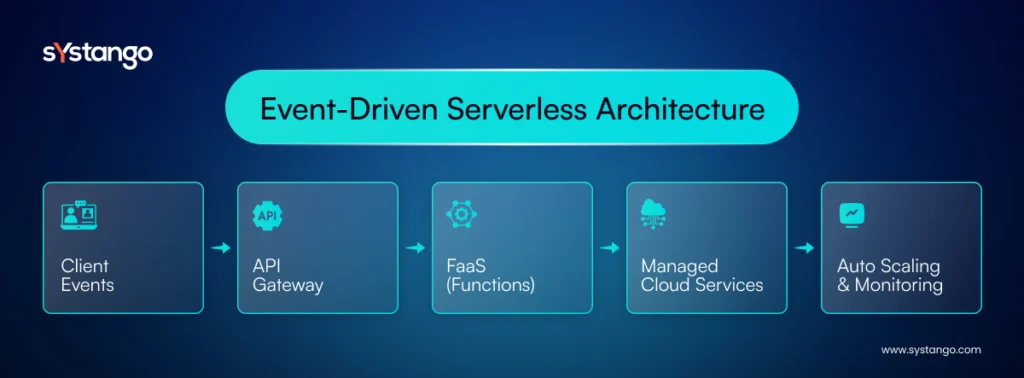
Serverless architecture is a cloud computing model where developers build and run applications without managing servers or infrastructure. While servers still exist, cloud providers abstract all provisioning, scaling, and maintenance.
At its core, serverless relies on:
1. Function as a Service (FaaS)
Event-driven, stateless functions that execute code in response to triggers.
Examples: AWS Lambda, Azure Functions, Google Cloud Functions
2. Backend as a Service (BaaS)
Managed cloud services for authentication, databases, storage, messaging, and APIs.
Examples: Firebase, Auth0, DynamoDB, Cloud Firestore
In practice, modern event-driven serverless architecture combines FaaS with managed cloud services to build scalable, resilient systems.
II. Key Benefits of Serverless Architecture in 2026
Research from McKinsey indicates that organisations adopting cloud-native engineering practices can significantly improve development productivity and accelerate time-to-market, while structured governance can unlock 20–30% or more in cloud cost optimisation.
As cloud platforms mature, serverless computing benefits extend far beyond cost savings.
1. Automatic Scaling by Design
Serverless applications scale instantly based on demand—no capacity planning or manual intervention required.
2. Serverless Cost Optimisation
According to the Cloud Native Computing Foundation (CNCF) Annual Survey, organisations adopting cloud-native architectures — including serverless — report measurable improvements in resource efficiency and operational cost control compared to traditional infrastructure models.
You pay only for execution time and requests. This answers a common query:
how serverless architecture reduces infrastructure costs by eliminating idle resources.
3. Faster Time-to-Market
Smaller, independent functions enable rapid releases and shorter development cycles.
4. Reduced Operational Overhead
No server patching, OS upgrades, or runtime management.
5. Built-In Resilience and Security
Cloud providers isolate functions, patch infrastructure, and offer native monitoring and observability.
III. Serverless Architecture Trends Shaping Cloud Development in 2026
1. AI and Serverless Convergence
The future of serverless computing and AI integration is already here. Serverless platforms now power:
- Real-time AI inference
- Event-driven ML pipelines
- Auto-scaling AI workloads
Cloud providers increasingly optimise AI workloads using serverless for cost and performance efficiency.
2. Serverless Edge Computing Trends 2026
Serverless is moving closer to users via edge platforms:
- AWS Lambda@Edge
- Cloudflare Workers
- Azure Edge Functions
This reduces latency and supports real-time global applications.
3. Stateful Serverless Capabilities
Traditionally stateless, serverless now supports state via:
- Durable Functions
- Step Functions
- Managed state stores
This expands serverless into long-running and complex workflows.
4. Serverless DevOps and CI/CD
Modern pipelines integrate:
- Event-based deployments
- Infrastructure as Code (IaC)
- Automated testing and rollback
Serverless DevOps and CI/CD enable faster, safer releases with minimal overhead.
IV. Serverless Architecture Use Cases That Deliver Business Value
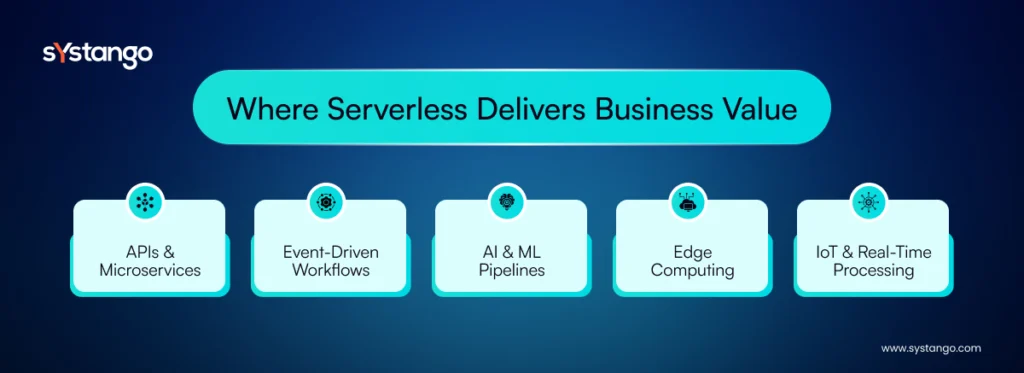
Across the USA and UK, serverless architecture use cases span industries and scales.
Common Use Cases
- APIs and microservices
- Event-driven workflows
- Real-time data processing
- IoT and mobile backends
- Background jobs and schedulers
- Chatbots and AI assistants
Startups vs Enterprises
- Serverless computing for startups enables rapid experimentation and low upfront cost.
- Enterprises use serverless to modernise legacy systems, reduce operational burden, and scale globally.
V. Enterprise Case Study: AI-Driven Legal Operations Platform
A digital legal operations platform partnered with Systango to modernise its backend using serverless and AI-enabled cloud services.
Measured Outcomes:
- 80% faster document turnaround through intelligent processing
- 20% reduction in workforce load via AI-powered client support
- Significant increase in workflow efficiency
- Firm-wide visibility through real-time dashboards
By combining serverless event processing, AI-driven automation, and secure cloud architecture, the platform improved scalability while maintaining compliance and operational control.
VI. Serverless vs Traditional Architecture
| Aspect | Serverless Architecture | Traditional Architecture |
| Infrastructure | Fully managed | Self-managed |
| Scaling | Automatic | Manual / configured |
| Cost Model | Pay-per-use | Fixed / provisioned |
| Deployment | Function-level | Application-level |
| Time-to-Market | Faster | Slower |
This comparison explains why many organisations now prefer serverless vs traditional architecture for modern cloud workloads.
VII. Best Practices for Implementing Serverless Successfully
- Design for events, not servers
- Optimise cold start performance
- Apply serverless architecture security best practices (least privilege, secrets management, monitoring)
- Use observability and tracing
- Avoid vendor lock-in with portable design
- Integrate security into CI/CD pipelines
In enterprise environments, serverless rarely operates in isolation. Many organisations deploy serverless functions across hybrid and multi-cloud architectures to optimise workload placement, reduce vendor dependency, and meet regional compliance requirements. Designing portable, event-driven systems ensures long-term architectural flexibility.
VIII. Challenges to Expect (and How to Address Them)
- Cold starts: Mitigate with warm-up strategies and edge functions
- Vendor lock-in: Abstract logic and use open standards
- Debugging complexity: Invest in logging and tracing
- Cost unpredictability: Monitor execution and apply serverless cost optimisation
IX. Best Serverless Platforms in 2026
Leading cloud providers continue to invest heavily:
- AWS: Lambda, Step Functions, EventBridge
- Microsoft Azure: Azure Functions, Durable Functions
- Google Cloud: Cloud Functions, Cloud Run
- Alibaba Cloud: Function Compute, Serverless App Engine
These remain the best serverless platforms in 2026 for production workloads.
X. The Future of Serverless Architecture for Leaders (2026 & Beyond)
Looking ahead, serverless will increasingly:
- Power AI-driven and self-optimising systems
- Integrate deeply with edge computing
- Support complex, stateful business workflows
- Become the default backend model for cloud-native applications
Serverless is no longer experimental—it’s foundational to digital transformation.
Strategic Summary
Serverless architecture in 2026 represents more than an infrastructure choice — it reflects cloud maturity.
Organisations that successfully implement serverless typically demonstrate:
- Strong DevOps integration
- Cost governance visibility
- Security-by-design principles
- Event-driven system thinking
- Alignment with hybrid and multi-cloud strategies
For enterprise leaders, serverless adoption signals a shift from infrastructure management to innovation velocity.
Conclusion
Serverless architecture has evolved into a strategic accelerator for modern enterprises. By eliminating infrastructure management, enabling event-driven scalability, and aligning cost directly with usage, serverless transforms cloud from an operational burden into a competitive advantage.
However, enterprise success depends on disciplined implementation — governance, observability, security, and architectural portability must be embedded from day one.
At Systango, we help organisations design secure, scalable, and multi-cloud-ready serverless architectures that deliver measurable business outcomes — not just technical modernisation.
Executive Summary
In 2026, serverless architecture is a strategic cloud operating model — not just a development trend. By removing infrastructure management and enabling event-driven, auto-scaling systems, serverless aligns cost with usage while accelerating innovation.
Enterprises use serverless to power AI workloads, real-time applications, and modern cloud-native platforms with greater efficiency and resilience. However, sustainable success requires strong governance, observability, security, and architectural portability across hybrid or multi-cloud environments.
For business leaders, serverless represents a scalable, cost-efficient foundation for future-ready digital growth.