Data volume is no longer the challenge.
Decision latency is.
Organisations now operate across CRM systems, eCommerce platforms, finance tools, marketing automation, and cloud databases. Yet without unified analytics, insights remain delayed and fragmented.
According to Gartner, data and analytics maturity is now directly tied to business competitiveness, with organisations prioritising AI-augmented analytics to accelerate decisions.
Zoho Analytics 2026 positions itself as a unified, AI-powered intelligence layer that reduces reporting lag and improves strategic clarity.
What’s Inside
IV. Key Zoho Analytics Features (2026)
V. Business Impact: Quantified Case Proof
VI. Zoho Analytics vs Power BI 2026
VII. Using Zoho Analytics for Strategic Growth
IX. Future Outlook: BI in 2026+
Key Takeaways
This guide explains how Zoho Analytics 2026 enables organisations to transform multi-source data into AI-powered, actionable insights.
It covers:
- Core Zoho Analytics Features
- Ask Zia and GPT integrations
- Predictive analytics and automation
- Zoho Analytics vs Power BI 2026 comparison
- Real-world implementation outcomes
- Strategic rollout framework
Designed for founders, CTOs, and business leaders, this guide shows how to leverage AI-driven BI for measurable ROI.
I. The Enterprise Challenge
Most businesses face three structural BI limitations:
- Disconnected data silos
- Manual reporting cycles
- Delayed strategic decision-making
McKinsey research indicates that organisations effectively leveraging advanced analytics can significantly improve operational efficiency and decision quality.
Without modern AI analytics tools, businesses risk reactive strategy instead of predictive execution.
II. Strategic Insight
Business intelligence in 2026 is no longer about dashboards.
It is about operational intelligence infrastructure.
Platforms must:
- Integrate seamlessly
- Enable non-technical users
- Provide AI-driven forecasting
- Support real-time collaboration
- Scale across enterprise use cases
This is where Zoho Analytics Benefits become strategically relevant.
III. What is Zoho Analytics?
Zoho Analytics is a cloud-native, self-service business intelligence platform that enables organisations to:
- Connect multiple data sources
- Cleanse and prepare data automatically
- Create AI-powered dashboards
- Run predictive models
- Enable conversational data queries
It is designed for startups, SMEs, and enterprise teams seeking scalable BI without IT dependency.
IV. Key Zoho Analytics Features (2026)
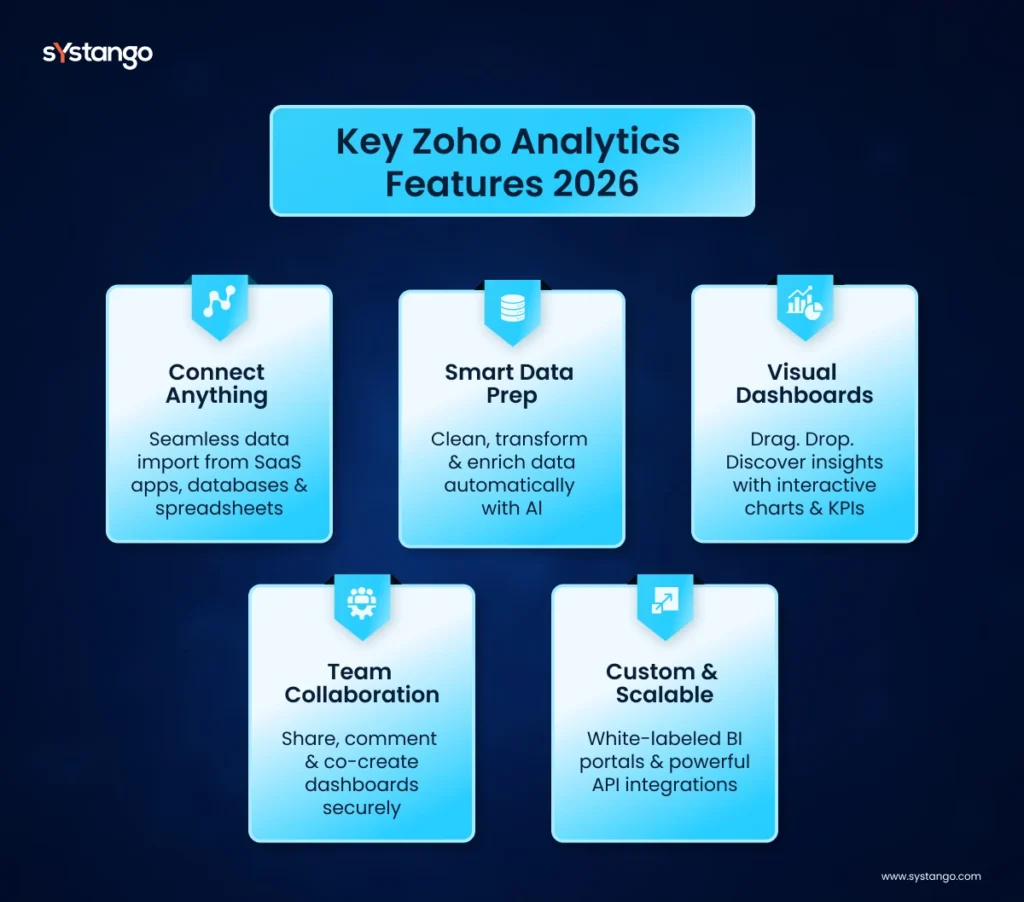
1. Unified Data Integration
Connect CRM, ERP, finance, marketing, and SaaS platforms using APIs and pre-built connectors.
2. AI-Driven Data Preparation
DataPrep automates cleansing and transformation workflows, reducing manual errors.
3. Intelligent Dashboards
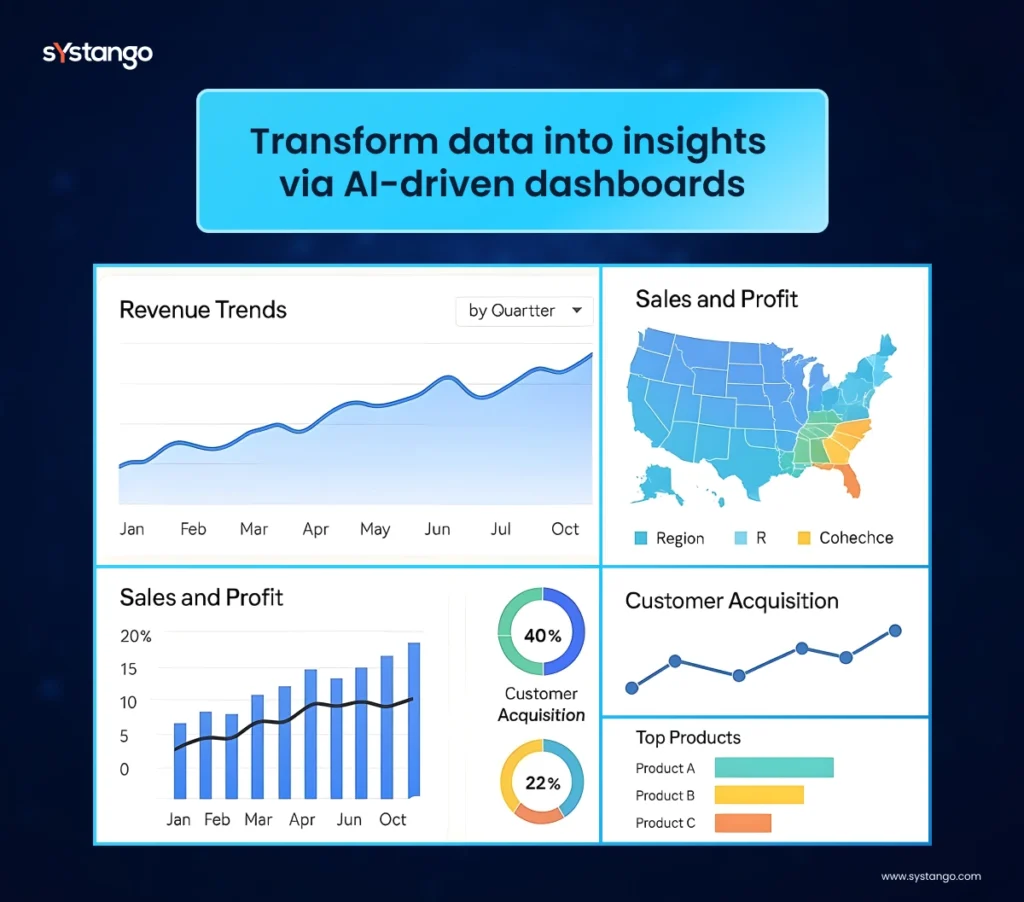
Drag-and-drop dashboards with KPIs, geo-maps, drill-downs, and predictive widgets support strategic clarity.
4. Team Collabs, Ask Zia & GPT Plugin
Enhanced team collaborations and also using the Zoho Analytics GPT plugin, users can:
- Query data conversationally
- Generate executive summaries
- Automate reporting
Example prompts:
“Predict next quarter revenue.”
“Summarise underperforming SKUs.”
5. Embedded BI & API Extensibility
Custom analytics portals and API integration support enterprise deployment and white-labelling.
V. Business Impact: Quantified Case Proof
A unified commerce platform partnered with Systango to implement Zoho Analytics-driven BI transformation.
Outcomes included:
- 20% reduction in operational costs via automation and coordination
- 15% faster order fulfilment through optimised inventory workflows
- 10% improvement in inventory accuracy, reducing stock mismatches
- 54% faster, data-driven decisions enabled by intelligent dashboards
These metrics illustrate how Zoho Analytics for business growth moves beyond reporting into operational optimisation.
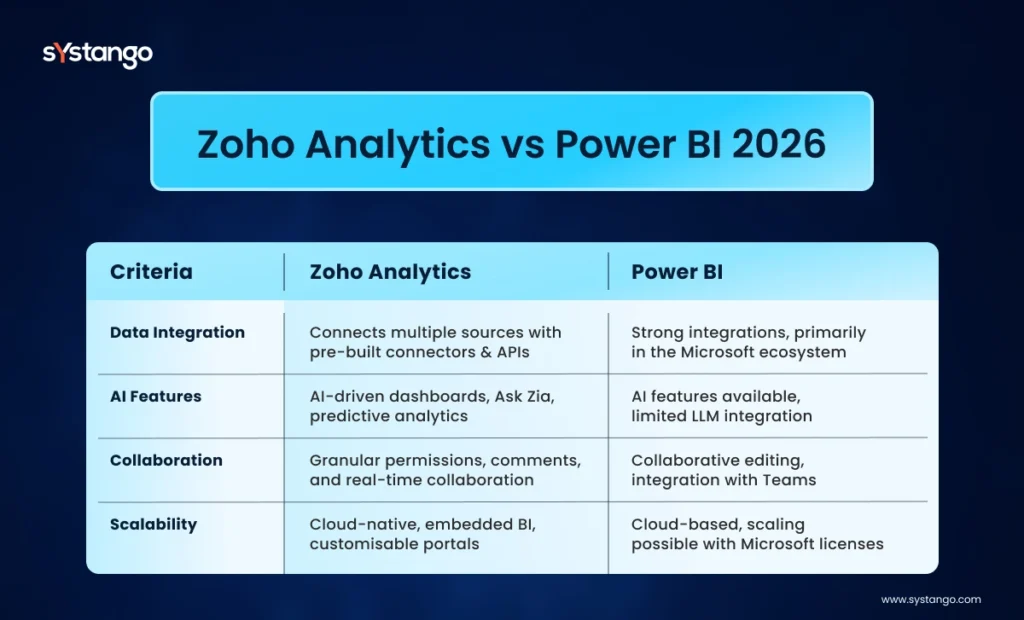
VI. Zoho Analytics vs Power BI 2026
When evaluating Zoho Analytics vs Power BI 2026, consider ecosystem flexibility and AI maturity.
Zoho differentiates through:
- Native AI assistant (Ask Zia)
- LLM integration readiness
- Multi-platform compatibility beyond Microsoft ecosystem
- Embedded BI flexibility
For organisations operating across mixed tech stacks, Zoho provides greater adaptability.
VII. Using Zoho Analytics for Strategic Growth
To maximise ROI:
Phase 1: Data Consolidation
Integrate CRM, finance, operations, and marketing data into unified analytics.
Phase 2: Automation & AI Layer
Deploy predictive analytics and automated reporting via Ask Zia.
Phase 3: Decision Enablement
Empower business units with self-service dashboards.
Phase 4: Continuous Optimisation
Refine forecasting models and KPIs based on real-time insights.
This roadmap transforms analytics from reporting tool to strategic growth engine.
VIII. Risk of Inaction
Without AI-powered BI:
- Decision cycles slow
- Manual reporting persists
- Data silos remain unresolved
- Forecasting remains reactive
In 2026, delayed insights equate to lost revenue opportunity.
IX. Future Outlook: BI in 2026+
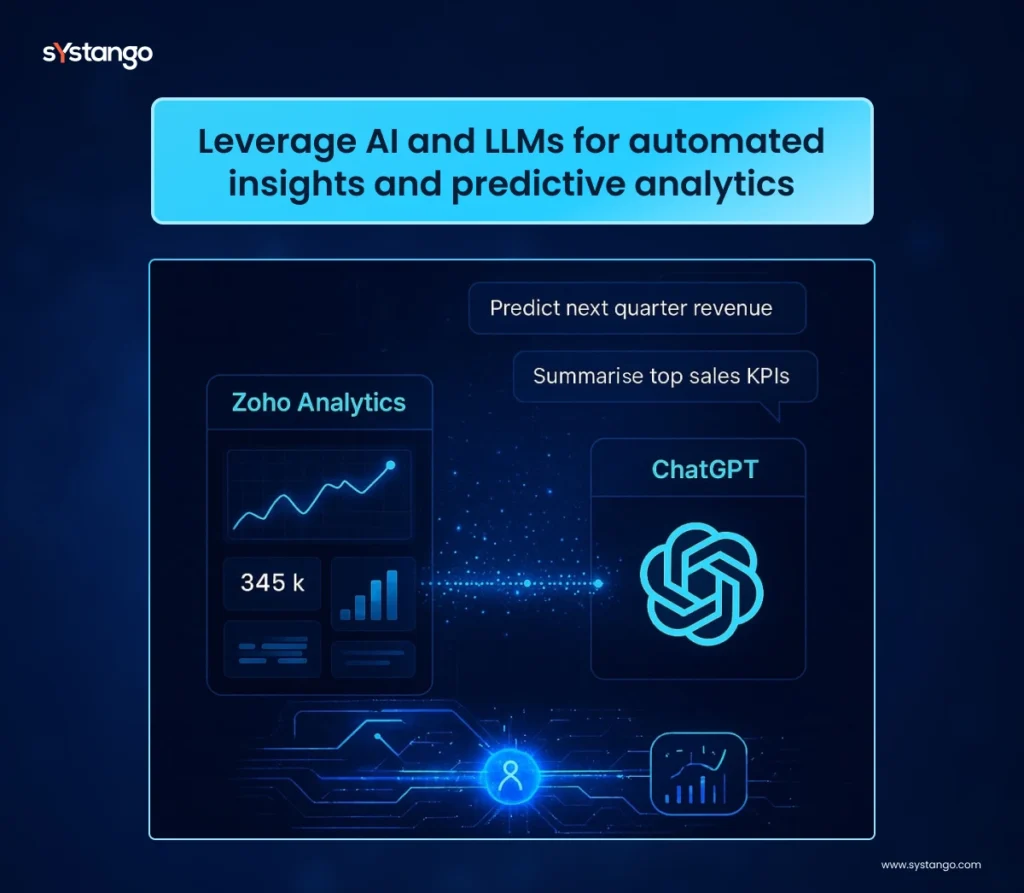
Businesses can now integrate Zoho with ChatGPT, marking a significant step towards augmented analytics and AI-driven business intelligence becoming central to enterprise competitiveness in the future.
Business intelligence will continue evolving toward:
- Conversational analytics
- Predictive-first dashboards
- Cross-platform integrations
- Embedded AI assistants
Zoho Analytics 2026 aligns with this future-ready direction.
X. Strategic Takeaways
- Zoho Analytics centralises multi-source data efficiently.
- AI-powered features accelerate decision velocity.
- GPT integrations enable conversational analytics.
- Embedded BI supports enterprise scalability.
- Structured implementation unlocks measurable ROI.
Strategic Summary
In 2026, the competitive edge lies in decision velocity. Zoho Analytics 2026 combines self-service BI, AI-powered dashboards, predictive analytics, and LLM integrations to convert fragmented data into operational intelligence. Businesses leveraging Zoho Analytics report measurable cost optimisation, faster fulfilment cycles, and improved inventory accuracy.
With Systango’s certified implementation expertise, organisations move from reporting dashboards to scalable, AI-enabled business intelligence infrastructure.
Conclusion
Zoho Analytics 2026 is not just a BI tool.
It is a strategic intelligence infrastructure.
With AI-powered insights, predictive modelling, and scalable architecture, it enables organisations to move from fragmented reporting to real-time decision advantage.
Through Systango’s certified implementation expertise, businesses unlock measurable outcomes – transforming analytics into sustainable growth and profitability.
Executive Summary
In 2026, competitive advantage depends on real-time decision intelligence. Zoho Analytics 2026 combines self-service BI, AI-driven dashboards, predictive analytics, and GPT integration to transform fragmented data into actionable insights. Organisations leveraging Zoho Analytics achieve measurable outcomes including operational cost reduction, faster fulfilment cycles, improved inventory accuracy, and accelerated data-driven decisions. With Systango’s certified implementation expertise, businesses move from static reporting to AI-powered operational intelligence. Zoho Analytics is positioned as a scalable, future-ready BI platform for startups and enterprises seeking sustained growth.