
that we call our AI Workbench,
embeds AI directly into how teams
plan, build, test, and ship software with the
governance, structure, and measurement needed to
turn experimentation into real delivery advantage.
AI Has Increased Activity.
Not Outcomes
AI without governance is noise. AI with structure is a competitive advantage. Most organisations are stuck in experimentation,
not because the tools are wrong, but because the delivery model hasn't changed.
What most teams look like:
01
Different teams, different
prompts, inconsistent results
02
Fragmented data,
poor decisions
03
Zero visibility into AI
in SDLC
04
No control or
governance
35-50%
AI-generated code is reworked
<20%
AI initiatives reach production
Slow
Velocity gains after initial adoption
ROI?
AI investments not delivering returns
This Is Not About Tools. It's About
How You Deliver
Systango's AI Workbench embeds AI directly into how your teams plan, build, test, and ship, with the governance, structure, and measurement to turn experimentation into real delivery advantage.
1
AI-Native SDLC
We transform how software is built, embedding AI across every stage from planning to deployment, not as an add-on but as the operating model.
2
Decision Intelligence
We transform how data is used, real-time delivery analytics, risk signals, and predictive insights that keep teams aligned and moving fast.
3
Governance Layer
We transform how AI is controlled, shared standards, compliance guardrails, and auditability built in, not bolted on.
4
Measurement Throughout
Strategic decisioning → context grounding → workflow redesign. We measure at every step. The tools come last.
What Makes This Different
Most organisations overestimate how far their AI adoption has actually progressed. In reality, teams use AI individually, standards are absent, results vary, and ROI is hard to demonstrate. AI is happening, but it isn't compounding.
The problem isn't effort. It's the approach. Most initiatives focus on introducing tools. We focus on embedding AI into how work actually gets done.
Built for enterprise platforms, PE-backed companies, and scaling product teams, whether you're modernising legacy systems, improving engineering velocity, or need to show measurable ROI from your technology investment.
Typical
AI Adoption
Systango
Approach
Tool-first
Workflow-first
Individual
usage
Standardised
across teams
No
measurement
Measurable outcomes
No governance
Built-in compliance
Experiments
Embedded delivery model

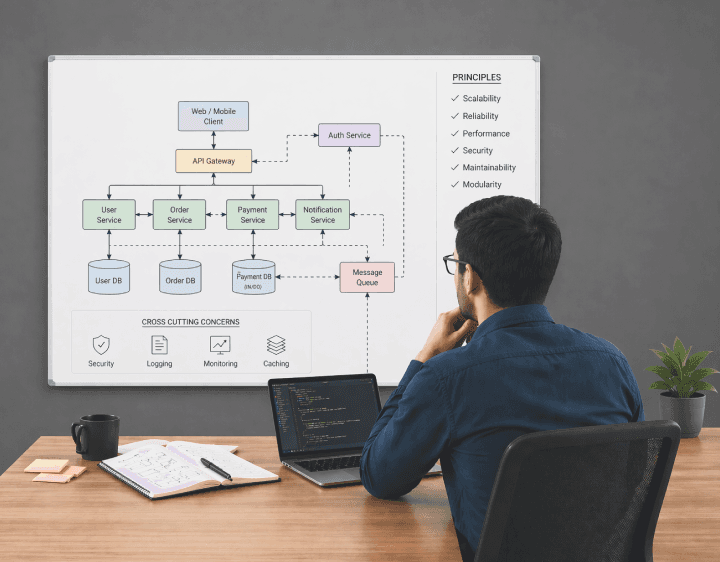

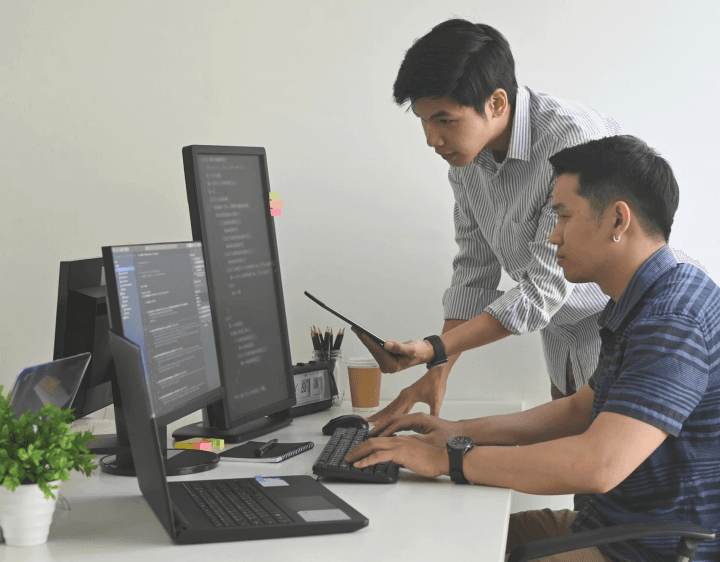

How AI Gets Embedded Across The SDLC
Most AI strategies break down in execution. Systango's AI Workbench embeds AI directly into how teams plan, build, test,
and ship, with the governance, structure, and measurement to turn experimentation into real delivery advantage.
Plan & Analyse
AI-assisted requirements structuring
Automated user story generation
Risk and feasibility analysis
Outcome: Clearer scope, faster alignment, up to 40–60% reduction in manual effort.

Design & Architect
Architecture recommendations
Codebase analysis for modernisation
Database and system validation
Outcome: Stronger foundations,
less downstream rework.
Build & Modernise
Code generation and refactoring
Legacy system modernisation support
Automated documentation
Outcome: Faster builds, cleaner code,
up to 50% improvement in engineering productivity.
Test & Deploy
Automated test case generation
Regression optimisation
DevOps pipeline acceleration
Outcome: Higher quality releases,
20–30% faster backlog-to-release cycles.
Measure & Optimise
Real-time delivery analytics
Predictive risk indicators
Continuous optimisation loops
Outcome: Compounding efficiency gains
across projects.