Key Takeaways
I. The Invisible Data Leak Sitting Inside Your Organisation Right Now
II. Why Traditional Security Controls Do Not Solve This Problem
III. The AIM Framework: Audit, Intercept, Mitigate — Before the Breach
IV. What BFSI Leaders Need to Ask Their Teams Today
V. Governance Is Not the Enemy of AI Adoption. It Is the Condition for It.
Your analysts are using AI. Your developers are using AI. Your compliance team is using AI. And in most financial services firms, not a single one of those interactions is governed, audited, or controlled.
That is not a technology problem. It is a governance gap and in an industry built on trust, regulation, and fiduciary responsibility, it is fast becoming the most underrated risk on your board’s agenda.

I. The Invisible Data Leak Sitting Inside Your Organisation Right Now
Every day, employees across financial services firms open a browser tab, navigate to ChatGPT, Gemini, or Microsoft Copilot, and get to work. They draft client emails, summarise earnings reports, debug proprietary trading algorithms, and alarmingly paste in account numbers, customer identifiers, and model assumptions without a second thought.
There is no malicious intent. There is simply no guardrail.

The question is no longer whether your teams are using AI tools. They are. The question is whether you have any visibility, control, or accountability over how.
II. Why Traditional Security Controls Do Not Solve This Problem
Most financial institutions have invested heavily in perimeter security firewalls, DLP tools, endpoint protection. These are designed for a world where sensitive data leaves through email attachments, USB drives, or external file transfers.
AI tools operate differently. A prompt sent to ChatGPT is not an email attachment. It does not trigger traditional DLP rules. It is a conversational text input unstructured, unlabelled, and sent through a legitimate browser session on a corporate device.
By the time a CISO discovers that a portfolio manager shared a client’s investment thesis with an external LLM, the data has already been processed. There is no rollback. And in many jurisdictions, there is a regulatory obligation to disclose.
This is precisely why 94% of CISOs now rank AI governance as their top emerging risk ahead of ransomware, insider threats, and third-party supply chain attacks.
III. The AIM Framework: Audit, Intercept, Mitigate Before the Breach
The governance conversation in financial services is shifting from reactive to pre-emptive. The architecture that delivers this is what we call the AIM framework: Audit, Intercept, Mitigate, a runtime control layer that sits between your people and every LLM they interact with.
Here is what each pillar means in practice:
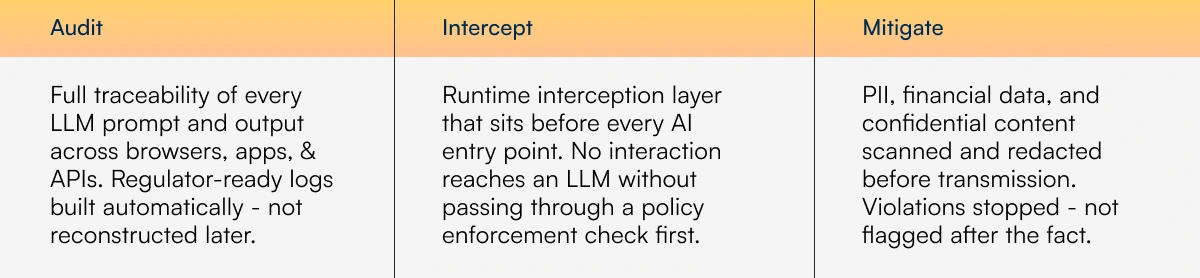
Systango’s Inhibitor governance layer operationalises this framework as a browser-native deployment — a lightweight Chrome Extension that requires no infrastructure overhaul, no API rerouting, and no months-long implementation programme.
In pilot deployments across 18+ environments, Inhibitor detected sensitive data exposure in 63% of cases and prevented 92% of PII or confidential data from reaching external LLMs. It now logs over 50,000 LLM interactions weekly and has reduced AI-related operational costs by 37% through intelligent token spend controls.
IV. What BFSI Leaders Need to Ask Their Teams Today
Governance conversations in fintech and wealthtech boardrooms often stall at the wrong question. The question is not: ‘Should we allow AI?’ That ship has sailed. The right question is: ‘Can we prove control?’
Under GDPR, DORA, and FCA Consumer Duty, the ability to demonstrate data governance is not optional it is a compliance obligation. If a client asks how their data was handled in your AI workflows, you need an answer. If a regulator asks the same question, you need evidence.
The firms that will navigate the next regulatory cycle successfully are those building their AI governance layer now before the audit, not in response to it.
Three questions every BFSI leader should put to their team this quarter:
• Do we have an audit trail for every AI interaction across the organisation?
• Are we able to demonstrate to the FCA or a client that sensitive data was not transmitted to external LLMs?
• Do we have policy enforcement in place at the point of use not a policy document in a drawer?
If the answer to any of these is ‘no’ or ‘we’re not sure’, the governance gap is already costing you in risk exposure, in future remediation cost, and in competitive trust.
V. Governance Is Not the Enemy of AI Adoption. It Is the Condition for It.
The financial services sector is not behind on AI adoption. It is behind on AI accountability. The organisations that close that gap first will not just be compliant, they will be the ones that enterprise clients, institutional partners, and regulators choose to trust.
Prevention is not just better than a cure. In financial services, it is the only acceptable standard.

About Systango | AI Governance Layer
Systango is an AI-native engineering partner to fintech, wealthtech, and insurtech firms. Our Inhibitor governance layer, delivered as a runtime AI control plane, intercepts, audits, and enforces your AI usage policies in real time. Deployed across 18+ environments, trusted by engineering and compliance teams to prevent the breaches that never make the news