At a Glance
- The problem: AI helps developers write code faster, yet finished features reach customers barely sooner.
- Why it happens: Coding is only 25% to 35% of the journey from idea to launch. Review, security checks, and approvals haven’t sped up.
- Business impact: Code waiting in review or release is AI spend with no return yet.
- The fix: An AI harness, also called an agent harness: guardrails, automated checks and human oversight around both the AI and the delivery process.
- Where this comes from: The patterns below are ones we see when we build AI-native delivery for platform teams, including in regulated environments.
The gap between code and delivery
Many companies have bought AI coding tools, and developers report real progress. Customers, however, see new features and fixes arrive only slightly sooner.
Consider a developer who builds a feature in a day with an AI assistant. It then waits in a review queue, a security scan and a release approval. Coding was quick; delivery was not. That mismatch is the AI productivity paradox.
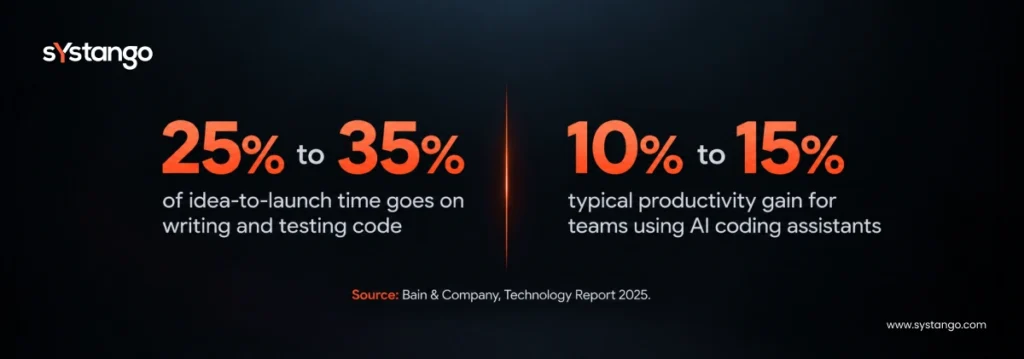
Bain’s 2025 Technology Report explains why. Writing and testing code takes only 25% to 35% of the time from idea to launch, so teams using AI assistants typically gain just 10% to 15%. Review, integration and release must speed up alongside coding, or they become the bottleneck.
For a Head of Department, the cost is clear: licence fees are already spent, and finished work that waits earns nothing. It also worsens over time. More AI output means more changes arriving while reviewers keep the same hours, so backlogs build. Google’s 2025 DORA report found AI adoption linked to higher throughput but lower delivery stability.
What is an AI harness?
An AI harness is the set of guardrails, automated checks, and human oversight around the AI and the delivery process. It lets teams move quickly without giving up quality, security or accountability. It works at two levels:
- Around the AI: it governs what the AI knows and may do, through shared instructions, approved tools and permissions.
- Around delivery: it governs what each change must pass before going live: tests, security scans, risk-based reviews and human sign-off.
It builds on CI/CD (the automated route code takes to customers) and DevSecOps (security built into every step), and extends both to AI-written work.
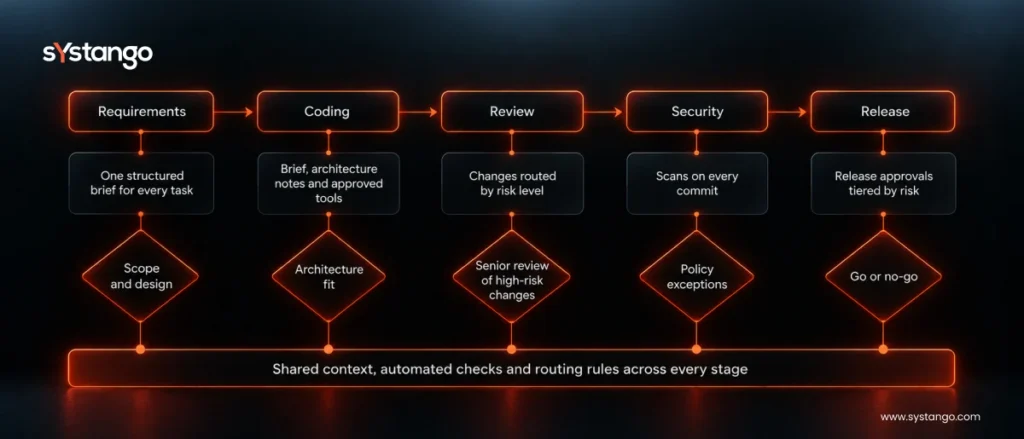
| Stage | AI speeds up | Still slows things | Harness response |
| Requirements | Drafting tasks | Fuzzy definition of “done” | One structured brief for every task |
| Coding | Generating code | Vague instructions | Brief, architecture notes and approved tools |
| Review | Summarising changes | Long waits | Changes routed by risk level |
| Security | Suggesting fixes | Late discovery | Scans on every commit |
| Release | Writing notes | Manual approvals | Release approvals tiered by risk |
Example: a change to a payments service
Without a harness, the AI writes code from a vague task, the change sits in a long review queue, and a last-minute scan sends it back to square one.
With one:
- One brief travels with the work, so everyone shares the same meaning of “done”.
- Scans run on every commit, so risky dependencies and exposed passwords are caught in minutes, not at release.
- Review effort matches the risk. A help-page edit needs only the automated checks. A payments change goes to a senior engineer with the check results attached.
At Systango, we build this into our AI Delivery Pipeline, with senior engineers approving higher-risk changes.
Why an AI harness is hard to get right
- Context goes stale. When the brief drifts from the real system, the AI confidently builds the wrong thing.
- Checks miss things. Code can pass every test and still be wrong for the business, so risky changes still need a senior engineer.
- Rules need balance. Too loose, and problems slip through. Too strict, and developers work around them. Start new checks in warning mode, and tighten them once the false alarms drop and the team trusts the results.
- Someone must own it. Without a named owner, rules decay and trust fades.
What it takes to start
You don’t need a new platform. Most teams start from the CI/CD pipeline and code-hosting tools they already have.
- People: one senior engineer to own the risk rules, plus time from the team running the pilot service.
- Scope: one service and one check at first, not the whole estate.
- Cost: mostly engineering time. Many scanning and policy tools have free or bundled tiers, so the higher cost is tuning rules until the noise is low enough that people trust them.
How to measure AI’s impact on delivery
Judge any fix by how long a change takes to reach customers, not by how much code is written. Track the five DORA delivery metrics for each application:
- Change lead time
- Deployment frequency
- Failed deployment recovery time
- Change failure rate
- Deployment rework rate
Add pull request review time as an early warning, because that’s where extra AI output piles up first. If code output climbs while these metrics stay flat, your gains are stuck before production.
Signs your team needs an AI harness
You likely need one if:
- AI-assisted changes arrive faster than reviewers can read them.
- Security scans or approvals happen only at the end and send work back.
- Your industry requires a record and a named approver for every change.
Where to start
- Pick one service.
- Map where work waits the longest between commit and release.
- Add one automated check at that point.
- Track change lead time for a month.
- Extend the same brief and check to the next stage.
Step two is usually the hardest to do from the inside, because the longest waits often sit between teams rather than inside one. In a Discovery Session, our engineers map that path with you on one of your services, and you leave with the first check to add and the metric to watch.
Key Takeaways
- Release speed follows the slowest stage, and coding is at most a third of the journey.
- Work that can’t ship earns nothing on the AI spend.
- A harness builds checks into the workflow, so verification keeps up with AI output.
- Start with one service and one check at the slowest handoff, then extend.
- Measure delivery with DORA metrics such as change lead time, not code volume.
- Treat the harness as an owned practice: its rules need tuning, not a one-time install.