Key Takeaways
I. A New Philosophy of Software Delivery
II. UI/UX Design From Static Artefacts to Living Systems
III. Development Agentic Coding and the 3x Velocity Shift
IV. Quality Assurance Shifting Left and Moving Faster
V. DevOps & Deployment Intelligence Embedded in the Pipeline
VI. Project Management From Reactive to Predictive
VII. The Business Benefit That Reaches Every Client
Something fundamental has changed in how the best software teams in the world operate. It is not a single tool, a single methodology, or a single moment of disruption. It is a pervasive, systematic integration of artificial intelligence across every stage of software delivery - from the first discovery conversation to the final deployment pipeline.
At Systango, we have spent the past two years rebuilding our entire development capability around this reality. The result is an AI-accelerated SDLC that does not just use AI as a feature - it uses AI as the engine. And the difference in outcomes for our clients is not marginal. It is transformational.

I. A New Philosophy of Software Delivery
Discovery & Business Analysis - From Weeks to Days
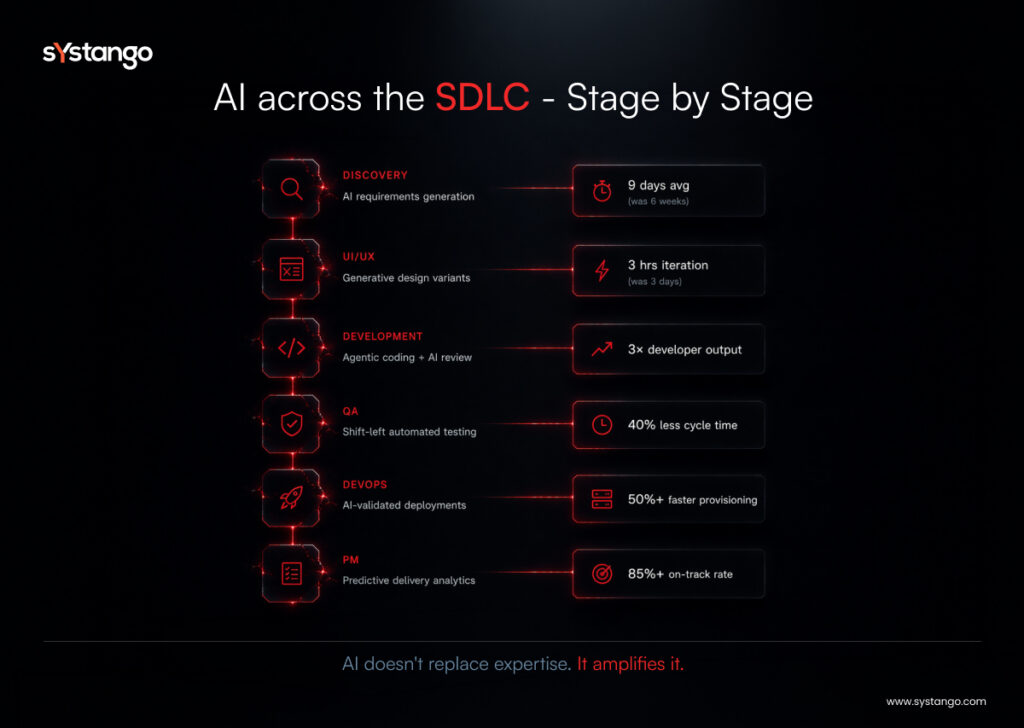
AI has transformed our discovery, and the BA function more dramatically than any other phase. Where a traditional discovery process might consume four to six weeks of workshops, document drafting, and revision cycles, our AI-assisted approach compresses this timeline to eight to twelve days without sacrificing depth.

Our BA team uses AI to accelerate requirements generation from stakeholder input, automatically identify gaps and ambiguities in requirements documents, generate user stories and acceptance criteria from high-level business briefs, and reverse-engineer legacy codebases into structured business logic documentation. The result is that our analysts spend their time on analysis - not on formatting documents, managing version histories, or chasing approvals.
- AI tools analyse stakeholder interview transcripts and extract structured requirements automatically
- Requirement conflicts and ambiguities are flagged before they reach development
- Legacy system reverse-engineering that previously took weeks now takes hours
- Use case prioritisation matrices are generated with business impact scoring
II. UI/UX Design - From Static Artefacts to Living Systems
AI has broken down the wall between design and development. Our design team uses AI to generate initial wireframe concepts from requirements briefs, produce multiple design variants for stakeholder review simultaneously, validate designs against accessibility standards automatically, and generate responsive component specifications that developers can implement without back-and-forth clarification.
Tools like Figma AI and generative design assistants mean that iteration cycles that previously took three days now take three hours. More importantly, the quality and consistency of design output has improved - because AI enforces design system compliance at every step, catching inconsistencies that human reviewers regularly miss under time pressure.
III. Development - Agentic Coding and the 3x Velocity Shift
The development phase is where AI’s impact on our output is most visible and most measurable. Our engineering teams operate with AI coding assistants embedded at every level of the development workflow - from initial architecture decisions through to unit test generation and code review.
Using tools including Cursor, agentic coding frameworks, and CodeRabbit for AI-powered review, our developers are consistently delivering three times the output of equivalent-sized teams operating without AI augmentation. This is not a projection or an aspiration. It is our measured, tracked delivery reality.
- Boilerplate code generation eliminates hours of repetitive scaffolding work per feature
- AI code review catches security vulnerabilities, logic errors, and style violations automatically
- Unit test generation from function signatures reduces QA handoff time significantly
- Agentic coding handles routine implementation tasks, freeing senior engineers for architecture and complex problem-solving
- Vibe coding for front-end accelerates UI implementation from design specifications
IV. Quality Assurance - Shifting Left and Moving Faster
Our QA function has been redesigned around a shift-left principle powered by AI. Rather than testing accumulating at the end of the pipeline, AI enables us to embed quality checking at every stage of development. Test cases are generated automatically from user stories and acceptance criteria. Test data sets are synthesised to cover edge cases that manual testers routinely miss. Regression testing is automated and continuous.
The practical outcome is a 40% reduction in QA cycle time and a significant increase in defect detection rates before code reaches production. Our clients experience fewer production incidents, faster release cycles, and higher confidence in every deployment.
V. DevOps & Deployment - Intelligence Embedded in the Pipeline
Our DevOps capability uses AI to automate environment configuration and provisioning, monitor deployments for anomalies in real time, predict infrastructure scaling requirements before demand spikes occur, and perform root cause analysis on incidents with dramatically reduced mean time to resolution.
Platform provisioning that previously required specialist intervention and hours of configuration now runs in minutes. Deployment confidence has increased because AI validates every deployment against security and compliance policies before it reaches production.
VI. Project Management - From Reactive to Predictive

AI has transformed how our project managers operate - shifting from reactive status reporting to predictive delivery management. AI analyses sprint velocity, identifies delivery risk early, flags resource conflicts before they cause delays, and generates stakeholder reports automatically from project management data.
The result is that our project managers spend less time on administrative overhead and more time on the work that actually protects delivery outcomes: removing blockers, making decisions, and managing stakeholder expectations proactively rather than reactively.
VII. The Business Benefit That Reaches Every Client
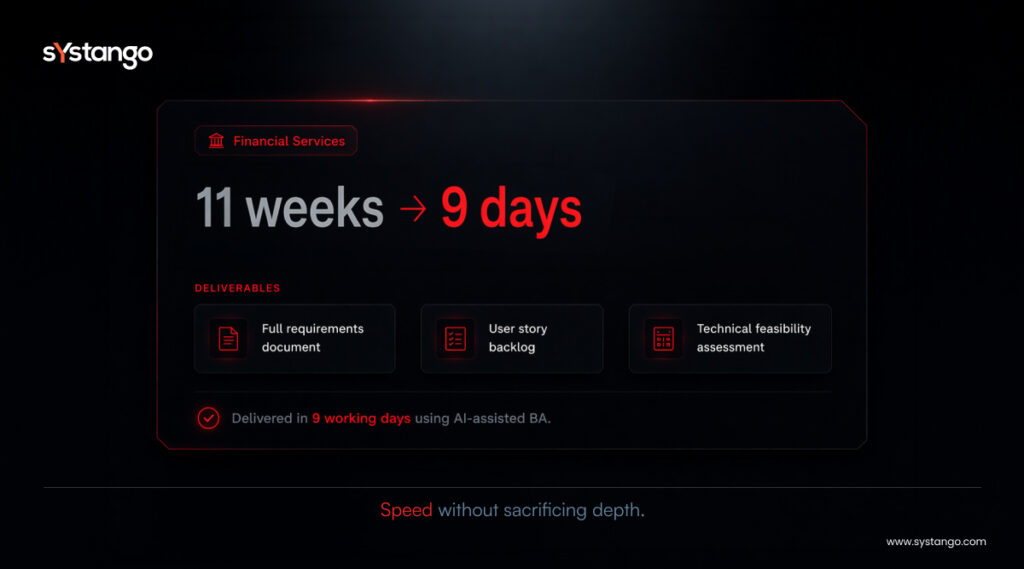
The cumulative impact of AI integration across all SDLC phases is not felt by Systango’s engineering team alone. It flows directly to clients in the form of faster time to market, lower cost per feature delivered, higher output quality, and greater predictability of delivery outcomes.
Clients who partner with Systango’s AI-accelerated delivery model are consistently bringing products to market weeks and months earlier than comparable engagements with traditional development approaches. In competitive markets, those weeks and months are not just delivery milestones - they are revenue, market share, and strategic advantage.