At a Glance
- What this covers: Why faster AI coding has not sped up delivery, and how an AI harness fixes it.
- Key finding: Coding is only 25% to 35% of idea-to-launch time, so speeding it up alone moves delivery little.
- Business impact: Code stuck in review or release queues is money spent with no return yet, and Google’s 2025 DORA report links AI to less stable delivery without strong checks.
- Where this comes from: The patterns below are ones we see when we build AI-native delivery for platform teams, including in regulated environments.
- What you will learn: Where gains leak, what a harness changes, what it takes to start and how to measure it.
The AI productivity paradox is the gap between how fast AI writes code and how fast that code reaches production. When review, security checks and release stay slow, faster coding changes little.
The fix is an AI harness: all the backend that helps an AI agent run, as Red Hat’s Ralph Bean describes it. Extended across delivery, it verifies every change at every stage.
1. Coding is a small share of delivery
Writing and testing code is only 25% to 35% of the time from idea to launch, according to Bain’s 2025 Technology Report. Teams using AI assistants see gains of 10% to 15%. Bain’s conclusion: “If AI speeds up coding, then code review, integration, and release must speed up as well to avoid bottlenecks.”
Google’s DORA report agrees. AI adoption links to higher throughput but still to lower stability, because without “robust control systems” a rise in change volume “leads to instability.”
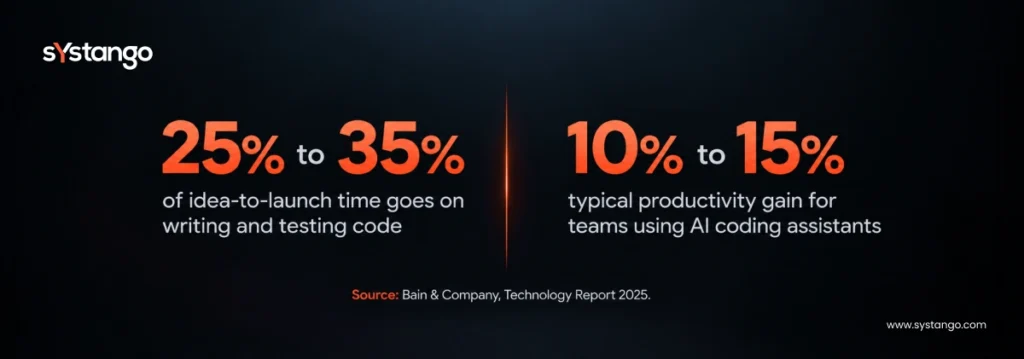
For a Head of Department, the licence cost is already spent, and each day a finished change waits in a queue delays its value.
2. Where the gains leak
| Stage | AI speeds up | What still slows it down | What the harness does |
| Requirements | Drafting tickets | Unclear acceptance criteria | One structured brief for every task |
| Coding | Code generation | Agents work from loose tickets | Brief, architecture notes and approved tools |
| Review | Pull request summaries | Reviewers queue or skim | Changes routed by risk level |
| Security | Fix suggestions | Scans run only at release | Scans on every commit |
| Release | Release notes | Approvals stay manual | Approvals tiered by risk |
3. What a harness changes
A harness works at two levels:
- Around the agent, it decides what the agent knows and can do: shared context, approved tools and permissions.
- Around the delivery pipeline, it decides what every change must pass: automated checks, human approval gates and logs.
The two depend on each other. As TensorOps puts it: “Agent autonomy increases with the quality of the verification signal.” Systango builds this into its AI Delivery Pipeline when senior engineers are in the loop.
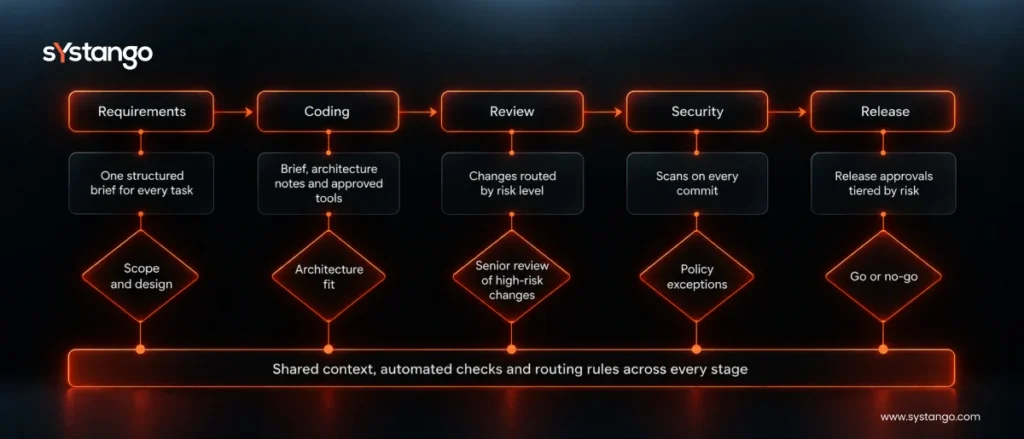
Take a change to a payments service. Without a harness, an agent codes from a loose ticket, the pull request waits in a long queue, and a release scan sends it back to the start. With one:
- The brief travels with the code. Every stage works from one brief of acceptance criteria and architecture notes, so “done” means the same everywhere.
- Checks run early. Dependency scans and secret detection run on every commit, so problems surface before review.
- Reviews are routed by risk. A documentation edit needs only the automated gates. A change to payments goes to a senior engineer with the results attached.
- Expect a noisy start. Strict checks fail more builds at first. Begin in warning mode, tighten as noise falls, and give one named person ownership of the risk categories.
4. What it takes to start
No new platform is needed. Most teams start from the CI/CD and code-hosting tools they already use.
- People: one senior engineer to own the risk rules, plus the pilot team’s time.
- Time: a first check on one service, then a month of lead-time data.
- Cost: mostly engineering time, spent tuning rules until people trust them.
Start with one service: map where work waits longest between commit and release, and add one check there. Systango’s AI Readiness Assessment helps teams decide where to begin.
5. How to tell whether it is working
- Track the five DORA delivery metrics per application: change lead time, deployment frequency, failed deployment recovery time, change fail rate and deployment rework rate.
- Add review time as an early signal.
- If output climbs while these stay flat, gains are stuck before production.
Key Takeaways
- Faster coding pays off only when review, security and release speed up with it.
- Give every stage one shared brief, so “done” means the same everywhere.
- Check security on every commit and route reviews by risk.
- Measure delivery with Google’s DORA metrics such as change lead time, not code volume.