In 2026, “build an exchange” no longer means shipping a trading UI and a wallet.
Regulators are closing gaps. Users are demanding proof, transparency and fast execution. And AI is shifting the baseline—fraud detection, risk scoring and liquidity optimisation are becoming table stakes.
If you’re serious about how to create a crypto exchange like Binance, you’re not competing on features alone.
You’re competing on trust, uptime, compliance, and execution speed.
What’s Inside
V. Centralised vs Decentralised vs Hybrid Exchanges
VIII. Detailed Implementation Roadmap
Key Takeaways
This guide covers how to build cryptocurrency exchange platform 2026, including:
- CEX vs DEX decision trade-offs
- Core architecture: matching engine, wallets, APIs, liquidity
- Security architecture and AI fraud detection in crypto exchange
- 2026 compliance overview (MiCA/SEC/UAE VARA considerations)
- Timeline and delivery roadmap
- What drives cryptocurrency exchange app development cost
- When white label crypto exchange solution makes sense vs custom build
I. Context
According to Chainalysis’ Global Crypto Adoption Index, global crypto usage continues to expand across both emerging and mature markets, reinforcing the structural demand for secure, scalable exchange infrastructure.
Crypto adoption is broader, but the market is stricter.
Three structural forces are shaping exchange builds in 2026:
- Regulation is operational now: licensing, reporting, KYC/AML and market surveillance are increasingly non-negotiable.
- Institutional expectations are rising: custody, segregation of duties, auditability, and incident response maturity.
- AI is reshaping platform advantage: risk scoring, fraud detection, behavioural analytics, and automated liquidity management.
This is why demand for enterprise crypto exchange development services and crypto trading platform development services is increasing—especially for teams operating across Europe and MENA.
II. Challenge
Most exchange initiatives fail (or stall) for predictable reasons:
- Underestimating secure cryptocurrency exchange architecture
- Treating compliance as a “later” activity
- Building a weak matching engine (latency, fairness, resilience)
- Poor liquidity integration → poor spreads → low retention
- Shipping without intelligent controls (fraud, abuse, wash trading)
If you want a platform that survives beyond launch, you must design for regulated scale from day one.
III. Insight
The winning build pattern in 2026 is:
Architecture first. Compliance embedded. AI layered. Liquidity engineered.
That approach reduces rework, de-risks audits, and improves time-to-market because you’re not rebuilding the foundation mid-flight.
IV. Strategic Framework
Use this decision framework to align product model with delivery reality:
1) Choose the exchange model
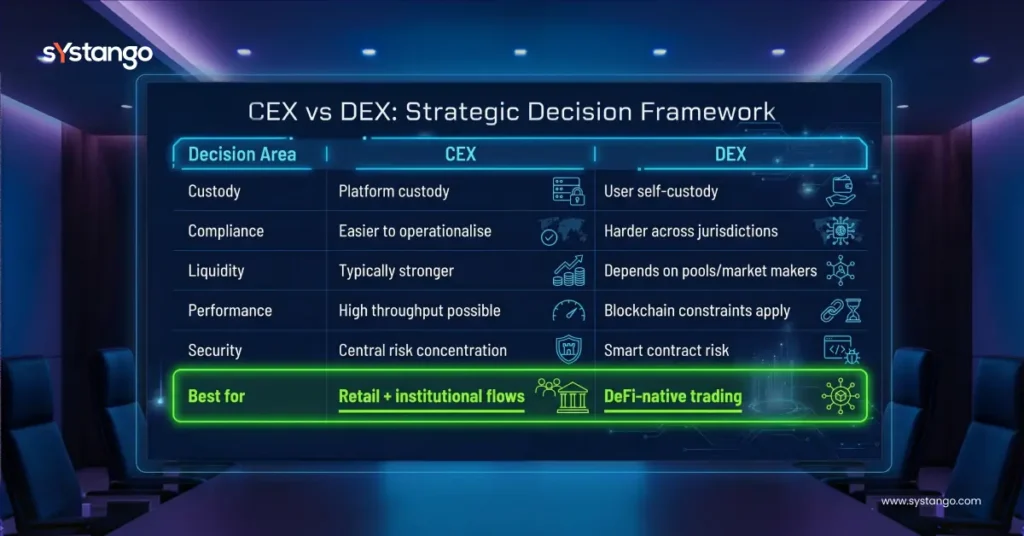
- centralized crypto exchange development → best for fiat on/off ramps, institutional flows, clearer compliance controls
- decentralized exchange development company approach → best for DeFi-native flows, self-custody, smart contract-led trading
- Hybrid is increasingly common (centralised UX + decentralised settlement components).
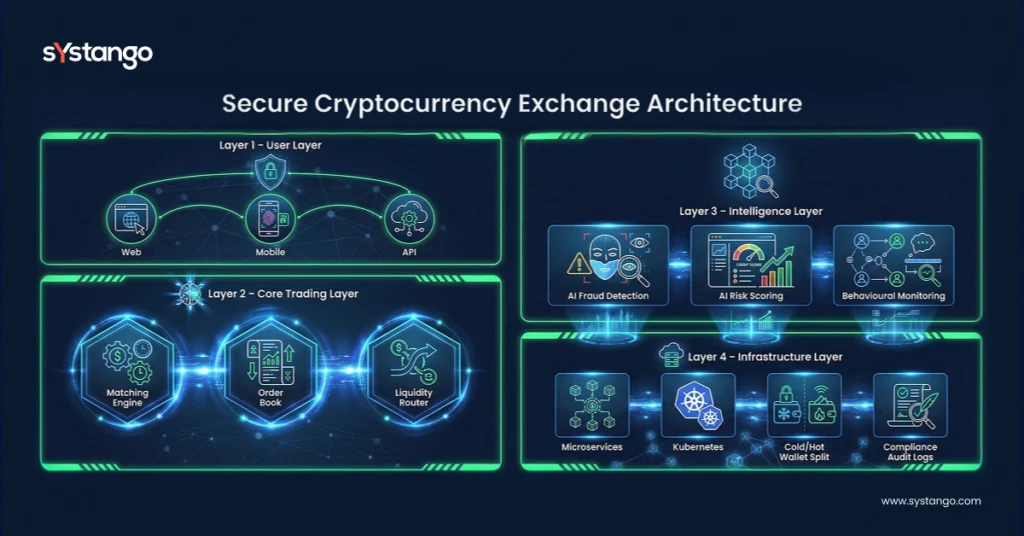
2) Define the core platform architecture
- Matching engine + order books (crypto exchange matching engine development)
- Custody strategy: hot/cold wallet split, signing controls
- APIs (public/private, WebSockets, FIX where relevant)
- Liquidity strategy (crypto exchange with liquidity integration)
- Observability, incident response, and governance controls
3) Embed intelligence
- AI driven crypto exchange platform controls: fraud detection, risk scoring, anomaly detection
- Market integrity controls (rate limiting, bot mitigation, behavioural monitoring)
V. Centralised vs Decentralised vs Hybrid Exchanges
VI. Business Impact (ROI)
A well-executed exchange build drives ROI through four levers:
- Revenue capacity
More liquidity + better execution → higher trade volume and repeat usage. - Risk reduction
Security-first architecture and AI monitoring reduces loss events, fraud exposure and operational disruption. - Compliance efficiency
Compliance-by-design lowers the cost of audits, reporting, and incident response while reducing regulatory downtime risk. - Scalability economics
Microservices and cloud-native patterns reduce the “rewrite tax” as you scale jurisdictions, pairs and user volumes.
This is why buyers increasingly choose a specialist crypto exchange development company rather than assembling ad-hoc teams.
VII. Real World Cases
Case 1: ZK-verified blockchain analytics infrastructure
A decentralised analytics platform partnered with Systango to engineer tamper-resistant, scalable blockchain infrastructure capable of delivering high-integrity insights at scale.
Measured outcomes and capabilities:
- 30% faster time-to-insight for data queries
- ZK-verified integrity for analytics outputs
- Multi-chain support and scalable data infrastructure
Case 2: AI DeFi trading platform outcomes

VIII. Detailed Implementation Roadmap
Phase 1: Strategy, model and compliance (Weeks 1–4)
- Choose CEX/DEX/hybrid model
- Define jurisdictions and baseline compliance (KYC/AML, reporting)
- Liquidity strategy and market-maker approach
- Architecture blueprint for cloud based crypto exchange infrastructure
Phase 2: Core build (Weeks 5–12)
- Matching engine and order books
- Wallet stack (hot/cold split, signing controls)
- Admin console, audit trails
- APIs + WebSockets + rate limiting
Phase 3: Security and AI layer (Weeks 10–16)
- AI based crypto trading engine support signals (risk scoring, anomaly detection)
- AI fraud detection in crypto exchange workflows
- DDoS mitigation, WAF, penetration testing
- Key management and access governance
Phase 4: Liquidity, performance and launch (Weeks 16–24)
- Liquidity integration + price feeds + monitoring
- Load testing and chaos testing
- Beta launch + staged rollout by region/pairs
- Post-launch optimisation and operational playbooks
This roadmap supports teams asking: How long does it take to develop a cryptocurrency exchange? - typically 4–6 months for a production-grade MVP, depending on compliance scope.
IX. Risk of Inaction
If you delay into “later in 2026” without architectural clarity:
- Liquidity concentrates around competitors
- Compliance timelines become gating constraints
- AI-native exchanges outpace you on safety and retention
- Your cost-to-correct grows (rebuild vs iterate)
In this market, speed without rigour becomes expensive.
X. Future Outlook (2026+)
Expect exchanges to evolve in three directions:
- AI-first operations: automated risk and market integrity controls as standard
- Proof-driven trust: ZK verification, transparency tooling, and auditability becoming differentiators
- Regulatory convergence: MiCA-aligned expectations are influencing global exchange operations, even outside the EU, as outlined by the European Securities and Markets Authority (ESMA).
Design now for modular compliance, observability, and AI controls—or you’ll be rebuilding as the market tightens.
XI. Strategic Takeaways
Visual here
- Model choice drives architecture (CEX vs DEX vs hybrid).
- Matching engine quality determines trust and retention.
- KYC and AML integration in crypto exchange must be built-in, not bolted-on.
- AI improves both platform safety and trading performance.
- Microservices enable scalability and cost control at growth inflection points.
- Partnering with an expert crypto exchange development company UK reduces delivery and compliance risk.
Strategic Summary
Modern exchanges in 2026 win by combining compliance-by-design, low-latency execution, and AI-driven risk controls. The right model (CEX/DEX/hybrid) depends on custody, liquidity, jurisdiction and target users.
Systango supports teams that want to launch your own crypto exchange with security-first architecture, AI-enabled platform intelligence, and delivery rigour proven across Web3 infrastructure builds.
Conclusion
To build cryptocurrency exchange platform 2026, you must engineer more than a trading experience.
You must engineer a trust system: compliant, secure, scalable and intelligent. Teams that get this right don’t just launch—they earn retention, survive audits, and scale across jurisdictions.
If you’re planning to launch your own crypto exchange, the fastest path is a governance-first build with AI-enabled controls and production-grade infrastructure from day one.
Executive Summary
In 2026, crypto exchanges compete on trust: compliance maturity, low-latency execution, scalable infrastructure, and AI-powered safety. To build cryptocurrency exchange platform 2026, teams must choose the right model (CEX/DEX/hybrid), design production-grade matching and custody architecture, integrate KYC/AML by default, and layer AI-driven risk and fraud controls. Systango case study proof shows measurable outcomes in AI-led DeFi builds—35% increase in trading confidence, 50% faster onboarding, 2.5X scalability, and 30% higher retention—alongside ZK-verified data infrastructure delivering 30% faster time-to-insight. With a phased roadmap and governance-first delivery, organisations can launch a secure, compliant, scalable exchange MVP within 4–6 months and avoid the rebuild tax that kills margins.