Cloud implementation in 2026 is no longer an infrastructure upgrade — it is a strategic operating model decision.
Enterprise leaders are navigating:
- AI-native workloads
- Multi-region compliance mandates
- Rising infrastructure volatility
- Margin pressure from inefficient cloud estates
- The shift toward multi-cloud resilience
According to Gartner, more than 85% of organizations will embrace a cloud-first principle by 2025, making cloud strategy a core business priority.
This is why cloud implementation services in 2026 must go beyond migration — they must deliver structured, secure, and multi-cloud-aligned operating models.
What’s Inside
I. Cloud Implementation Services: A Strategic Foundation for Enterprises
II. Why Cloud Implementation Matters More in 2026
III. Top Cloud Implementation Service Models (IaaS | PaaS | SaaS)
IV. Cloud Deployment Models Explained (Public, Private, Hybrid, Multi-Cloud)
V. Cloud Migration & Implementation Strategy — Step-by-Step
VI. Key Cloud Implementation Trends 2026 for Business Leaders
VII. Cost, ROI & Business Impact of Cloud Implementation
VIII. Cloud Implementation Challenges & Best Practices for Leaders
IX. Why Systango for Cloud Implementation Services
Key Takeaways
- Cloud implementation services now define enterprise scalability and cost predictability.
- Multi-cloud implementation reduces vendor lock-in and improves resilience.
- Security-first architectures and governance automation are non-negotiable.
- AI-enabled cloud platforms are redefining operational efficiency.
- 20–40% cost savings are achievable through structured cloud financial management.
- Implementation strategy determines ROI — not cloud adoption alone.
I. Cloud Implementation Services: A Strategic Foundation for Enterprises
Cloud implementation services refer to the end-to-end process of designing, deploying, migrating, integrating, and optimising cloud environments aligned with business goals.
For modern enterprises, cloud implementation goes beyond infrastructure setup. It includes:
- Cloud strategy and architecture design
- Secure cloud migration
- Hybrid and multi-cloud architecture
- Cloud-native development
- DevOps integration
- Continuous optimisation, governance, and compliance
According to MarketsandMarkets, the global cloud computing market is projected to exceed $1.2 trillion, driven by enterprise digital transformation, AI workloads, and data-intensive platforms
As a result, cloud implementation has become a strategic, board-level decision rather than just an IT initiative.
II. Why Cloud Implementation Matters More in 2026
Modern enterprises face:
- Rising infrastructure costs
- AI and data workloads demanding elastic scale
- Regulatory pressure around cloud security and compliance
- The need for faster innovation cycles
A poorly planned cloud journey leads to cost overruns, security gaps, and operational complexity. A well-executed cloud implementation strategy delivers:
- Faster time-to-market
- Improved resilience and scalability
- Measurable cloud implementation cost savings
- Long-term ROI
This is where enterprise cloud services and expert cloud transformation consulting become critical.
III. Top Cloud Implementation Service Models (IaaS | PaaS | SaaS)
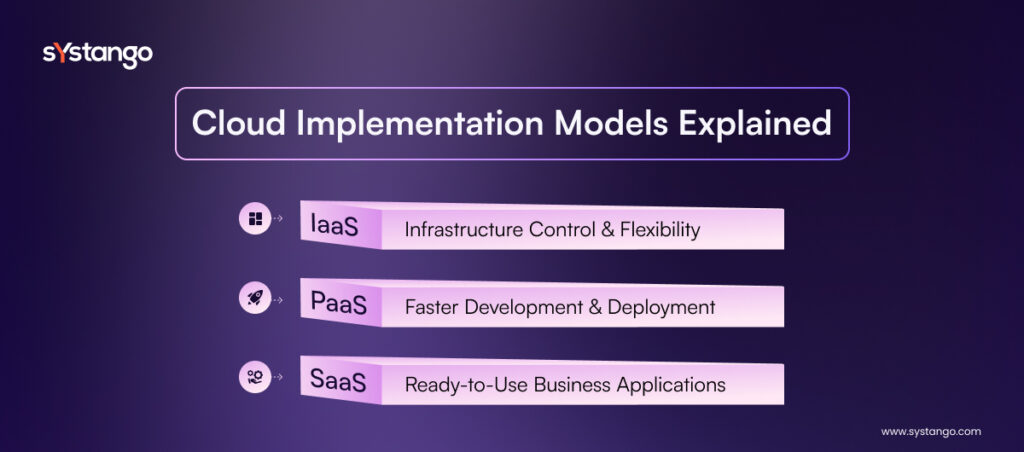
Understanding cloud implementation models is foundational to a successful cloud strategy.
1. IaaS (Infrastructure as a Service)
Provides virtualised compute, storage, and networking resources.
Best for:
- Legacy application modernisation
- Custom workloads needing flexibility
- Enterprises migrating from on-premise infrastructure
2. PaaS (Platform as a Service)
Offers managed platforms for application development and deployment.
Best for:
- Cloud native development services
- Faster application delivery
- Reduced operational overhead
3. SaaS (Software as a Service)
Delivers ready-to-use applications over the cloud.
Best for:
- CRM, ERP, analytics, collaboration tools
- Rapid adoption with minimal IT management
A strong cloud implementation partner helps businesses choose the right mix of IaaS, PaaS, SaaS cloud models rather than defaulting to one.
IV. Cloud Deployment Models Explained (Public, Private, Hybrid, Multi-Cloud)
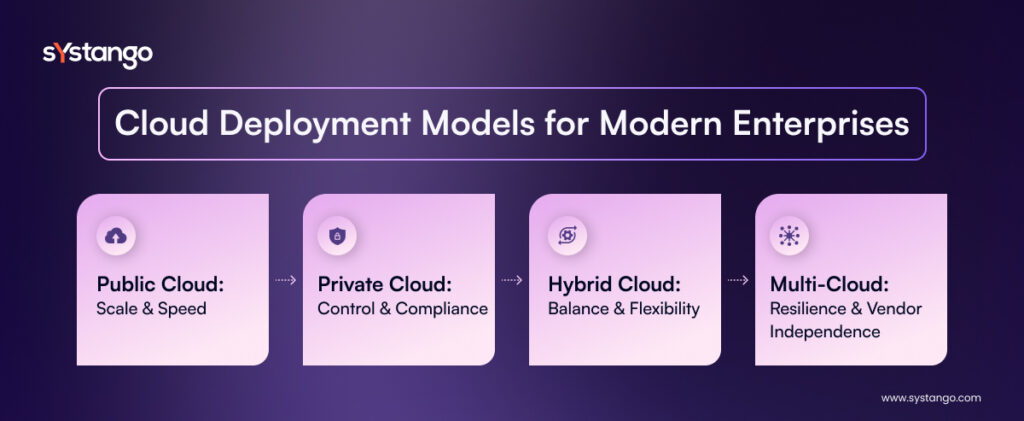
1. Public Cloud
Shared infrastructure hosted by providers like AWS, Azure, and GCP.
Ideal for scalability and innovation speed.
2. Private Cloud
Dedicated infrastructure offering higher control and customisation.
Often used in regulated industries.
3. Hybrid Cloud Solutions
Combine public and private clouds for flexibility and compliance.
4. Multi-Cloud Implementation
According to IDC, 93% of enterprises have deployed more than one public cloud provider, confirming that multi-cloud strategies — and the architectural interoperability and governance they demand — are now strategic priorities for large organisations.
Uses multiple cloud providers to avoid vendor lock-in and improve resilience.
In 2026, multi-cloud architecture is no longer optional for growth-stage or regulated enterprises. It enables workload distribution across providers such as Amazon Web Services, Microsoft Azure, and Google Cloud, Alibaba Cloud — improving resilience, negotiating leverage, and regional compliance flexibility.
This aligns directly with enterprise risk management frameworks.
V. Cloud Migration & Implementation Strategy — Step-by-Step
A successful cloud adoption roadmap typically includes:
- Assessment & Readiness
- Application and data evaluation
- Security and compliance mapping
- Architecture & Design
- Selecting deployment and service models
- Designing scalable, secure architectures
- Migration Execution
- Re-hosting, re-platforming, or re-architecting
- Leveraging cloud migration platforms
- Integration & DevOps
- CI/CD pipelines
- DevOps in cloud implementation for speed and reliability
- Optimisation & Governance
- Cloud cost optimisation
- Monitoring, security, and performance tuning
This structured approach reduces risk and maximises business impact.
VI. Key Cloud Implementation Trends 2026 for Business Leaders
- AI-Enabled Cloud Platforms
AI is now embedded in cloud operations — from auto-scaling to predictive cost optimisation.
- Security-First Cloud Architectures
Zero-trust models, policy-as-code, and continuous compliance are now default expectations.
- Serverless & Event-Driven Architectures
Reducing operational overhead while improving scalability.
- Edge + Cloud Convergence
Supporting low-latency applications in IoT, retail, and real-time analytics.
- Data Sovereignty & Regional Compliance
Critical for cloud deployment services USA / UK, especially in regulated sectors.
VII. Cost, ROI & Business Impact of Cloud Implementation
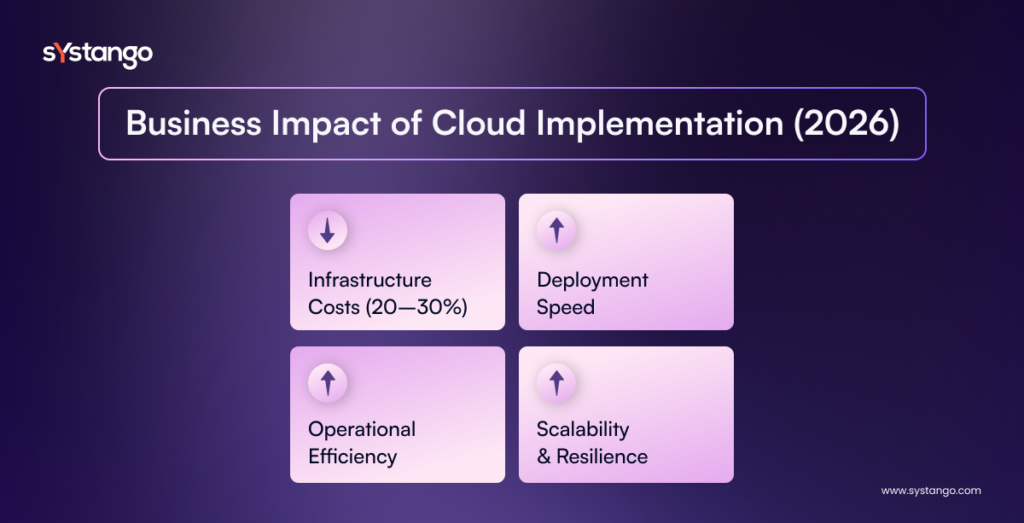
Industry research from McKinsey & Company shows that organisations with mature cloud financial management programmes can reduce cloud costs by 20–30% or more when governance and optimisation are embedded into cloud implementation strategy.
Well-executed cloud implementation services can deliver:
- Faster product launches
- Improved system resilience
- Higher engineering productivity
However, cost efficiency depends on:
- Architecture choices
- Governance maturity
- Ongoing optimisation
This is why cloud implementation cost savings should be designed, not assumed.
Enterprise Case Snapshot: Cloud Optimisation in Action
A fast-scaling energy technology platform partnered with Systango to optimise its cloud architecture and enable scalable regional growth.
Impact Delivered:
- USD 54,000 annual infrastructure savings through structured cloud optimisation
- 40% improvement in app responsiveness via backend performance tuning
- 36× faster throughput, reducing meter-data refresh from minutes to seconds
- Scalable foundation for 10,000+ users, supporting expansion into new regions
This demonstrates how disciplined cloud implementation — focused on performance, governance, and scalability — converts directly into measurable business impact.
VIII. Cloud Implementation Challenges & Best Practices for Leaders
Common Challenges
- Vendor lock-in
- Security misconfigurations
- Uncontrolled cloud spending
- Skills gaps
Best Practices
- Design for multi-cloud implementation where needed
- Automate governance and security
- Use Infrastructure as Code
- Continuously optimise workloads
IX. Why Systango for Cloud Implementation Services
Systango delivers enterprise-grade cloud implementation services across the USA and UK — helping organisations design, migrate, and optimise secure, scalable multi-cloud environments.
Our capabilities span:
- Cloud transformation consulting
- Secure cloud migration
- Hybrid and multi-cloud implementation
- Cloud-native development
- DevOps and automation
- Security, compliance, and governance
- AI-enabled cloud optimisation
With vendor-agnostic expertise across Amazon Web Services, Microsoft Azure, and Google Cloud, we align architecture to business goals — not platforms.
Our structured implementation frameworks have helped organisations reduce operational costs by up to 30% while improving resilience and scalability across complex cloud estates.
Systango enables secure, future-ready cloud transformation — with measurable business impact.
Strategic Summary
Cloud implementation services in 2026 define enterprise agility, resilience, and financial control. Organizations that adopt structured, security-first, and multi-cloud implementation strategies achieve measurable cost savings, improved scalability, and stronger governance maturity. The combination of AI-enabled cloud platforms, automated compliance, and architecture-led migration transforms cloud from infrastructure expense into strategic growth infrastructure.
Conclusion
In 2026, cloud success is not defined by migration — it is defined by implementation maturity.
Enterprises that approach cloud implementation strategically — with multi-cloud resilience, governance automation, AI-enabled optimisation, and security-first design — unlock measurable cost efficiency, faster innovation cycles, and long-term operational stability.
Cloud implementation services are no longer a technical support function. They are a competitive growth lever.
With the right architecture, governance discipline, and execution partner, cloud becomes an intelligent, scalable foundation for digital transformation — not an uncontrolled expense line.
Systango helps organisations implement cloud ecosystems that are secure, scalable, compliant, and built for sustained business impact.
Executive Summary
Cloud implementation has evolved from technical migration to enterprise transformation. In 2026, successful organizations design cloud ecosystems around multi-cloud resilience, financial governance, AI-enabled automation, and compliance alignment. Poorly structured implementations lead to cost leakage, security exposure, and operational complexity. Well-executed cloud implementation services deliver 20–40% infrastructure efficiency improvements, faster innovation cycles, and long-term ROI. Enterprises that treat cloud implementation as a strategic discipline — not an IT project — will lead in scalability, resilience, and digital competitiveness.