Regulatory non-compliance is no longer just a legal issue it’s an architectural one. For FinTechs operating in the UK and US, failing to embed compliance at the data layer can result in enforcement actions, sanctions, and reputational damage.
Building compliant systems isn’t about ticking boxes. It’s about designing infrastructure that is audit-ready, scalable, and resilient to regulatory change from day one. This guide outlines the key requirements, architecture components, and decisions needed to achieve that.
Key Takeaways
1. What Is Compliance-First Data Architecture?
2. FCA Data Governance Requirements: What You Must Build
3. SEC Requirements & Record Retention Policy
4. Core Components of Compliant Data Architecture
5. Cloud Infrastructure and Compliance
6. Reducing Risk Through Modern Architecture
1. What Is Compliance-First Data Architecture?
DEFINITION
Compliance-first data architecture embeds regulatory requirements, data retention, access control, reporting, and Audit trail generation directly into system design before development begins.
Traditional approaches treat compliance as an afterthought, creating gaps and costly fixes. In contrast, a compliance-first model ensures:
- Data lineage is tracked end-to-end
- Every interaction creates an immutable Audit trail
- Retention rules are automated
- Regulatory reporting is built in
For FinTechs under FCA and SEC oversight, this approach is not optional—it’s foundational.
2. FCA Data Governance Requirements: What You Must Build
The FCA doesn’t provide a single checklist, but its regulations clearly define expectations for Data governance and recordkeeping.
Record-Keeping Obligations
Firms must maintain records that:
- Demonstrate compliance
- Support regulatory investigations
- Capture transactions, communications, and decisions
- Reconstruct regulated activities on demand
Retention Timelines
Under MiFID II:
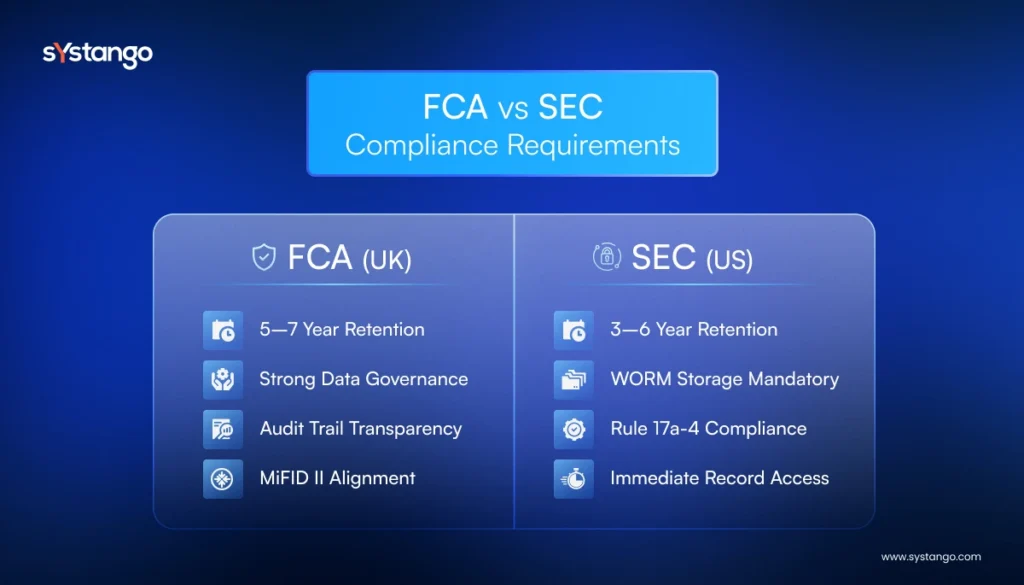
- Records must be retained for 5–7 years
- Data must be quickly retrievable
- Delays or missing records are treated as compliance failures
Audit Logging & Access
The FCA expects:
- Detailed Audit trail of data access
- Role-based access control (least privilege)
- Tamper-evident logs
- Traceable reporting outputs
COMPLIANCE RISK
Weak Data governance and missing Audit trail systems are among the most common causes of FCA enforcement actions.
3. SEC Requirements & Record Retention Policy
For FinTechs dealing with the US markets, SEC Rule 17a-4 defines strict Record retention policy requirements.
What Rule 17a-4 Requires
- Records must be stored in non-editable formats
- Use of WORM storage (Write Once, Read Many)
- Immediate accessibility for regulators
- Retention periods from 3 to 6 years (or longer)
WORM Storage in Practice
WORM storage ensures data cannot be modified or deleted within the retention period. Any system allowing changes to financial records is non-compliant.
Cloud platforms support WORM storage, but misconfiguration (e.g., incorrect retention locks) can still lead to failure during audits.
Electronic Record Standards
SEC requires:
- Original format preservation
- Indexed and searchable records
- Integrity verification (e.g., hashing)
- Backup in separate locations
ENFORCEMENT NOTE
Failures in Record retention policy and WORM storage are among the most frequent SEC violations.
4. Core Components of Compliant Data Architecture
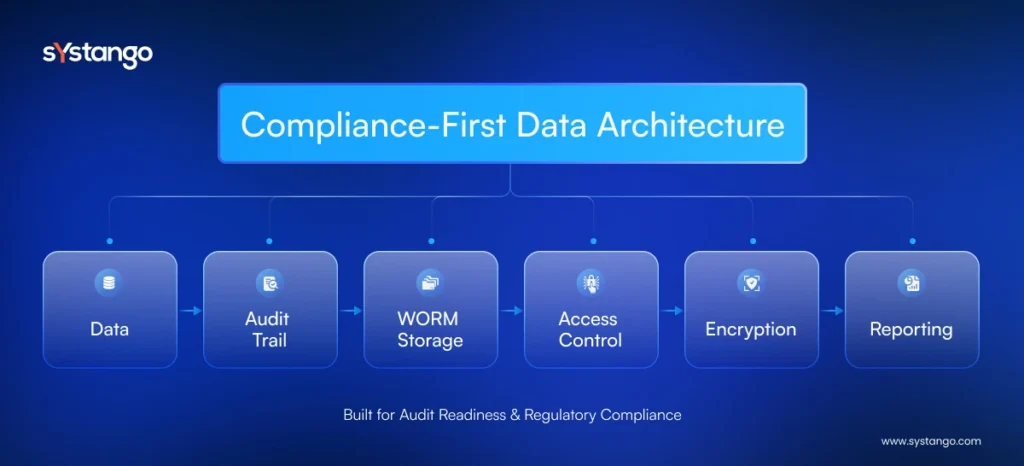
A compliant system is built through integrated components:
1. Immutable Data Infrastructure
- WORM storage for regulated data
- Append-only logs
- Cryptographic integrity checks
2. Audit-Ready Pipelines
- Full data lineage tracking
- Timestamped transformations
- Automated Audit Trail Generation
- Alerts for anomalies
3. Access Control (RBAC)
- Role-based permissions
- Just-in-time access
- Automated reviews
- Identity-linked Audit trail
4. Encryption
- AES-256 for stored data
- TLS 1.2+ for data in transit
- Managed encryption keys
- Automated rotation
5. Reporting Layer
- Pre-built regulatory templates
- Data validation checks
- Source-to-report traceability
- Version-controlled logic
6. Record retention policy Engine
- Policy-driven retention rules
- Legal hold mechanisms
- Auditable deletion workflows
- Cross-system tracking
5. Cloud Infrastructure and Compliance
Cloud platforms can support Regulatory compliance for fintech, but only with proper configuration.
Data Residency
- Enforce storage location controls
- Restrict cross-border transfers
- Monitor data movement
Zero-Trust Security
- No implicit trust
- Continuous verification
- Microsegmentation of sensitive data
Governance Automation
- Policy-as-code enforcement
- Continuous monitoring
- Automated audit evidence collection
ARCHITECTURE NOTE
AWS, Azure, and GCP all offer compliance-relevant services — but none of them is compliant out of the box. Shared responsibility models mean you own the configuration. If your data architect doesn’t understand this, your audit will.
6. Reducing Risk Through Modern Architecture
The Cost of Retrofitting
Delaying compliance leads to:
- 3–5x higher engineering costs
- Product delays
- Increased investor risk
- Licensing challenges
Compliance as Advantage
Strong Data governance and Record retention policy frameworks enable:
- Faster enterprise deals
- Improved investor confidence
- Easier regulatory approvals
- Scalable expansion
Building for Scale
- Modular compliance systems
- Continuous regulatory monitoring
- Updated architecture documentation
The goal is not just passing audits but sustaining compliance as regulations evolve.