At a Glance
- What this covers: Why SR 11-7 now applies to WealthTech AI, the three model risk management components your SDLC must deliver, how financial AI governance changes at each phase, and the three signals that tell you your platform is not ready for SEC examination.
- Key finding: SR 11-7 was written in 2011 for quantitative models. It was not written for LLMs or neural networks. But it applies to them – and most WealthTech AI platforms are not built to satisfy all three components.
- Business impact: The most common SR 11-7 finding is not a non-compliant model. It is a technically excellent model that cannot demonstrate its own compliance – because the documentation, validation, and monitoring infrastructure was never built to produce the evidence.
- What you will learn: The three SR 11-7 components every WealthTech AI system must satisfy, how compliance changes at each SDLC phase, and three self-assessment signals to run before your next model change.
Model risk management under SR 11-7 requires three things from every regulated quantitative finance AI system: rigorous development documentation, independent validation before deployment, and ongoing performance monitoring after go-live. Most WealthTech AI platforms satisfy none of them completely.
SR 11-7 was written for quantitative models in 2011. It was not written for large language models, neural networks, or agentic AI systems making investment recommendations at scale. But it applies to them. The Federal Reserve’s definition is broad: any quantitative method that applies statistical, economic, financial, or mathematical theories to process input data into estimates.
Every AI system making or influencing a regulated financial decision is a model subject to SR 11-7 – and most cannot demonstrate it because they were never built to produce the evidence.
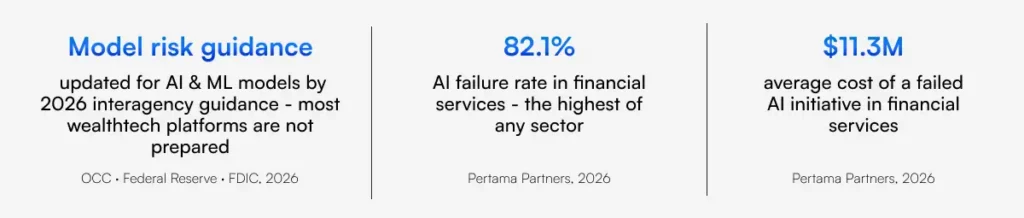
I. Why SR 11-7 now applies to WealthTech AI – and why most platforms are not ready
The gap for most wealthtech AI platforms is not awareness – it is engineering. SR 11-7 compliance requires documentation, validation, and monitoring infrastructure built into the system from the first sprint. It cannot be produced retrospectively for a system not instrumented to capture it.
Three signals that your WealthTech AI system is not SR 11-7 ready:
- The development team cannot produce a complete model development document – conceptual soundness, data quality, limitation disclosures – for the current production model
- Independent validation with a separate scope, separate team, and documented independence record has never been completed on the production model
- Ongoing performance monitoring does not include automated alerts for model drift against defined thresholds
If any of these three describes your current production system, that’s the signal to run a regulatory mapping exercise before the next model change – not after an examination is announced.
II. The three SR 11-7 model risk management components
1. Model development documentation
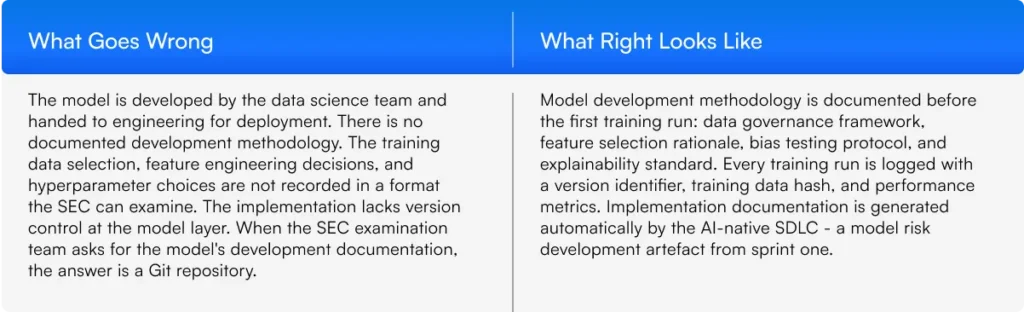
SR 11-7 requires comprehensive documentation of the model development process: theoretical basis, data used and quality assessment, assumptions made and their limitations, and performance testing completed before deployment. For quantitative finance AI systems, this means treating the model development document as an engineering deliverable – produced during development, not reconstructed when examination is announced. The most common SR 11-7 finding is incomplete documentation of model limitations. Not because the limitations do not exist – they always do – but because they were never formally documented at the point of development.
2. Independent AI validation
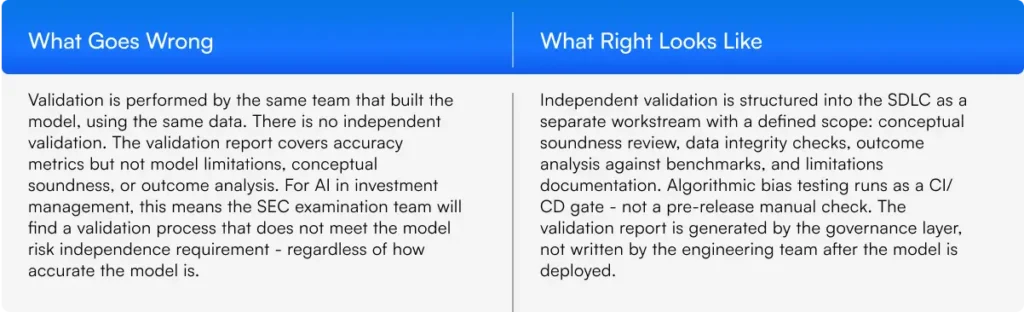
AI validation under SR 11-7 requires a separate team, separate scope, and documented independence record. Validation by the team that built the model does not satisfy the requirement regardless of how rigorous the internal review was. AI model testing for SR 11-7 covers conceptual soundness review, outcomes analysis, benchmarking against alternative approaches, and sensitivity testing – each documented in a validation report independent of development documentation and available to SEC examiners on request.
3. Ongoing AI model governance and monitoring
SR 11-7 requires ongoing monitoring against defined thresholds with a documented escalation process for when performance deteriorates. The AI model governance infrastructure required – model registry, performance monitoring, automated alerts, documented escalation – must be built alongside the model. Retrofitting it after deployment means reconstructing performance history that was never captured.
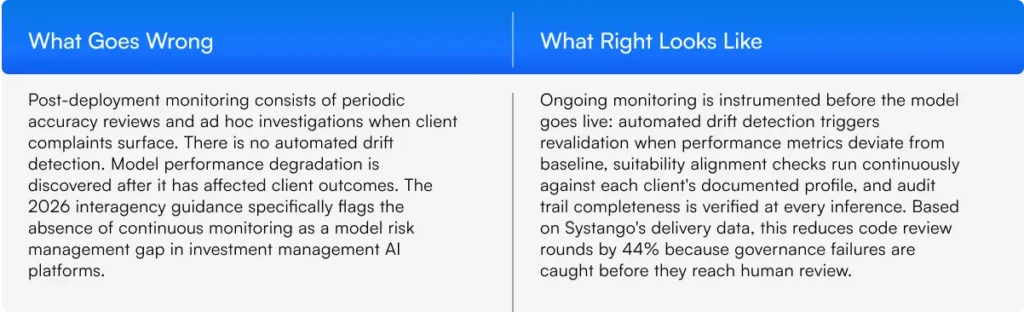
For a deeper look at how production model monitoring and drift detection work in practice, see our MLOps blog.
III. How financial AI governance changes the SDLC
SR 11-7 compliant financial AI governance requires changes at every SDLC phase:
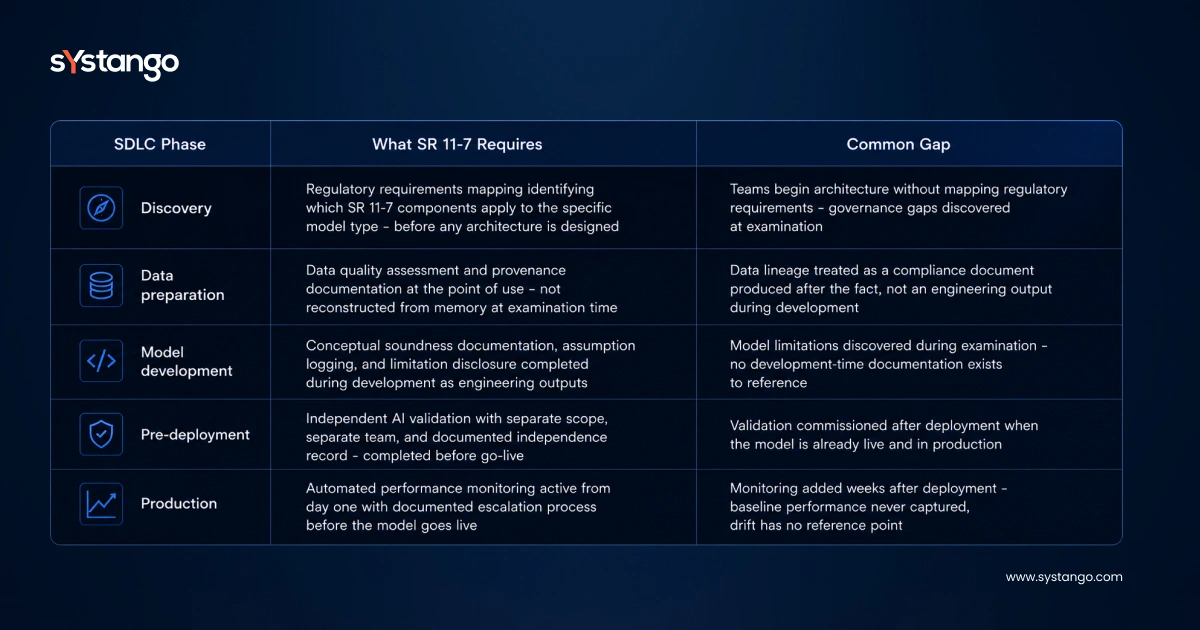
What this looks like when built correctly:
A regulated investment platform building AI systems across mutual fund advisory and portfolio management workflows needed model governance infrastructure designed before any model went live – development documentation produced during build, independent validation structured as a separate workstream, and automated monitoring active from day one of production.
Systango embedded SR 11-7-equivalent model governance into the AI-native SDLC from the first sprint – compliance constraints encoded before development began, audit trails built into the inference pipeline, and model change management logged as a governance event at every update. The governance layer was not a separate compliance workstream. It was part of the engineering delivery.
Lesson from this engagement: The compliance team had documentation ready before the first regulatory review was scheduled – not because they prepared for it, but because the engineering team had been producing it as a byproduct of development from sprint one
Key Takeaways
- SR 11-7 was written in 2011 for quantitative models, but its definition – any system applying statistical or mathematical methods to produce quantitative estimates – captures LLMs, neural networks, and agentic AI systems by extension, whether or not they were built with SR 11-7 in mind.
- The most common finding isn’t a missing capability – it’s incomplete documentation of limitations and assumptions that existed all along but were never formally captured at the point of development.
- Independent validation by the build team does not satisfy SR 11-7, regardless of how rigorous the internal review was – it requires a genuinely separate team, scope, and documented independence record.
- All three SR 11-7 components – documentation, validation, monitoring – need to be designed in from Discovery, not treated as compliance tasks completed after the engineering work is otherwise done.
Systango’s AI-native SDLC embeds SR 11-7 model risk management components into every WealthTech AI delivery: development documentation produced as an engineering deliverable, independent AI validation structured before the first sprint, and AI model governance infrastructure – registry, monitoring, alerting, change management – active from day one of production.
As a publicly listed, ISO 27001-certified engineering company with active delivery experience across WealthTech and regulated capital markets, explore our AI-native SDLC and AI Readiness Assessment to understand how we approach your SR 11-7 compliance challenge.